

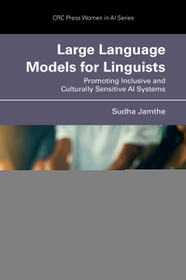
Large Language Models for Linguists
Building Culturally Sensitive AI
Sorozatcím: CRC Press Women in AI Series;
-
10% KEDVEZMÉNY?
- Kiadói listaár GBP 54.99
-
24 827 Ft (23 645 Ft + 5% áfa)
Az ár azért becsült, mert a rendelés pillanatában nem lehet pontosan tudni, hogy a beérkezéskor milyen lesz a forint árfolyama az adott termék eredeti devizájához képest. Ha a forint romlana, kissé többet, ha javulna, kissé kevesebbet kell majd fizetnie.
- Kedvezmény(ek) 10% (kb. 2 482 Ft)
- Kedvezményes ár 22 345 Ft (21 281 Ft + 5% áfa)
22 345 Ft

Beszerezhetőség
Még nem jelent meg, de rendelhető. A megjelenéstől számított néhány héten belül megérkezik.
Why don't you give exact delivery time?
A beszerzés időigényét az eddigi tapasztalatokra alapozva adjuk meg. Azért becsült, mert a terméket külföldről hozzuk be, így a kiadó kiszolgálásának pillanatnyi gyorsaságától is függ. A megadottnál gyorsabb és lassabb szállítás is elképzelhető, de mindent megteszünk, hogy Ön a lehető leghamarabb jusson hozzá a termékhez.
A termék adatai:
- Kiadás sorszáma 1
- Kiadó Chapman and Hall
- Megjelenés dátuma 2026. november 16.
- ISBN 9781032889559
- Kötéstípus Puhakötés
- Terjedelem294 oldal
- Méret 234x156 mm
- Súly 453 g
- Nyelv angol
- Illusztrációk 29 Illustrations, black & white; 24 Halftones, black & white; 5 Line drawings, black & white; 8 Tables, black & white 700
Kategóriák
Rövid leírás:
Bridges the gap between linguistics and technology. Provides in-depth education on large language models for linguists. Gives a playbook for linguists to get involved in teaching AI in a way that preserves the world's diverse linguistic and cultural heritage.
TöbbHosszú leírás:
This book bridges linguistics and technology, offering an in-depth exploration of Large Language Models (LLMs) tailored for linguists. It examines how Artificial Intelligence (AI) is trained using language as data, often overlooking linguistic nuance, and empowers linguists to shape AI development to preserve diverse linguistic and cultural heritages.
Key Features:
- Accessible to All: No prior knowledge of technology or coding required, making it ideal for anyone transitioning into AI for languages.
- Demystifies LLMs: Covers essential concepts like Natural Language Processing (NLP), Named Entity Recognition (NER), hallucinations, fine-tuning, and custom LLMs for languages.
- Global Scope: Includes research, datasets, and LLM models for languages such as Portuguese, Yoruba, Tamil, Hindi, Swahili, Spanish, Korean, Arabic, Indigenous languages, and sign languages.
- Cultural Context: Explores how historical trauma, colonialism, migration, and resilience shape language, emphasizing the need for AI to respect this complexity.
- Practical Playbook: Guides linguists and cultural stewards in creating datasets and benchmarks that honor their communities, showcasing how vocabulary reflects cultural identity.
- Online Resources: Offers tools, datasets, and community support for building AI tailored to specific languages at LLMLinguist.org.
Ideal for humanities scholars, computational linguists, and technologists seeking to develop language models that preserve the cultural richness of the world's voices.
TöbbTartalomjegyzék:
1. LLM for Linguists - The What and Why 2. Why AI is not a logophile 3. Collocated words over morphology 4. Can you teach AI imposter syndrome 5. Why does ChatGPT write like a human? 6. Technologies to Build LLM for Global Languages 7. Creativity and Resilience of the Global South 8. Languages AI of India 9. Languages carrying complex Identities: Conquests, Colonization, and Decolonization 10. Languages with scripts changed by history 11. Africa Leads AI for African Language AI 12. AI for Languages impacted by war: Korean, Arabic, Italian 13. Preserving Endangered Indigenous Languages 14. How can AI learn new languages: Pidgin, Multicultural London English, Gay Fanfiction 15. AI and Gender Equality 16. Building Culture-Aware Language AI 17. Bringing Identity Into Language AI 18. Towards an Inclusive World with Sign Language and AI 19. Language AI Playbook for Linguists 20. Building Inclusive Language AI Without Cognitive Bias 21. Conclusion - Standing on the Shoulders of Giants
Több
