

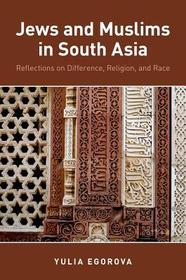
Jews and Muslims in South Asia
Reflections on Difference, Religion, and Race
-
10% KEDVEZMÉNY?
- A kedvezmény csak az 'Értesítés a kedvenc témákról' hírlevelünk címzettjeinek rendeléseire érvényes.
- Kiadói listaár GBP 96.00
-
43 344 Ft (41 280 Ft + 5% áfa)
Az ár azért becsült, mert a rendelés pillanatában nem lehet pontosan tudni, hogy a beérkezéskor milyen lesz a forint árfolyama az adott termék eredeti devizájához képest. Ha a forint romlana, kissé többet, ha javulna, kissé kevesebbet kell majd fizetnie.
- Kedvezmény(ek) 10% (cc. 4 334 Ft off)
- Kedvezményes ár 39 010 Ft (37 152 Ft + 5% áfa)
Iratkozzon fel most és részesüljön kedvezőbb árainkból!
Feliratkozom
43 344 Ft

Beszerezhetőség
Megrendelésre a kiadó utánnyomja a könyvet. Rendelhető, de a szokásosnál kicsit lassabban érkezik meg.
Why don't you give exact delivery time?
A beszerzés időigényét az eddigi tapasztalatokra alapozva adjuk meg. Azért becsült, mert a terméket külföldről hozzuk be, így a kiadó kiszolgálásának pillanatnyi gyorsaságától is függ. A megadottnál gyorsabb és lassabb szállítás is elképzelhető, de mindent megteszünk, hogy Ön a lehető leghamarabb jusson hozzá a termékhez.
A termék adatai:
- Kiadó OUP USA
- Megjelenés dátuma 2018. október 18.
- ISBN 9780199856237
- Kötéstípus Keménykötés
- Terjedelem210 oldal
- Méret 142x211x17 mm
- Súly 340 g
- Nyelv angol
- Illusztrációk 6 0
Kategóriák
Rövid leírás:
Jews and Muslims in South Asia examines how Jews and Muslims relate to each other in a place where, in contrast to Europe, their perceived attitudes towards one another do not often make headlines. Yulia Egorova finds that in this context Jewish and Muslim communities interact in ways that don't fit Western stereotypes. At the same time, this relationship is still intrinsically connected to global narratives about Jews and Muslims.
TöbbHosszú leírás:
Jews and Muslims in South Asia examines how Jews and Muslims relate to each other in a place where, in contrast to Europe, their perceived attitudes towards one another do not often make headlines. In the European imagination, Jews and Muslims have both been seen as the ultimate "other." At the same time, Western politics and media construct Jews and Muslims in opposition to each other and see their relationship as unavoidably polarized due to the conflict in the Middle East. In this book, Yulia Egorova explores how South Asian Jews and Muslims relate to each other outside of a Western and Christian context, and reveals that despite some important differences this relationship is still intrinsically connected to global narratives about Jews and Muslims. She also shows that the Hindu right have turned South Asian Jewish experiences into a rhetorical tool to deny the existence of discrimination against religious minorities, and that this ostensible celebration of Jewishness masks not only anti-Muslim, but also anti-Jewish prejudice. She argues that South Asia inherited these notions of racial and religious difference from the British during the colonial period, which continue to cause stigmatization and oppression to this day. Jews and Muslims in South Asia is a fascinating new contribution to the academic discussion on anti-Semitism, Islamophobia, and their overlapping histories.
This rigorously researched book highlights the common roots of antisemitism and Islamophobia in an ethically nuanced manner while broadening the discussion of Muslim-Jewish relations to areas outside of the Perso-Arabic context. Highly readable and relevant far outside the domains of inquiry with which it engages directly, this volume's impact is sure to be felt both inside and outside of academia.
Tartalomjegyzék:
Acknowledgements
Glossary
Chapter 1. Introduction
Chapter 2. Diversities and Minorities
Chapter 3. The Tropes of Jewish/Muslim Difference
Chapter 4. Un/settled Relations
Chapter 5. Terror, Race, Security
Chapter 6. Conclusion
Bibliography

