

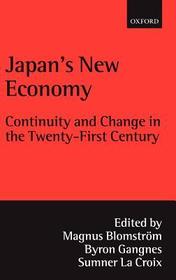
Japan's New Economy
Continuity and Change in the Twenty-First Century
-
10% KEDVEZMÉNY?
- A kedvezmény csak az 'Értesítés a kedvenc témákról' hírlevelünk címzettjeinek rendeléseire érvényes.
- Kiadói listaár GBP 177.50
-
80 141 Ft (76 325 Ft + 5% áfa)
Az ár azért becsült, mert a rendelés pillanatában nem lehet pontosan tudni, hogy a beérkezéskor milyen lesz a forint árfolyama az adott termék eredeti devizájához képest. Ha a forint romlana, kissé többet, ha javulna, kissé kevesebbet kell majd fizetnie.
- Kedvezmény(ek) 10% (kb. 8 014 Ft)
- Kedvezményes ár 72 127 Ft (68 693 Ft + 5% áfa)
Iratkozzon fel most és részesüljön kedvezőbb árainkból!
Feliratkozom
80 141 Ft

Beszerezhetőség
Megrendelésre a kiadó utánnyomja a könyvet. Rendelhető, de a szokásosnál kicsit lassabban érkezik meg.
Why don't you give exact delivery time?
A beszerzés időigényét az eddigi tapasztalatokra alapozva adjuk meg. Azért becsült, mert a terméket külföldről hozzuk be, így a kiadó kiszolgálásának pillanatnyi gyorsaságától is függ. A megadottnál gyorsabb és lassabb szállítás is elképzelhető, de mindent megteszünk, hogy Ön a lehető leghamarabb jusson hozzá a termékhez.
A termék adatai:
- Kiadó OUP Oxford
- Megjelenés dátuma 2001. január 25.
- ISBN 9780199241729
- Kötéstípus Keménykötés
- Terjedelem338 oldal
- Méret 244x164x23 mm
- Súly 635 g
- Nyelv angol
- Illusztrációk numerous line figures 0
Kategóriák
Rövid leírás:
This volume fills an important gap in the existing economic literature. While much has been written about Japan's pre-1990s institutions and economic performance, this text is unique in its forward-looking orientation - trying to understand not only the institutional and structural changes that have already reshaped Japan in the 1990s, but to identify the critical trends and institutional changes that will mould Japan's new economy over the next decade.
TöbbHosszú leírás:
Japan's economy stumbled in the 1990s. After four decades of rapid growth that transformed Japan into a wealthy country at the world's technological frontier, the last decade brought prolonged economic stagnation. The rapid run-up in asset prices in the late 1980s, followed by their collapse in the early 1990s, left a debt overhang that paralyzed the banking sector. Policy reforms were initially half-hearted, and businesses were slow to restructure as the global economy changed. The lagging economy has seemed impervious to aggressive fiscal stimulus measures and is still plagued by ongoing price deflation. Japan's struggle has called into question the ability of the country's economic institutions - originally designed to support factor accumulation and rapid development - to adapt to the new economic environment of the 21st century.
Yet Japan's economy is already changing. Driven by an aging population, rapid technological change, and increasing global competition, the country's public and private institutions are being slowly reshaped. This volume explores the forces that will drive structural and institutional change in three areas over the next decade: the macroeconomy, the organization of industry, and the global economic and political environment. Economists, demographers, and Japan specialists examine key aspects of the economy that will be transformed in coming years, including population and savings, the public pension system, labor markets, financial reforms, deregulation of service industries, productivity performance, foreign investment, trade, and the impact of an emerging China.
The volume fills an important gap in the existing economic literature. While much has been written about Japan's pre-1990s institutions and economic performance, this volume is unique in its forward-looking orientation - trying to understand not only the institutional and structural changes that have already reshaped Japan in the 1990s, but to identify the critical trends and institutional changes that will mould Japan's new economy over the next decade.
Tartalomjegyzék:
Historical, Structural, and Macroeconomic Perspectives on the Japanese Economic Crisis
Population, Labor Force, Saving, and Japan's Future
Will Japan's Current Account Turn to Deficit?
Japan's Public Pension System in the Twenty-First Century
Japanese Labor Markets: Can We Expect Significant Change?
Central Banking, Financial, and Regulatory Change in Japan
Japan's Big Bang and the Transformation of Financial Markets
Has Japan Specialized in the Wrong Industries?
The Sogo Shosha: Finding a New Role?
Regulatory Reform in Japan: The Road Ahead
FDI in the Restructuring of the Japanese Economy
A New Millennium for Japanese-North American Economic Policy Relations?
Japan as Number Three: Effects of European Integration
Economic Development in China and its Implications for Japan

