

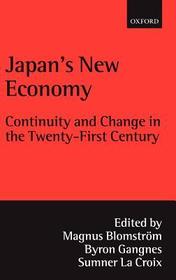
Japan's New Economy
Continuity and Change in the Twenty-First Century
- Publisher's listprice GBP 177.50
-
80 141 Ft (76 325 Ft + 5% VAT)
The price is estimated because at the time of ordering we do not know what conversion rates will apply to HUF / product currency when the book arrives. In case HUF is weaker, the price increases slightly, in case HUF is stronger, the price goes lower slightly.
- Discount 10% (cc. 8 014 Ft off)
- Discounted price 72 127 Ft (68 693 Ft + 5% VAT)
Subcribe now and take benefit of a favourable price.
Subscribe
80 141 Ft

Availability
printed on demand
Why don't you give exact delivery time?
Delivery time is estimated on our previous experiences. We give estimations only, because we order from outside Hungary, and the delivery time mainly depends on how quickly the publisher supplies the book. Faster or slower deliveries both happen, but we do our best to supply as quickly as possible.
Product details:
- Publisher OUP Oxford
- Date of Publication 25 January 2001
- ISBN 9780199241729
- Binding Hardback
- No. of pages338 pages
- Size 244x164x23 mm
- Weight 635 g
- Language English
- Illustrations numerous line figures 0
Categories
Short description:
This volume fills an important gap in the existing economic literature. While much has been written about Japan's pre-1990s institutions and economic performance, this text is unique in its forward-looking orientation - trying to understand not only the institutional and structural changes that have already reshaped Japan in the 1990s, but to identify the critical trends and institutional changes that will mould Japan's new economy over the next decade.
MoreLong description:
Japan's economy stumbled in the 1990s. After four decades of rapid growth that transformed Japan into a wealthy country at the world's technological frontier, the last decade brought prolonged economic stagnation. The rapid run-up in asset prices in the late 1980s, followed by their collapse in the early 1990s, left a debt overhang that paralyzed the banking sector. Policy reforms were initially half-hearted, and businesses were slow to restructure as the global economy changed. The lagging economy has seemed impervious to aggressive fiscal stimulus measures and is still plagued by ongoing price deflation. Japan's struggle has called into question the ability of the country's economic institutions - originally designed to support factor accumulation and rapid development - to adapt to the new economic environment of the 21st century.
Yet Japan's economy is already changing. Driven by an aging population, rapid technological change, and increasing global competition, the country's public and private institutions are being slowly reshaped. This volume explores the forces that will drive structural and institutional change in three areas over the next decade: the macroeconomy, the organization of industry, and the global economic and political environment. Economists, demographers, and Japan specialists examine key aspects of the economy that will be transformed in coming years, including population and savings, the public pension system, labor markets, financial reforms, deregulation of service industries, productivity performance, foreign investment, trade, and the impact of an emerging China.
The volume fills an important gap in the existing economic literature. While much has been written about Japan's pre-1990s institutions and economic performance, this volume is unique in its forward-looking orientation - trying to understand not only the institutional and structural changes that have already reshaped Japan in the 1990s, but to identify the critical trends and institutional changes that will mould Japan's new economy over the next decade.
Table of Contents:
Historical, Structural, and Macroeconomic Perspectives on the Japanese Economic Crisis
Population, Labor Force, Saving, and Japan's Future
Will Japan's Current Account Turn to Deficit?
Japan's Public Pension System in the Twenty-First Century
Japanese Labor Markets: Can We Expect Significant Change?
Central Banking, Financial, and Regulatory Change in Japan
Japan's Big Bang and the Transformation of Financial Markets
Has Japan Specialized in the Wrong Industries?
The Sogo Shosha: Finding a New Role?
Regulatory Reform in Japan: The Road Ahead
FDI in the Restructuring of the Japanese Economy
A New Millennium for Japanese-North American Economic Policy Relations?
Japan as Number Three: Effects of European Integration
Economic Development in China and its Implications for Japan

