

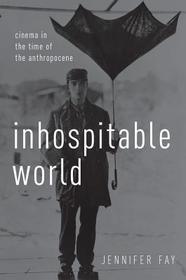
Inhospitable World
Cinema in the Time of the Anthropocene
-
10% KEDVEZMÉNY?
- A kedvezmény csak az 'Értesítés a kedvenc témákról' hírlevelünk címzettjeinek rendeléseire érvényes.
- Kiadói listaár GBP 122.50
-
55 308 Ft (52 675 Ft + 5% áfa)
Az ár azért becsült, mert a rendelés pillanatában nem lehet pontosan tudni, hogy a beérkezéskor milyen lesz a forint árfolyama az adott termék eredeti devizájához képest. Ha a forint romlana, kissé többet, ha javulna, kissé kevesebbet kell majd fizetnie.
- Kedvezmény(ek) 10% (cc. 5 531 Ft off)
- Kedvezményes ár 49 778 Ft (47 408 Ft + 5% áfa)
Iratkozzon fel most és részesüljön kedvezőbb árainkból!
Feliratkozom
55 308 Ft

Beszerezhetőség
Megrendelésre a kiadó utánnyomja a könyvet. Rendelhető, de a szokásosnál kicsit lassabban érkezik meg.
Why don't you give exact delivery time?
A beszerzés időigényét az eddigi tapasztalatokra alapozva adjuk meg. Azért becsült, mert a terméket külföldről hozzuk be, így a kiadó kiszolgálásának pillanatnyi gyorsaságától is függ. A megadottnál gyorsabb és lassabb szállítás is elképzelhető, de mindent megteszünk, hogy Ön a lehető leghamarabb jusson hozzá a termékhez.
A termék adatai:
- Kiadó OUP USA
- Megjelenés dátuma 2018. április 19.
- ISBN 9780190696771
- Kötéstípus Keménykötés
- Terjedelem270 oldal
- Méret 163x236x20 mm
- Súly 528 g
- Nyelv angol 0
Kategóriák
Rövid leírás:
While standard ecological cricitism attends to the environmental crisis as an unraveling of our natural state, this book looks to films and media theory to consider how they reflect upon the creation and destruction of artifial, human environments. What are the implications of ecological inhospitality? And what role might cinema and media theory play in challenging our presumed right to occupy and populate the world? As an art form, cinema enjoys a unique relationship to the material, elemental world it captures and produces. Through it, we may appreciate the ambitions to design an unhomely planet that may no longer accommodate us.
TöbbHosszú leírás:
In recent years, environmental and human rights advocates have suggested that we have entered the first new geological epoch since the end of the ice age: the Anthropocene. In this new epoch, humans have come to reshape unwittingly both the climate and natural world; humankind has caused mass extinctions of plant and animal species, polluted the oceans, and irreversibly altered the atmosphere. Ironically, our efforts to make the planet more hospitable to ourselves seem to be driving us toward our inevitable extinction. A force of nature, humanity is now decentered as the agent of history. As Jennifer Fay argues, this new situation is to geological science what cinema has always been to human culture.
Film, like the Anthropocene, is a product of the industrial revolution, but arises out of a desire to preserve life and master time and space. It also calls for the creation of artificial worlds, unnatural weather, and deadly environments for entertainment, scientific study, and devising military strategy. Filmmaking stages, quite literally, the process by which worlds and weather come into being and meaning, and it mimics the forces that are driving this new planetary inhospitality. Cinema, in other words, provides an image of "nature" in the age of its mechanical reproducability. Fay argues that cinema exemplifies the philosophical, political, and perhaps even logistical processes by which we can adapt to these forces and also imagine a world without humans in it. Whereas standard ecological criticism attends to the environmental crisis as an unraveling of our natural state, this book looks to film (from Buster Keaton, to Jia Zhangke, to films of atomic testing and early polar exploration) to consider how it reflects upon the creation and destruction of human environments. What are the implications of ecological inhospitality? What role might cinema and media theory play in challenging our presumed right to occupy and populate the world? As an art form, film enjoys a unique relationship to the material, elemental world it captures and produces. Through it, we may appreciate the ambitions to design an unhomely planet that may no longer accommodate us.
[A] stunningly original and deeply troubling book... Throughout the text, Fay makes astonishing and compelling connections between these films and the collapse of a once ecologically stable world. The result is a groundbreaking, one-of-a-kind book destined to be a classic. This is film criticism at its most urgent and impressive. Essential.
Tartalomjegyzék:
Acknowledgments
Introduction
Part One: On Location
1. Buster Keaton's Climate Change
2. Nuclear Conditioning
3. The Ecologies of Film Noir
Part Two: At the End of the World
4. Still Life
5. Antarctica and Siegfried Kracauer's Extraterrestrial Film Theory
Conclusion: The Epoch and the Archive
Notes
Bibliography
Index

