

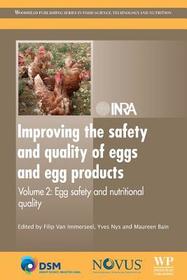
Improving the Safety and Quality of Eggs and Egg Products
Egg Safety and Nutritional Quality
Sorozatcím: Woodhead Publishing Series in Food Science, Technology and Nutrition;
-
10% KEDVEZMÉNY?
- A kedvezmény csak az 'Értesítés a kedvenc témákról' hírlevelünk címzettjeinek rendeléseire érvényes.
- Kiadói listaár EUR 200.00
-
82 950 Ft (79 000 Ft + 5% áfa)
Az ár azért becsült, mert a rendelés pillanatában nem lehet pontosan tudni, hogy a beérkezéskor milyen lesz a forint árfolyama az adott termék eredeti devizájához képest. Ha a forint romlana, kissé többet, ha javulna, kissé kevesebbet kell majd fizetnie.
- Kedvezmény(ek) 10% (cc. 8 295 Ft off)
- Kedvezményes ár 74 655 Ft (71 100 Ft + 5% áfa)
Iratkozzon fel most és részesüljön kedvezőbb árainkból!
Feliratkozom
82 950 Ft

Beszerezhetőség
Megrendelésre a kiadó utánnyomja a könyvet. Rendelhető, de a szokásosnál kicsit lassabban érkezik meg.
Why don't you give exact delivery time?
A beszerzés időigényét az eddigi tapasztalatokra alapozva adjuk meg. Azért becsült, mert a terméket külföldről hozzuk be, így a kiadó kiszolgálásának pillanatnyi gyorsaságától is függ. A megadottnál gyorsabb és lassabb szállítás is elképzelhető, de mindent megteszünk, hogy Ön a lehető leghamarabb jusson hozzá a termékhez.
A termék adatai:
- Kiadó Elsevier Science
- Megjelenés dátuma 2016. augusztus 19.
- ISBN 9780081016800
- Kötéstípus Puhakötés
- Terjedelem448 oldal
- Méret 233x155 mm
- Súly 620 g
- Nyelv angol 0
Kategóriák
Hosszú leírás:
Eggs are economical and of high nutritional value, yet can also be a source of foodborne disease. Understanding of the factors influencing egg quality has increased in recent years and new technologies to assure egg safety have been developed. Improving the safety and quality of eggs and egg products reviews recent research in these areasVolume 2 focuses on egg safety and nutritional quality. Part one provides an overview of egg contaminants, covering both microbial pathogens and chemical residues. Salmonella control in laying hens is the focus of part two. Chapters cover essential topics such as monitoring and control procedures in laying flocks and egg decontamination methods. Finally, part three looks at the role of eggs in nutrition and other health applications. Chapters cover dietary cholesterol, egg allergy, egg enrichment and bioactive fractions of eggs, among other topics.With its distinguished editors and international team of contributors, Volume 2 of Improving the safety and quality of eggs and egg products is an essential reference for managers in the egg industry, professionals in the food industry using eggs as ingredients and all those with a research interest in the subject.
TöbbTartalomjegyzék:
Contributor contact details
Woodhead Publishing Series in Food Science, Technology and Nutrition
Advertisement
Preface
Part I: Microbial and chemical contamination of eggs
Chapter 1: Microbiology and safety of table eggs
Abstract:
1.1 Introduction
1.2 Washing table eggs
1.3 Table egg facility sanitation
1.4 Regulations
1.5 Microbiology of table eggs
1.6 Bringing eggs and foodborne disease into perspective
1.7 Acknowledgements
Chapter 2: Foodborne disease associated with eggs: microbial hazards and Salmonella Enteritidis risk assessment
Abstract:
2.1 Introduction
2.2 Hazard identification
2.3 Quantitative risk assessment: Salmonella enteritidis in eggshells
2.4 Conclusion
Chapter 3: Internal contamination of eggs by Salmonella Enteritidis
Abstract:
3.1 Salmonella Enteritidis and eggs: a close connection
3.2 Eggshell surface contamination
3.3 Eggshell penetration
3.4 Contamination of the egg during development in the reproductive tract
3.5 Salmonella Enteritidis virulence factors involved in chicken reproductive tract colonization
Chapter 4: Chemical residues and contaminants in eggs
Abstract:
4.1 Introduction
4.2 Chemical contaminants in animal-derived foodstuffs: origins and regulatory context
4.3 Modes of transfer into the egg
4.4 Monitoring strategies
4.5 Origin of non-conformities and preventing risk during rearing
4.6 Conclusion
Part II: Salmonella control in laying hens
Chapter 5: Detection and monitoring of Salmonella in laying hen flocks
Abstract:
5.1 Introduction
5.2 What to sample
5.3 Recommended sampling regime of laying houses
5.4 Serology
5.5 Methods used for the 2004/2005 baseline survey and Salmonella control programmes in flocks of laying hens in the European Union
5.6 Factors affecting the detection of Salmonella infection
5.7 Significance of under-detection
Chapter 6: Epidemiology of Salmonella infections in laying hens with special emphasis on the influence of the housing system
Abstract:
6.1 Introduction
6.2 Effect of the housing system on Salmonella prevalence
6.3 Factors related to housing system and Salmonella prevalence
6.4 Presence of Salmonella serotypes other than S. Enteritidis in outdoor production systems
6.5 Conclusions
6.6 Acknowledgement
Chapter 7: Pre-harvest measures to control Salmonella in laying hens
Abstract:
7.1 Introduction
7.2 Vaccination
7.3 Genetic selection for naturally occurring resistance
7.4 Gastrointestinal colonization control
7.5 Future trends
7.6 Sources of further information and advice
Chapter 8: Management and sanitation procedures to control Salmonella in laying hen flocks
Abstract:
8.1 Introduction
8.2 Management procedures to prevent introduction of Salmonella on the farm or to suppress the infection pressure from the environment
8.3 Sanitation and decontamination
8.4 Future trends: management and sanitation procedures for a Salmonella-free production chain
8.5 Sources of further information and advice
Chapter 9: Egg decontamination by washing
Abstract:
9.1 Introduction
9.2 Historical and commercial perspective
9.3 The egg washing process
9.4 Factors that influence the microbiological quality of washed eggs
9.5 Post-washing treatments
9.6 Benefits and problems associated with egg washing
9.7 Conclusions
Chapter 10: Alternative egg decontamination techniques to washing
Abstract:
10.1 Introduction
10.2 Washing methods currently used in industry
10.3 Hot air pasteurization
10.4 Microwave pasteurization
10.5 Gas plasma
10.6 Pulsed light
10.7 Conclusions and future trends
Part III: Eggs in nutrition and other applications
Chapter 11: The nutritional quality of eggs
Abstract:
11.1 Reputation of the egg
11.2 Nutritional evaluation of eggs: composition
11.3 Nutritional evaluation of eggs: macronutrients
11.4 Nutritional evaluation of eggs: micronutrients
11.5 Improving the nutritional quality of eggs
11.6 Conclusions
Chapter 12: Eggs, dietary cholesterol and disease: facts and folklore
Abstract:
12.1 Egg nutrition: facts and folklore
12.2 Serum cholesterol and dietary cholesterol as risk factors for coronary heart disease
12.3 Impact of cholesterol perception on egg consumption
12.4 Evidence from egg-feeding studies in humans
12.5 The relative effects of dietary saturated fat and dietary cholesterol on serum cholesterol
12.6 Current consensus and recommendations
12.7 Conclusion
Chapter 13: Egg allergy
Abstract:
13.1 Introduction
13.2 Egg allergy: an overview
13.3 Egg proteins
13.4 Egg yolk allergenicity
13.5 Effects of processing on the allergenicity of egg proteins
13.6 Conclusion and future trends
Chapter 14: Modifying egg lipids for human health
Abstract:
14.1 Introduction
14.2 Egg lipid fractions
14.3 Fatty acid metabolism in laying hens
14.4 Effect of hen's diet on lipid components
14.5 Sensory characteristics of enriched eggs
14.6 Conclusion
Chapter 15: Egg enrichment with vitamins and trace minerals
Abstract:
15.1 Introduction
15.2 Egg enrichment with vitamins
15.3 Water-soluble vitamin enrichment
15.4 Egg enrichment in trace minerals
Chapter 16: Bioactive fractions of eggs for human and animal health
Abstract:
16.1 Introduction
16.2 Egg fractions
16.3 Antibody applications
16.4 Bioactive properties of eggs
16.5 Cryoprotective activity
16.6 Conclusions
Chapter 17: Using egg IgY antibodies for health, diagnostic and other industrial applications
Abstract:
17.1 Introduction
17.2 Overview of the avian immune system and IgY biosynthesis
17.3 Production and purification of IgY
17.4 Advantages of eggs as an alternative antibody source
17.5 Applications of IgY
17.6 Immunotherapeutic applications of IgY
17.7 Conclusion and future trends
Chapter 18: Strategic planning for the development of the egg nutraceutical industry
Abstract:
18.1 Introduction
18.2 Egg nutraceutical business - strengths, weaknesses, opportunities and threats (SWOT) analysis
18.3 Strategic goals for the egg nutraceutical business
18.4 Action plan for the egg nutraceutical business
18.5 Conclusion
Index
Több
