

-
10% KEDVEZMÉNY?
- A kedvezmény csak az 'Értesítés a kedvenc témákról' hírlevelünk címzettjeinek rendeléseire érvényes.
- Kiadói listaár GBP 27.99
-
12 637 Ft (12 035 Ft + 5% áfa)
Az ár azért becsült, mert a rendelés pillanatában nem lehet pontosan tudni, hogy a beérkezéskor milyen lesz a forint árfolyama az adott termék eredeti devizájához képest. Ha a forint romlana, kissé többet, ha javulna, kissé kevesebbet kell majd fizetnie.
- Kedvezmény(ek) 10% (cc. 1 264 Ft off)
- Kedvezményes ár 11 373 Ft (10 832 Ft + 5% áfa)
Iratkozzon fel most és részesüljön kedvezőbb árainkból!
Feliratkozom
12 637 Ft

Beszerezhetőség
Megrendelésre a kiadó utánnyomja a könyvet. Rendelhető, de a szokásosnál kicsit lassabban érkezik meg.
Why don't you give exact delivery time?
A beszerzés időigényét az eddigi tapasztalatokra alapozva adjuk meg. Azért becsült, mert a terméket külföldről hozzuk be, így a kiadó kiszolgálásának pillanatnyi gyorsaságától is függ. A megadottnál gyorsabb és lassabb szállítás is elképzelhető, de mindent megteszünk, hogy Ön a lehető leghamarabb jusson hozzá a termékhez.
A termék adatai:
- Kiadás sorszáma 2
- Kiadó OUP Oxford
- Megjelenés dátuma 2013. február 7.
- ISBN 9780199660179
- Kötéstípus Puhakötés
- Terjedelem392 oldal
- Méret 245x174x18 mm
- Súly 604 g
- Nyelv angol
- Illusztrációk Figures, Line Drawings 0
Kategóriák
Rövid leírás:
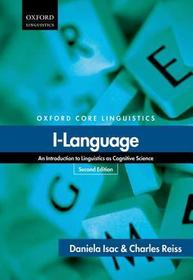
The book introduces the major branches of theoretical linguistics - phonology, morphology, syntax, semantics - in the context of cognitive science, with reference to fields such as vision, auditory perception, and philosophy of mind.
TöbbHosszú leírás:
I-Language introduces the uninitiated to linguistics as cognitive science. In an engaging, down-to-earth style Daniela Isac and Charles Reiss give a crystal-clear demonstration of the application of the scientific method in linguistic theory. Their presentation of the research program inspired by Noam Chomsky shows how the focus of theory and research in linguistics shifted from treating language as a disembodied, human-external entity to cognitive biolinguistics - the study of language as a human cognitive system embedded within the mind/brain of each individual. The recurring theme of equivalence classes in linguistic computation ties together the presentation of material from phonology, morphology, syntax, and semantics. The same theme is used to help students understand the place of linguistics in the broader context of the cognitive sciences, by drawing on examples from vision, audition and even animal cognition.
This textbook is unique in its integration of empirical issues of linguistic analysis, engagement with philosophical questions that arise in the study of language, and treatment of the history of the field. Topics ranging from allophony to reduplication, ergativity, and negative polarity are invoked to show the implications of findings in cognitive biolinguistics for philosophical issues like reference, the mind-body problem, and nature-nurture debates.
The well-tested material in the book is appropriate for a variety of audiences, from large introductory courses in linguistics to graduate seminars in cognitive science or philosophy of mind. It contains numerous exercises and guides for further reading as well as ideas for student projects. A companion website with guidance for instructors and answers to the exercises features a series of pdf slide presentations to accompany the teaching of each topic.
This fully revised and updated second edition includes additional exercises and expanded discussions on topics such as language and culture, philosophy, and rationalist explorations of language and mind.
Review from previous edition This book is an engaging and pioneering introduction to Biolinguistic theory construction and scientific method. It's one of very few texts I've ever read that clarifies, with formal yet accessible linguistic analyses and argument, the Chomskyan shift in focus away from treating human language as some kind of non-psychological human-external entity to the study of human language as "I-language" - a cognitive system embedded within the mind/brain of each individual.
Tartalomjegyzék:
Part I: The Object of Inquiry
What is I-Language?
I-everything: Triangles, streams, words
Approaches to the Study of Language
I-/E-/P-Language
Part II: Linguistic Representation and Computation
A Syntactic Theory That Won't Work
Abstract Representations
Some Details of Sentence Structure
Binding
Ergativity
Part III: Universal Grammar
Approaches to UG: Empirical Evidence
Approaches to UG: Logic
Part IV: Implications and Conclusions
Social Implications
Rationalist Explorations
Open Questions and Closing Remarks
References
Index

