

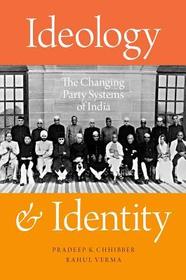
Ideology and Identity
The Changing Party Systems of India
-
10% KEDVEZMÉNY?
- A kedvezmény csak az 'Értesítés a kedvenc témákról' hírlevelünk címzettjeinek rendeléseire érvényes.
- Kiadói listaár GBP 33.49
-
15 120 Ft (14 400 Ft + 5% áfa)
Az ár azért becsült, mert a rendelés pillanatában nem lehet pontosan tudni, hogy a beérkezéskor milyen lesz a forint árfolyama az adott termék eredeti devizájához képest. Ha a forint romlana, kissé többet, ha javulna, kissé kevesebbet kell majd fizetnie.
- Kedvezmény(ek) 10% (cc. 1 512 Ft off)
- Kedvezményes ár 13 608 Ft (12 960 Ft + 5% áfa)
Iratkozzon fel most és részesüljön kedvezőbb árainkból!
Feliratkozom
15 120 Ft

Beszerezhetőség
Megrendelésre a kiadó utánnyomja a könyvet. Rendelhető, de a szokásosnál kicsit lassabban érkezik meg.
Why don't you give exact delivery time?
A beszerzés időigényét az eddigi tapasztalatokra alapozva adjuk meg. Azért becsült, mert a terméket külföldről hozzuk be, így a kiadó kiszolgálásának pillanatnyi gyorsaságától is függ. A megadottnál gyorsabb és lassabb szállítás is elképzelhető, de mindent megteszünk, hogy Ön a lehető leghamarabb jusson hozzá a termékhez.
A termék adatai:
- Kiadó OUP USA
- Megjelenés dátuma 2018. november 8.
- ISBN 9780190623883
- Kötéstípus Puhakötés
- Terjedelem336 oldal
- Méret 155x231x20 mm
- Súly 476 g
- Nyelv angol
- Illusztrációk 50 illustrations 0
Kategóriák
Rövid leírás:
Ideology and Identity shows that party politics and elections in India are a contest of ideas. Using survey data from the Indian National Election Studies (NES) and survey experiments from smaller but more focused studies, the book shows that Indian electoral politics, as represented by political parties, their members, and their voters, is in fact marked by deep ideological cleavages.
TöbbHosszú leírás:
Indian party politics, commonly viewed as chaotic, clientelistic, and corrupt, is nevertheless a model for deepening democracy and accommodating diversity. Historically, though, observers have argued that Indian politics is non-ideological in nature. In contrast, Pradeep Chhibber and Rahul Verma contend that the Western European paradigm of "ideology" is not applicable to many contemporary multiethnic countries. In these more diverse states, the most important ideological debates center on statism-the extent to which the state should dominate and regulate society-and recognition-whether and how the state should accommodate various marginalized groups and protect minority rights from majorities. Using survey data from the Indian National Election Studies and evidence from the Constituent Assembly debates, they show how education, the media, and religious practice transmit the competing ideas that lie at the heart of ideological debates in India.
This book will be useful to students and scholars interested in understanding the intellectual lineages of the issues that concern political parties in India today, and the Indian party system. It is well organized and the proofreading is good
Tartalomjegyzék:
Acknowledgements
List of Tables and Graphs
Introduction: Ideology in India's Electoral Politics
Chapter 1. State Formation and Ideological Conflict in Multiethnic Countries
Chapter 2. Ideology, Identity, and the 2014 National Elections
Chapter 3. Intellectual Lineages of the Politics of Statism and Recognition
Chapter 4. Who Opposes Reservations and Why?
Chapter 5. The Myth of Vote Buying in India
Chapter 6. Transformational Leaders and Ideological Shifts
Chapter 7. Transmitting Ideology
Chapter 8. Statism, Recognition, and the Party System Change in India
Chapter 9. Ideological Challenges and the Decline of the Congress Party
Chapter 10. The BJP and an Ideological Consolidation of the Right?
Conclusion: Ideas, Leaders, and Party Systems
Appendix
Bibliography
Index

