

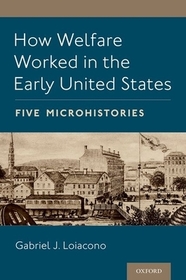
How Welfare Worked in the Early United States
Five Microhistories
-
10% KEDVEZMÉNY?
- A kedvezmény csak az 'Értesítés a kedvenc témákról' hírlevelünk címzettjeinek rendeléseire érvényes.
- Kiadói listaár GBP 29.99
-
13 540 Ft (12 895 Ft + 5% áfa)
Az ár azért becsült, mert a rendelés pillanatában nem lehet pontosan tudni, hogy a beérkezéskor milyen lesz a forint árfolyama az adott termék eredeti devizájához képest. Ha a forint romlana, kissé többet, ha javulna, kissé kevesebbet kell majd fizetnie.
- Kedvezmény(ek) 10% (kb. 1 354 Ft)
- Kedvezményes ár 12 186 Ft (11 606 Ft + 5% áfa)
Iratkozzon fel most és részesüljön kedvezőbb árainkból!
Feliratkozom
13 540 Ft

Beszerezhetőség
Becsült beszerzési idő: A Prosperónál jelenleg nincsen raktáron, de a kiadónál igen. Beszerzés kb. 3-5 hét..
A Prosperónál jelenleg nincsen raktáron.
Why don't you give exact delivery time?
A beszerzés időigényét az eddigi tapasztalatokra alapozva adjuk meg. Azért becsült, mert a terméket külföldről hozzuk be, így a kiadó kiszolgálásának pillanatnyi gyorsaságától is függ. A megadottnál gyorsabb és lassabb szállítás is elképzelhető, de mindent megteszünk, hogy Ön a lehető leghamarabb jusson hozzá a termékhez.
A termék adatai:
- Kiadó OUP USA
- Megjelenés dátuma 2021. augusztus 10.
- ISBN 9780197515433
- Kötéstípus Puhakötés
- Terjedelem246 oldal
- Méret 155x231x17 mm
- Súly 340 g
- Nyelv angol 111
Kategóriák
Rövid leírás:
How Welfare Worked in the Early United States traces the lives of five people from the Revolutionary War to 1850. The book explains welfare--or "poor relief," as early Americans called it--in its original form as well as the government's obligation to provide this aid throughout time.
TöbbHosszú leírás:
What was American welfare like in George Washington's day? It was expensive, extensive, and run by local governments. Known as "poor relief," it included what we would now call welfare and social work. Unlike other aspects of government, poor relief remained consistent in structure between the establishment of the British colonies in the 1600s and the New Deal of the 1930s. In this book, Gabriel J. Loiacono follows the lives of five people in Rhode Island between the Revolutionary War and 1850: a long-serving overseer of the poor, a Continental Army veteran who was repeatedly banished from town, a nurse who was paid by the government to care for the poor, an unwed mother who cared for the elderly, and a paralyzed young man who attempted to become a Christian missionary from inside of a poorhouse. Of Native, African, and English descent, these five Rhode Islanders utilized poor relief in various ways. Tracing their involvement with these programs, Loiacono explains the importance of welfare through the first few generations of United States history.
In Washington's day, poor relief was both generous and controlling. Two centuries ago, Americans paid for--and many relied on--an astonishing governmental system that provided food, housing, and medical care to those in need. This poor relief system also shaped American households and dictated where Americans could live and work. Recent generations have assumed that welfare is a new development in the United States. This book shows how old welfare is in the United States of America through five little-known, but compelling, life stories.
Tartalomjegyzék:
Introduction
Chapter 1: Overseer of the Poor: How William Larned Spent Public Funds on the Needy
Chapter 2: Warned Out: How Cuff Roberts was Banished by Poor Law Officials
Chapter 3: Healthcare for the Poor: How "One-Eyed" Sarah Saved Paupers' Lives
Chapter 4: Hard-working Single Mother: Lydia Bates and Poor Relief in a Small Town
Chapter 5: Stuck in the Poorhouse: William Fales and the Experience of Institutionalization
Epilogue: What Can We Learn from These Five Lives?
Acknowledgements
Notes
Bibliography

