

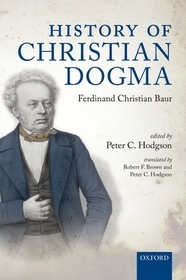
History of Christian Dogma
by Ferdinand Christian Baur
-
10% KEDVEZMÉNY?
- A kedvezmény csak az 'Értesítés a kedvenc témákról' hírlevelünk címzettjeinek rendeléseire érvényes.
- Kiadói listaár GBP 147.50
-
66 596 Ft (63 425 Ft + 5% áfa)
Az ár azért becsült, mert a rendelés pillanatában nem lehet pontosan tudni, hogy a beérkezéskor milyen lesz a forint árfolyama az adott termék eredeti devizájához képest. Ha a forint romlana, kissé többet, ha javulna, kissé kevesebbet kell majd fizetnie.
- Kedvezmény(ek) 10% (cc. 6 660 Ft off)
- Kedvezményes ár 59 937 Ft (57 083 Ft + 5% áfa)
Iratkozzon fel most és részesüljön kedvezőbb árainkból!
Feliratkozom
66 596 Ft

Beszerezhetőség
Megrendelésre a kiadó utánnyomja a könyvet. Rendelhető, de a szokásosnál kicsit lassabban érkezik meg.
Why don't you give exact delivery time?
A beszerzés időigényét az eddigi tapasztalatokra alapozva adjuk meg. Azért becsült, mert a terméket külföldről hozzuk be, így a kiadó kiszolgálásának pillanatnyi gyorsaságától is függ. A megadottnál gyorsabb és lassabb szállítás is elképzelhető, de mindent megteszünk, hogy Ön a lehető leghamarabb jusson hozzá a termékhez.
A termék adatai:
- Kiadó OUP Oxford
- Megjelenés dátuma 2014. augusztus 14.
- ISBN 9780198719250
- Kötéstípus Keménykötés
- Terjedelem416 oldal
- Méret 241x163x27 mm
- Súly 764 g
- Nyelv angol 0
Kategóriák
Rövid leírás:
This book is a translation of a mid-nineteenth-century work on the history of Christian dogma by Ferdinand Christian Baur (1792-1860), who brilliantly applied Hegelian categories to his historical studies in New Testament, church history, and history of Christian dogma.
TöbbHosszú leírás:
History of Christian Dogma is a translation of Ferdinand Christian Baur's Lehrbuch der christlichen Dogmengeschichte, second edition, 1858. The Lehrbuch, which Baur himself prepared, summarizes in 400 pages his lectures on the history of Christian dogma, published post-humously in four volumes. Baur, professor of theology at the University of Tübingen from 1826 to 1860, brilliantly applied Hegelian categories to his historical studies in New Testament, church history, and history of Christian dogma. According to Baur, "Dogma" is the rational articulation of the Christian "idea" or principle-the idea that God and humanity are united through Christ and reconciled in the faith of the spiritual community. Following an introduction on the concept and history of the history of dogma, the Lehrbuch treats three main periods: the dogma of the ancient church or the substantiality of dogma; the dogma of the Middle Ages or the dogma of inwardly reflected consciousness; and dogma in the modern era or dogma and free self-consciousness. The entire history is a progression in the self-articulation of dogma through conflict and resolution, moving gradually from objective to subjective forms and to the mediation of subject and object by the philosophers and theologians of the early nineteenth century. The detailed analyses provide a wealth of information on individual thinkers and doctrines that is still relevant today.
TöbbTartalomjegyzék:
Editorial Introduction
History of Christian Dogma
Preface to the First Edition (1847)
Preface to the Second Edition (1858)
Introduction
First Major Period From the Apostolic Age to the End of the Sixth Century The Dogma of the Ancient Church, or the Substantiality of Dogma
Part 1. From the Apostolic Age to the Council of Nicaea
Part 2. From the Council of Nicaea to the End of the Sixth Century
Second Major Period From the Beginning of the Seventh Century to the Reformation The Dogma of the Middle Ages, or the Dogma of Inwardly Reflected Consciousness
Part 1. From the Beginning of the Seventh Century, or Gregory I, to the Beginning of Scholasticism, or Anselm of Canterbury
Part 2. From the Beginning of Scholasticism to the Reformation
Third Major Period From the Reformation to the Most Recent Times Dogma in the Modern Era, or Dogma and Free Self-Consciousness
Part 1. From the Reformation to the Beginning of the Eighteenth Century
Part 2. From the Beginning of the Eighteenth Century to the Most Recent Times
Bibliography
Index

