

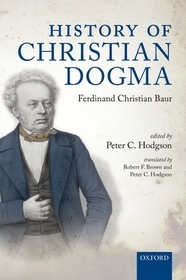
History of Christian Dogma
by Ferdinand Christian Baur
- Publisher's listprice GBP 147.50
-
66 596 Ft (63 425 Ft + 5% VAT)
The price is estimated because at the time of ordering we do not know what conversion rates will apply to HUF / product currency when the book arrives. In case HUF is weaker, the price increases slightly, in case HUF is stronger, the price goes lower slightly.
- Discount 10% (cc. 6 660 Ft off)
- Discounted price 59 937 Ft (57 083 Ft + 5% VAT)
Subcribe now and take benefit of a favourable price.
Subscribe
66 596 Ft

Availability
printed on demand
Why don't you give exact delivery time?
Delivery time is estimated on our previous experiences. We give estimations only, because we order from outside Hungary, and the delivery time mainly depends on how quickly the publisher supplies the book. Faster or slower deliveries both happen, but we do our best to supply as quickly as possible.
Product details:
- Publisher OUP Oxford
- Date of Publication 14 August 2014
- ISBN 9780198719250
- Binding Hardback
- No. of pages416 pages
- Size 241x163x27 mm
- Weight 764 g
- Language English 0
Categories
Short description:
This book is a translation of a mid-nineteenth-century work on the history of Christian dogma by Ferdinand Christian Baur (1792-1860), who brilliantly applied Hegelian categories to his historical studies in New Testament, church history, and history of Christian dogma.
MoreLong description:
History of Christian Dogma is a translation of Ferdinand Christian Baur's Lehrbuch der christlichen Dogmengeschichte, second edition, 1858. The Lehrbuch, which Baur himself prepared, summarizes in 400 pages his lectures on the history of Christian dogma, published post-humously in four volumes. Baur, professor of theology at the University of Tübingen from 1826 to 1860, brilliantly applied Hegelian categories to his historical studies in New Testament, church history, and history of Christian dogma. According to Baur, "Dogma" is the rational articulation of the Christian "idea" or principle-the idea that God and humanity are united through Christ and reconciled in the faith of the spiritual community. Following an introduction on the concept and history of the history of dogma, the Lehrbuch treats three main periods: the dogma of the ancient church or the substantiality of dogma; the dogma of the Middle Ages or the dogma of inwardly reflected consciousness; and dogma in the modern era or dogma and free self-consciousness. The entire history is a progression in the self-articulation of dogma through conflict and resolution, moving gradually from objective to subjective forms and to the mediation of subject and object by the philosophers and theologians of the early nineteenth century. The detailed analyses provide a wealth of information on individual thinkers and doctrines that is still relevant today.
MoreTable of Contents:
Editorial Introduction
History of Christian Dogma
Preface to the First Edition (1847)
Preface to the Second Edition (1858)
Introduction
First Major Period From the Apostolic Age to the End of the Sixth Century The Dogma of the Ancient Church, or the Substantiality of Dogma
Part 1. From the Apostolic Age to the Council of Nicaea
Part 2. From the Council of Nicaea to the End of the Sixth Century
Second Major Period From the Beginning of the Seventh Century to the Reformation The Dogma of the Middle Ages, or the Dogma of Inwardly Reflected Consciousness
Part 1. From the Beginning of the Seventh Century, or Gregory I, to the Beginning of Scholasticism, or Anselm of Canterbury
Part 2. From the Beginning of Scholasticism to the Reformation
Third Major Period From the Reformation to the Most Recent Times Dogma in the Modern Era, or Dogma and Free Self-Consciousness
Part 1. From the Reformation to the Beginning of the Eighteenth Century
Part 2. From the Beginning of the Eighteenth Century to the Most Recent Times
Bibliography
Index

