

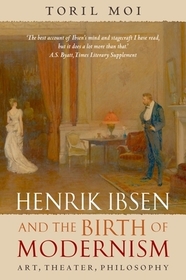
Henrik Ibsen and the Birth of Modernism
Art, Theater, Philosophy
-
10% KEDVEZMÉNY?
- A kedvezmény csak az 'Értesítés a kedvenc témákról' hírlevelünk címzettjeinek rendeléseire érvényes.
- Kiadói listaár GBP 37.99
-
17 152 Ft (16 335 Ft + 5% áfa)
Az ár azért becsült, mert a rendelés pillanatában nem lehet pontosan tudni, hogy a beérkezéskor milyen lesz a forint árfolyama az adott termék eredeti devizájához képest. Ha a forint romlana, kissé többet, ha javulna, kissé kevesebbet kell majd fizetnie.
- Kedvezmény(ek) 10% (cc. 1 715 Ft off)
- Kedvezményes ár 15 437 Ft (14 702 Ft + 5% áfa)
Iratkozzon fel most és részesüljön kedvezőbb árainkból!
Feliratkozom
17 152 Ft

Beszerezhetőség
Megrendelésre a kiadó utánnyomja a könyvet. Rendelhető, de a szokásosnál kicsit lassabban érkezik meg.
Why don't you give exact delivery time?
A beszerzés időigényét az eddigi tapasztalatokra alapozva adjuk meg. Azért becsült, mert a terméket külföldről hozzuk be, így a kiadó kiszolgálásának pillanatnyi gyorsaságától is függ. A megadottnál gyorsabb és lassabb szállítás is elképzelhető, de mindent megteszünk, hogy Ön a lehető leghamarabb jusson hozzá a termékhez.
A termék adatai:
- Kiadó OUP Oxford
- Megjelenés dátuma 2008. február 14.
- ISBN 9780199202591
- Kötéstípus Puhakötés
- Terjedelem416 oldal
- Méret 233x156x34 mm
- Súly 642 g
- Nyelv angol
- Illusztrációk 4 colour plates, 10 b/w in-text 0
Kategóriák
Rövid leírás:
Published to coincide with the hundredth anniversary of his death, this is a major critical study of Henrik Ibsen by a leading literary theorist. Toril Moi offers a radical reappraisal of Ibsen's place in the birth of modernism and the origins of modern theatre, his influence on other writers, and the connection between his visual imagination and his plays.
TöbbHosszú leírás:
Henrik Ibsen (1828-1906) is the founder of modern theater, and his plays are performed all over the world. Yet in spite of his unquestioned status as a classic of the stage, Ibsen is often dismissed as a boring old realist, whose plays are of interest only because they remain the gateway to modern theater. In Henrik Ibsen and the Birth of Modernism, Toril Moi makes a powerful case not just for Ibsen's modernity, but also for his modernism.
Henrik Ibsen and the Birth of Modernism situates Ibsen in his cultural context, emphasizes his position as a Norwegian in European culture, and shows how important painting and other visual arts were for his aesthetic education. The book rewrites literary history, reminding modern readers that idealism was the dominant aesthetic paradigm of the nineteenth century. Modernism was born in the ruins of idealism, Moi argues, thus challenging traditional theories of the opposition between realism and modernism.
By reading Ibsen's modernist plays as investigations of the fate of love in an age of skepticism, Moi shows why Ibsen still matters to us. In this book, Ibsen's plays are showed to be profoundly concerned by theater and theatricality, both on stage and in everyday life. Ibsen's unsettling explorations of women, men, and marriage here emerge as chronicles of the tension between skepticism and the everyday, and between critique and utopia in modernity.
This radical new account places Ibsen in his rightful place alongside Baudelaire, Flaubert, and Manet as a founder of European modernism.
...an illuminating rer-valuation of the influence of aesthetic idealism, a welcome discussion about the need to take back real language in literary criticism, a veritable handbook of imaginative approaches to take to the culture clash of the nineteenth century, a sometimes fruitful, often frustrating, even troubling read for those who have been engaged with Ibsen for a long time...
Tartalomjegyzék:
An Ibsen Chronology
Introduction
Part I: Ibsen's Place in History
Ibsen and the Ideology of Modernism
Postcolonial Norway? Ibsen's Cultural Resources
Rethinking Literary History: Idealism, Realism, and the Birth of Modernism
Ibsen's Visual World: Spectacles, Painting, Theater
Part II: Ibsen's Modern Breakthrough
The Idealist Straitjacket: Ibsen's Early Aesthetics
Becoming Modern: Modernity and Theater in Emperor and Galilean
Part III: Ibsen's Modernism: Love in an Age of Skepticism
'First and Foremost a Human Being': Idealism, Theater, and Gender in A Doll's House
Losing Touch with the Everyday: Love and Language in The Wild Duck
Losing Faith in Language: Fantasies of Perfect Communication in Rosmersholm
The Art of Transformation: Art, Marriage, and Freedom in The Lady From the Sea
Epilogue: Idealism and the 'Bad' Everyday
Appendix 1: Synopsis of Emperor and Galilean
Appendix 2: Translating Ibsen

