

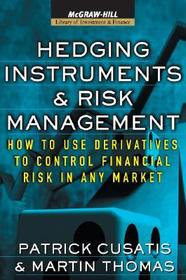
Hedging Instruments and Risk Management
How to Use Derivatives to Control Financial Risk in Any Market
Sorozatcím: McGraw-Hill Library of Investment and Finance;
-
10% KEDVEZMÉNY?
- A kedvezmény csak az 'Értesítés a kedvenc témákról' hírlevelünk címzettjeinek rendeléseire érvényes.
- Kiadói listaár GBP 51.99
-
23 473 Ft (22 355 Ft + 5% áfa)
Az ár azért becsült, mert a rendelés pillanatában nem lehet pontosan tudni, hogy a beérkezéskor milyen lesz a forint árfolyama az adott termék eredeti devizájához képest. Ha a forint romlana, kissé többet, ha javulna, kissé kevesebbet kell majd fizetnie.
- Kedvezmény(ek) 10% (cc. 2 347 Ft off)
- Kedvezményes ár 21 125 Ft (20 120 Ft + 5% áfa)
Iratkozzon fel most és részesüljön kedvezőbb árainkból!
Feliratkozom
23 473 Ft

Beszerezhetőség
Bizonytalan ideig nincs raktáron a kiadónál, rendelése nem javasolt.
Why don't you give exact delivery time?
A beszerzés időigényét az eddigi tapasztalatokra alapozva adjuk meg. Azért becsült, mert a terméket külföldről hozzuk be, így a kiadó kiszolgálásának pillanatnyi gyorsaságától is függ. A megadottnál gyorsabb és lassabb szállítás is elképzelhető, de mindent megteszünk, hogy Ön a lehető leghamarabb jusson hozzá a termékhez.
A termék adatai:
- Kiadó McGraw-Hill Education
- Megjelenés dátuma 2005. március 16.
- ISBN 9780071443128
- Kötéstípus Keménykötés
- Terjedelem432 oldal
- Méret 231x160x31 mm
- Súly 687 g
- Nyelv angol 0
Kategóriák
Rövid leírás:
A straightforward approach to hedging risk in equity, fixed income, commodity, currency, and mortgage markets
- Mathematical and statistical concepts required to construct, implement, and evaluate an effective hedge
- Characteristics of key hedging tools and techniques, including futures, swaps, and options
- Hedging strategies for commodity, currency, equity, bond, and mortgage risk markets, with historical performance of each
Financial risk impacts virtually every business operation, yet can be managed using a relatively uniform set of techniques. Hedging Instruments & Risk Management is a clearly-written guide to the mechanics of using these techniques to hedge in today?s risk-driven marketplace.
?Most markets share a fundamental structure that can be managed with a common set of mechanics. Our objective in writing this book is to provide the reader with a self-contained, accessible guide to the mechanics and risks of hedging in various markets.?
--From Chapter 1
Businesses are exposed to systematic price risk in many forms. Because this risk exposure can impact the ability to forecast, plan, or even operate a business in an efficient and competitive manner, most financial decision-makers turn to hedging to neutralize this risk so they can focus on core business opportunities.
Hedging Instruments & Risk Management provides a comprehensive and results-oriented approach to making informed hedging decisions. Focusing on practical details of key hedging instruments as well as insights into the real-world application of these instruments, this finance practitioner?s handbook covers information including:
- Basic concepts of valuation, including how to accurately calculate present value of future cash flows
- Mathematics of bond pricing and risk measurement, including volatility, duration, and convexity
- How to extract spot and implied forward rates from coupon bonds, as well as construct a swap zero-coupon yield curve from market prices
- Structure and uses of the futures markets, including specifications of major contracts in commodity, fixed income, and equity markets
- Basic knowledge of binomial option pricing, along with Black-Scholes options pricing models and extensions
- Techniques for hedging exposure to commodity price fluctuations and foreign currency risk
- Effective ways for corporate bond issuers to protect against interest rate risk using swaptions, forward delivery bonds and swaps
- Swap contract structure, pricing, and volatility, including descriptions of plain vanilla interest rate swaps as well as more complex contracts such as currency, equity, basis, credit default, and total rate of return swaps
Hedging allows financial professionals to accomplish a number of risk management objectives, from decreasing cash flow volatility and offsetting interest rate fluctuations to minimizing price risk, default risk, and more. In a world of razor-thin margins, the challenge is to select a hedge that provides the most protection while incurring the least expense. Hedging Instruments & Risk Management compiles the information, data, definitions, and examples hedgers need to consistently meet this challenge, and develop a stable, long-term, and cost-effective hedging strategy.
TöbbHosszú leírás:
Books on complex hedging instruments are often more confusing than the instruments themselves
Hedging Instruments & Risk Management brings clarity to the topic, giving money managers the straightforward knowledge they need to employ hedging tools and techniques in four key markets?equity, currency, fixed income, and mortgage.
Using real-world data and examples, this high-level book shows practitioners how to develop a common set of mathematical and statistical tools for hedging in various markets and then outlines several hedging strategies with the historical performance of each.
Books on complex hedging instruments are often more confusing than the instruments themselves
Hedging Instruments & Risk Management brings clarity to the topic, giving money managers the straightforward knowledge they need to employ hedging tools and techniques in four key markets?equity, currency, fixed income, and mortgage.
Using real-world data and examples, this high-level book shows practitioners how to develop a common set of mathematical and statistical tools for hedging in various markets and then outlines several hedging strategies with the historical performance of each.
TöbbTartalomjegyzék:
A straightforward approach to hedging risk in equity, fixed income, commodity, currency, and mortgage markets
- Mathematical and statistical concepts required to construct, implement, and evaluate an effective hedge
- Characteristics of key hedging tools and techniques, including futures, swaps, and options
- Hedging strategies for commodity, currency, equity, bond, and mortgage risk markets, with historical performance of each
Financial risk impacts virtually every business operation, yet can be managed using a relatively uniform set of techniques. Hedging Instruments & Risk Management is a clearly-written guide to the mechanics of using these techniques to hedge in today?s risk-driven marketplace.
?Most markets share a fundamental structure that can be managed with a common set of mechanics. Our objective in writing this book is to provide the reader with a self-contained, accessible guide to the mechanics and risks of hedging in various markets.?
--From Chapter 1
Businesses are exposed to systematic price risk in many forms. Because this risk exposure can impact the ability to forecast, plan, or even operate a business in an efficient and competitive manner, most financial decision-makers turn to hedging to neutralize this risk so they can focus on core business opportunities.
Hedging Instruments & Risk Management provides a comprehensive and results-oriented approach to making informed hedging decisions. Focusing on practical details of key hedging instruments as well as insights into the real-world application of these instruments, this finance practitioner?s handbook covers information including:
- Basic concepts of valuation, including how to accurately calculate present value of future cash flows
- Mathematics of bond pricing and risk measurement, including volatility, duration, and convexity
- How to extract spot and implied forward rates from coupon bonds, as well as construct a swap zero-coupon yield curve from market prices
- Structure and uses of the futures markets, including specifications of major contracts in commodity, fixed income, and equity markets
- Basic knowledge of binomial option pricing, along with Black-Scholes options pricing models and extensions
- Techniques for hedging exposure to commodity price fluctuations and foreign currency risk
- Effective ways for corporate bond issuers to protect against interest rate risk using swaptions, forward delivery bonds and swaps
- Swap contract structure, pricing, and volatility, including descriptions of plain vanilla interest rate swaps as well as more complex contracts such as currency, equity, basis, credit default, and total rate of return swaps
Hedging allows financial professionals to accomplish a number of risk management objectives, from decreasing cash flow volatility and offsetting interest rate fluctuations to minimizing price risk, default risk, and more. In a world of razor-thin margins, the challenge is to select a hedge that provides the most protection while incurring the least expense. Hedging Instruments & Risk Management compiles the information, data, definitions, and examples hedgers need to consistently meet this challenge, and develop a stable, long-term, and cost-effective hedging strategy.
Több
