
• Kapcsolat

  • Hírlevél

  • Rólunk

  • Szállítási lehetőségek

  • Prospero könyvpiaci podcast

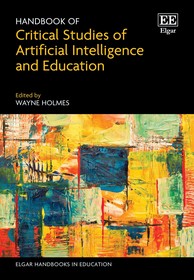
  • Handbook of Critical Studies of Artificial Intelligence and Education

    Handbook of Critical Studies of Artificial Intelligence and Education by Holmes, Wayne;

      • 10% KEDVEZMÉNY?

      • A kedvezmény csak az 'Értesítés a kedvenc témákról' hírlevelünk címzettjeinek rendeléseire érvényes.
      • Kiadói listaár GBP 250.00
      • Az ár azért becsült, mert a rendelés pillanatában nem lehet pontosan tudni, hogy a beérkezéskor milyen lesz a forint árfolyama az adott termék eredeti devizájához képest. Ha a forint romlana, kissé többet, ha javulna, kissé kevesebbet kell majd fizetnie.

        119 437 Ft (113 750 Ft + 5% áfa)
      • Kedvezmény(ek) 10% (cc. 11 944 Ft off)
      • Kedvezményes ár 107 494 Ft (102 375 Ft + 5% áfa)

    119 437 Ft

    db

    Beszerezhetőség

    Még nem jelent meg, de rendelhető. A megjelenéstől számított néhány héten belül megérkezik.

    Why don't you give exact delivery time?

    A beszerzés időigényét az eddigi tapasztalatokra alapozva adjuk meg. Azért becsült, mert a terméket külföldről hozzuk be, így a kiadó kiszolgálásának pillanatnyi gyorsaságától is függ. A megadottnál gyorsabb és lassabb szállítás is elképzelhető, de mindent megteszünk, hogy Ön a lehető leghamarabb jusson hozzá a termékhez.

    A termék adatai:

    • Kiadó Edward Elgar Publishing
    • Megjelenés dátuma 2026. május 21.

    • ISBN 9781035335862
    • Kötéstípus Keménykötés
    • Terjedelem548 oldal
    • Méret 244x169 mm
    • Súly 666 g
    • Nyelv angol
    • 700

    Kategóriák

    Hosszú leírás:

    This timely Handbook explores, from a critical studies perspective, the ethical, sociocultural, and political implications of Artificial Intelligence for education. Questioning techno-optimistic narratives surrounding AI, leading international scholars from a range of disciplines address the challenges that AI technologies pose to educators, administrators and policymakers.


    The Handbook initiates a necessary conversation regarding the implications of AI for human rights, social justice and equity in education. Chapters offer unique, interdisciplinary perspectives, challenging common assumptions and dominant narratives and providing frameworks for understanding AI’s influence on teaching, learning and governance. Drawing on in-depth reviews and empirical data, the Handbook advocates for critical engagement with the connections between AI and education and for decisive policy and regulation to control its growing impact on educational environments and beyond.


    The Handbook is a vital resource for graduate students and academics working in education, educational technologies, and AI in education, particularly those open to exploring critical approaches to the field. It is also an essential read for educators and higher education administrators and professionals grappling with the impact of AI on their institutions, as well as policymakers developing AI policy and regulations for education.


    This timely Handbook explores, from a critical studies perspective, the ethical, sociocultural, and political implications of Artificial Intelligence for education. Questioning techno-optimistic narratives surrounding AI, leading international scholars from a range of disciplines address the challenges that AI technologies pose to educators, administrators and policymakers.

    Több

    Tartalomjegyzék:

    Contents
    Foreword by Audrey Watters xvi
    What do you mean by critical AI? by Ilkka Tuomi xix
    Introduction to the Handbook of Critical Studies of Artificial Intelligence and
    Education 1
    Wayne Holmes
    PART I CRITICAL PERSPECTIVES ON AI AND EDUCATION
    1 Teaching in the age of its technical reproducibility: a critical perspective
    on sociotechnical transformations of education 13
    Valeria Cesaroni
    2 Neither the helm nor the wheel: charting the landscape of agency in highly
    automated education 30
    Ana Mouta and Emanuele Bardone
    3 The new spirit of education and the techno-politics of AI 50
    Ron Salaj
    4 Whose goals? Challenging the role of AI in education and the need for
    student voices 70
    Velislava Hillman and Sam Illingworth
    5 An Islamically inspired critical pedagogy in the AI era: a multiplex
    framework for fostering wisdom 87
    Junaid Qadir and Recep Senturk
    6 The democratic risks of AI in education: an epistemic perspective 101
    Tiina Räisä, Leonardo Espinosa-Leal and Matteo Stocchetti
    PART II EDUCATIONAL FRAMEWORKS AND AI LITERACY
    7 Sociocultural reimagining of AI Literacy for educators 115
    Karen Moran Jackson and Rosemary Papa
    8 Pedagogy of AIED 130
    Patricia Gibson
    9 Modelling critical AI literacies from a posthumanist perspective: a
    cognitive assemblage for Human–Technology–World relations 145
    Marcelo El Khouri Buzato and Priscila Gonsales
    10 Between hype and fear: AI Literacy for the development of critical
    educational imaginaries 161
    Àlex Valverde-Valencia
    11 AI and assessment in education: imagining practices in utopian terms 177
    Luis Medina-Gual and Rafael Garcia Campos
    12 Towards a taxonomy of AI learning 198
    Jeremy Knox and David Lundie
    PART III SOCIOCULTURAL AND ETHICAL IMPLICATIONS OF AI IN
    EDUCATION
    13 Coded crisis and situated algorithms: a decolonial intersectional feminist
    perspective on the ethics of AI in education 213
    Xinman Liu
    14 Discourse before doctrine: the category error at the heart of AI ethics
    education 233
    Lucas J. Wiese and Daniel S. Schiff
    15 A vernacularised taxonomy of harms for AI in education 247
    Wm. Matthew Kennedy and Daniel Vargas Campos
    16 Critical data and Artificial Intelligence literacies in academic practice 265
    Javiera Atenas, Federica Picasso, Chrissi Nerantzi, Leo Havemann,
    Anna Serbati, Daniele Agostini and Nicholas Caldwell
    17 Artificial Intelligence in education from the perspective of information
    ethics: the case of Plan Ceibal in Uruguay 284
    Maximiliano Rodríguez-Fleitas and Sofia Ache
    18 Posthuman and postgender education: embodying AI subjectivities 295
    Manuel López-Pereyra and Diego de Santiago Delfín
    PART IV PRACTICAL APPLICATIONS AND CASE STUDIES OF AI IN
    EDUCATION
    19 Tales of temptation: staff and student reflections on AI and dishonesty in
    the neoliberal academy 310
    Hakan Ergül and Nicole Brown
    20 Ludic perspectives on AI 326
    Diane Carr and Bruno de Paula
    21 Authentic learning in a GenAI writing classroom? The reality and its
    paradox 335
    Bernice Yeo
    22 Learning, agency, and Generative AI: a grassroots perspective 350
    Ignas Kalpokas and Julija Kalpokienė
    23 Imaginaries of responsible Generative AI in secondary education 364
    Jen Ross, Esther Priyadharshini, Harry Dyer, Ayça Atabey, Colton
    Botta, Cara Wilson and Judy Robertson
    24 AI in the classroom: using problem-based learning to enhance reflexivity
    and build critical thinking skills 384
    Judith E. Rosenbaum and Sheridan Kelley Adams
    PART V POLICY AND GOVERNANCE OF AI IN EDUCATION
    25 After AI: a research agenda for investigating policy and the future of
    schooling 403
    Kalervo N. Gulson
    26 Groundhog AI: power and pedagogy in the face of discourses of disruption
    in university policies and position statements 416
    Louise Drumm
    27 AI and the future of academic labour organising 431
    Robert Ovetz and Lindsay Weinberg
    28 EdTech policies in South Korea between 2007 and 2023: teachers,
    students, and machines 446
    Kyungmee Lee
    29 Artificial Intelligence and data colonialism in education: Implications for
    education governance in the Global South 468
    Mauro Jarquín-Ramírez and Enrique-Javier Díez-Gutiérrez
    30 Addressing inequalities in the uses of Artificial Intelligence in Higher
    Education in Latin America: the AI controversy, a comparison of Ecuador
    and Colombia 483
    María Belén Albornoz, Cheryl Martens and Ángel Gutiérrez

    Több
    0