

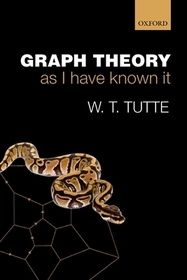
Graph Theory As I Have Known It
Sorozatcím: Oxford Lecture Series in Mathematics and Its Applications; 11;
-
10% KEDVEZMÉNY?
- A kedvezmény csak az 'Értesítés a kedvenc témákról' hírlevelünk címzettjeinek rendeléseire érvényes.
- Kiadói listaár GBP 45.49
-
21 732 Ft (20 697 Ft + 5% áfa)
Az ár azért becsült, mert a rendelés pillanatában nem lehet pontosan tudni, hogy a beérkezéskor milyen lesz a forint árfolyama az adott termék eredeti devizájához képest. Ha a forint romlana, kissé többet, ha javulna, kissé kevesebbet kell majd fizetnie.
- Kedvezmény(ek) 10% (cc. 2 173 Ft off)
- Kedvezményes ár 19 559 Ft (18 627 Ft + 5% áfa)
Iratkozzon fel most és részesüljön kedvezőbb árainkból!
Feliratkozom
21 732 Ft

Beszerezhetőség
Megrendelésre a kiadó utánnyomja a könyvet. Rendelhető, de a szokásosnál kicsit lassabban érkezik meg.
Why don't you give exact delivery time?
A beszerzés időigényét az eddigi tapasztalatokra alapozva adjuk meg. Azért becsült, mert a terméket külföldről hozzuk be, így a kiadó kiszolgálásának pillanatnyi gyorsaságától is függ. A megadottnál gyorsabb és lassabb szállítás is elképzelhető, de mindent megteszünk, hogy Ön a lehető leghamarabb jusson hozzá a termékhez.
A termék adatai:
- Kiadó OUP Oxford
- Megjelenés dátuma 2012. május 24.
- ISBN 9780199660551
- Kötéstípus Puhakötés
- Terjedelem164 oldal
- Méret 233x155x9 mm
- Súly 270 g
- Nyelv angol
- Illusztrációk 66 b/w line drawings 0
Kategóriák
Rövid leírás:
A unique introduction to graph theory, written by one of the founding fathers. Professor William Tutte, codebreaker and mathematician, details his experiences in the area and provides a fascinating insight into the processes leading to his proofs.
TöbbHosszú leírás:
Graph Theory as I Have Known It provides a unique introduction to graph theory by one of the founding fathers, and will appeal to anyone interested in the subject. It is not intended as a comprehensive treatise, but rather as an account of those parts of the theory that have been of special interest to the author. Professor Tutte details his experience in the area, and provides a fascinating insight into how he was led to his theorems and the proofs he used. As well as being of historical interest it provides a useful starting point for research, with references to further suggested books as well as the original papers.
The book starts by detailing the first problems worked on by Professor Tutte and his colleagues during his days as an undergraduate member of the Trinity Mathematical Society in Cambridge. It covers subjects such as combinatorial problems in chess, the algebraicization of graph theory, reconstruction of graphs, and the chromatic eigenvalues. In each case fascinating historical and biographical information about the author's research is provided.
William Tutte (1917-2002) studied at Cambridge where his fascination for mathematical puzzles brought him into contact with like-minded undergraduates, together becoming known as the 'Trinity four', the founders of modern graph theory. His notable problem-solving skills meant he was brought to Bletchley Park during World War Two. Key in the enemy codebreaking efforts, he cracked the Lorenz cipher for which the Colossus machine was built, making his contribution comparable to Alan Turing's codebreaking for Enigma. Following his incredible war effort Tutte returned to academia and became a fellow of the Royal Society in Britain and Canada, finishing his career as Distinguished Professor Emeritus at the University of Waterloo, Ontario.
Review from previous edition [T]he present book . . . is not a comprehensive treatise on graph theory but is restricted to those parts of the subject which Tutte himself researched, telling how he was led to his theorems and their proofs. . . For those of us who find much research-level mathematical literature heavy going, it is good to have this readable account of how some of the ideas developed.
Tartalomjegyzék:
Squaring the square
Knights errant
Graphs within graphs
Unsymmetrical electricity
Algebra in graph theory
Symmetry in graphs
Graphs on spheres
The Cats of Cheshire
Reconstruction
Planar enumeration
The chromatic eigenvalues
In conclusion
Bibliography
Index

