

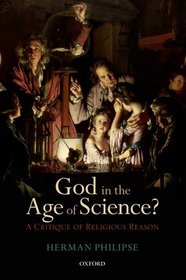
God in the Age of Science?
A Critique of Religious Reason
-
10% KEDVEZMÉNY?
- A kedvezmény csak az 'Értesítés a kedvenc témákról' hírlevelünk címzettjeinek rendeléseire érvényes.
- Kiadói listaár GBP 22.49
-
10 744 Ft (10 232 Ft + 5% áfa)
Az ár azért becsült, mert a rendelés pillanatában nem lehet pontosan tudni, hogy a beérkezéskor milyen lesz a forint árfolyama az adott termék eredeti devizájához képest. Ha a forint romlana, kissé többet, ha javulna, kissé kevesebbet kell majd fizetnie.
- Kedvezmény(ek) 10% (cc. 1 074 Ft off)
- Kedvezményes ár 9 669 Ft (9 209 Ft + 5% áfa)
Iratkozzon fel most és részesüljön kedvezőbb árainkból!
Feliratkozom
10 744 Ft

Beszerezhetőség
Megrendelésre a kiadó utánnyomja a könyvet. Rendelhető, de a szokásosnál kicsit lassabban érkezik meg.
Why don't you give exact delivery time?
A beszerzés időigényét az eddigi tapasztalatokra alapozva adjuk meg. Azért becsült, mert a terméket külföldről hozzuk be, így a kiadó kiszolgálásának pillanatnyi gyorsaságától is függ. A megadottnál gyorsabb és lassabb szállítás is elképzelhető, de mindent megteszünk, hogy Ön a lehető leghamarabb jusson hozzá a termékhez.
A termék adatai:
- Kiadó OUP Oxford
- Megjelenés dátuma 2014. február 13.
- ISBN 9780198701521
- Kötéstípus Puhakötés
- Terjedelem392 oldal
- Méret 235x157x20 mm
- Súly 558 g
- Nyelv angol 0
Kategóriák
Rövid leírás:
Herman Philipse puts forward a powerful new critique of belief in God. He examines the strategies that have been used for the philosophical defence of religious belief, and by careful reasoning casts doubt on the legitimacy of relying on faith instead of evidence, and on probabilistic arguments for the existence of God.
TöbbHosszú leírás:
God in the Age of Science? is a critical examination of strategies for the philosophical defence of religious belief. The main options may be presented as the end nodes of a decision tree for religious believers. The faithful can interpret a creedal statement (e.g. 'God exists') either as a truth claim, or otherwise. If it is a truth claim, they can either be warranted to endorse it without evidence, or not. Finally, if evidence is needed, should its evidential support be assessed by the same logical criteria that we use in evaluating evidence in science, or not? Each of these options has been defended by prominent analytic philosophers of religion.
In part I Herman Philipse assesses these options and argues that the most promising for believers who want to be justified in accepting their creed in our scientific age is the Bayesian cumulative case strategy developed by Richard Swinburne. Parts II and III are devoted to an in-depth analysis of this case for theism. Using a 'strategy of subsidiary arguments', Philipse concludes (1) that theism cannot be stated meaningfully; (2) that if theism were meaningful, it would have no predictive power concerning existing evidence, so that Bayesian arguments cannot get started; and (3) that if the Bayesian cumulative case strategy did work, one should conclude that atheism is more probable than theism. Philipse provides a careful, rigorous, and original critique of theism in the world today.
a rigorous but fair critique of the central problems of natural theology that forces readers to take atheism seriously.
Tartalomjegyzék:
Preface
Part I. Natural Theology
The Priority of Natural Theology
The Rise, Fall, and Resurrection of Natural Theology
The Reformed Objection to Natural Theology
Refutation of the Reformed Objection
The Rationality of Natural Theology
A Grand Strategy
Part II. Theism as a Theory
Analogy, Metaphor, and Coherence
God's Necessity
The Predictive Power of Theism
The Immunization of Theism
Part III. The Probability of Theism
Ultimate Explanation and Prior Probability
Cosmological Arguments
Arguments from Order to Design
Other Inductive Arguments
Religious Experience and the Burden of Proof
Conclusion
References
Index

