

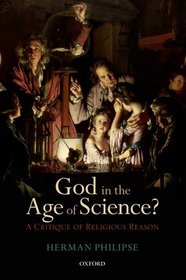
God in the Age of Science?
A Critique of Religious Reason
- Publisher's listprice GBP 22.49
-
10 744 Ft (10 232 Ft + 5% VAT)
The price is estimated because at the time of ordering we do not know what conversion rates will apply to HUF / product currency when the book arrives. In case HUF is weaker, the price increases slightly, in case HUF is stronger, the price goes lower slightly.
- Discount 10% (cc. 1 074 Ft off)
- Discounted price 9 669 Ft (9 209 Ft + 5% VAT)
Subcribe now and take benefit of a favourable price.
Subscribe
10 744 Ft

Availability
printed on demand
Why don't you give exact delivery time?
Delivery time is estimated on our previous experiences. We give estimations only, because we order from outside Hungary, and the delivery time mainly depends on how quickly the publisher supplies the book. Faster or slower deliveries both happen, but we do our best to supply as quickly as possible.
Product details:
- Publisher OUP Oxford
- Date of Publication 13 February 2014
- ISBN 9780198701521
- Binding Paperback
- No. of pages392 pages
- Size 235x157x20 mm
- Weight 558 g
- Language English 0
Categories
Short description:
Herman Philipse puts forward a powerful new critique of belief in God. He examines the strategies that have been used for the philosophical defence of religious belief, and by careful reasoning casts doubt on the legitimacy of relying on faith instead of evidence, and on probabilistic arguments for the existence of God.
MoreLong description:
God in the Age of Science? is a critical examination of strategies for the philosophical defence of religious belief. The main options may be presented as the end nodes of a decision tree for religious believers. The faithful can interpret a creedal statement (e.g. 'God exists') either as a truth claim, or otherwise. If it is a truth claim, they can either be warranted to endorse it without evidence, or not. Finally, if evidence is needed, should its evidential support be assessed by the same logical criteria that we use in evaluating evidence in science, or not? Each of these options has been defended by prominent analytic philosophers of religion.
In part I Herman Philipse assesses these options and argues that the most promising for believers who want to be justified in accepting their creed in our scientific age is the Bayesian cumulative case strategy developed by Richard Swinburne. Parts II and III are devoted to an in-depth analysis of this case for theism. Using a 'strategy of subsidiary arguments', Philipse concludes (1) that theism cannot be stated meaningfully; (2) that if theism were meaningful, it would have no predictive power concerning existing evidence, so that Bayesian arguments cannot get started; and (3) that if the Bayesian cumulative case strategy did work, one should conclude that atheism is more probable than theism. Philipse provides a careful, rigorous, and original critique of theism in the world today.
a rigorous but fair critique of the central problems of natural theology that forces readers to take atheism seriously.
Table of Contents:
Preface
Part I. Natural Theology
The Priority of Natural Theology
The Rise, Fall, and Resurrection of Natural Theology
The Reformed Objection to Natural Theology
Refutation of the Reformed Objection
The Rationality of Natural Theology
A Grand Strategy
Part II. Theism as a Theory
Analogy, Metaphor, and Coherence
God's Necessity
The Predictive Power of Theism
The Immunization of Theism
Part III. The Probability of Theism
Ultimate Explanation and Prior Probability
Cosmological Arguments
Arguments from Order to Design
Other Inductive Arguments
Religious Experience and the Burden of Proof
Conclusion
References
Index

