

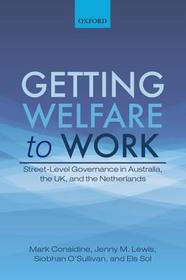
Getting Welfare to Work
Street-Level Governance in Australia, the UK, and the Netherlands
-
10% KEDVEZMÉNY?
- A kedvezmény csak az 'Értesítés a kedvenc témákról' hírlevelünk címzettjeinek rendeléseire érvényes.
- Kiadói listaár GBP 115.00
-
51 922 Ft (49 450 Ft + 5% áfa)
Az ár azért becsült, mert a rendelés pillanatában nem lehet pontosan tudni, hogy a beérkezéskor milyen lesz a forint árfolyama az adott termék eredeti devizájához képest. Ha a forint romlana, kissé többet, ha javulna, kissé kevesebbet kell majd fizetnie.
- Kedvezmény(ek) 10% (cc. 5 192 Ft off)
- Kedvezményes ár 46 730 Ft (44 505 Ft + 5% áfa)
Iratkozzon fel most és részesüljön kedvezőbb árainkból!
Feliratkozom
51 922 Ft

Beszerezhetőség
Megrendelésre a kiadó utánnyomja a könyvet. Rendelhető, de a szokásosnál kicsit lassabban érkezik meg.
Why don't you give exact delivery time?
A beszerzés időigényét az eddigi tapasztalatokra alapozva adjuk meg. Azért becsült, mert a terméket külföldről hozzuk be, így a kiadó kiszolgálásának pillanatnyi gyorsaságától is függ. A megadottnál gyorsabb és lassabb szállítás is elképzelhető, de mindent megteszünk, hogy Ön a lehető leghamarabb jusson hozzá a termékhez.
A termék adatai:
- Kiadó OUP Oxford
- Megjelenés dátuma 2015. szeptember 24.
- ISBN 9780198743705
- Kötéstípus Keménykötés
- Terjedelem216 oldal
- Méret 239x172x19 mm
- Súly 506 g
- Nyelv angol 0
Kategóriák
Rövid leírás:
Getting Welfare to Work traces the development of the Australia, UK, and Dutch employment services systems.
TöbbHosszú leírás:
Getting Welfare to Work traces the radical reform of the Australian, UK, and Dutch public employment services systems. Starting with major changes from 1998, this book examines how each national system has moved from traditional public services towards more privately provided and market-based methods.
Each of these three countries developed innovative forms of contracting-out and complex incentive regimes to motivate welfare clients and to control the agencies charged with helping them. The Australian system pioneered the use of large, national contracts for services to all unemployed jobseekers. By the end of our study period this system was entirely outsourced to private agencies. Meanwhile the UK elected a form of contestability under Blair and Cameron, culminating in a new public-private financing model known as the 'Work Programme'. The Dutch had evolved their far more complex system from a traditional public service approach to one using a variety of specific contracts for private agencies. These innovations have changed welfare delivery and created both opportunities and new constraints for policy makers.
Getting Welfare to Work tells the story of these bold policy reforms from the perspective of street-level bureaucrats. Interviews and surveys in each country over a fifteen year period are used to critically appraise this central pillar of the welfare state. The original data analysed in Getting Welfare to Work provides a unique comparative perspective on three intriguing systems. It points to new ways of thinking about modes of governance, system design, regulation of public services, and so-called activation of welfare clients. It also sheds light on the predicament of third sector organisations that contract to governments through competitive tenders with precise performance monitoring, raising questions of 'mission drift'.
Tartalomjegyzék:
Reforming Welfare Systems
Australia's Competitive Contract Model
Driving Change at the Australian Frontline
The United Kingdom's Dual System
When Less is More - Transforming the UK Frontline
The Netherlands' Hybrid Market
Activation and the Dutch Frontline
Governance Modes
Networking Types
Welfare Markets and the Politics of Activation

