

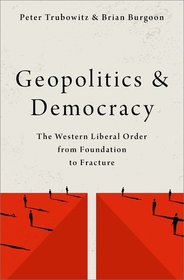
Geopolitics and Democracy
The Western Liberal Order from Foundation to Fracture
-
10% KEDVEZMÉNY?
- A kedvezmény csak az 'Értesítés a kedvenc témákról' hírlevelünk címzettjeinek rendeléseire érvényes.
- Kiadói listaár GBP 68.00
-
30 702 Ft (29 240 Ft + 5% áfa)
Az ár azért becsült, mert a rendelés pillanatában nem lehet pontosan tudni, hogy a beérkezéskor milyen lesz a forint árfolyama az adott termék eredeti devizájához képest. Ha a forint romlana, kissé többet, ha javulna, kissé kevesebbet kell majd fizetnie.
- Kedvezmény(ek) 10% (cc. 3 070 Ft off)
- Kedvezményes ár 27 632 Ft (26 316 Ft + 5% áfa)
Iratkozzon fel most és részesüljön kedvezőbb árainkból!
Feliratkozom
30 702 Ft

Beszerezhetőség
Megrendelésre a kiadó utánnyomja a könyvet. Rendelhető, de a szokásosnál kicsit lassabban érkezik meg.
Why don't you give exact delivery time?
A beszerzés időigényét az eddigi tapasztalatokra alapozva adjuk meg. Azért becsült, mert a terméket külföldről hozzuk be, így a kiadó kiszolgálásának pillanatnyi gyorsaságától is függ. A megadottnál gyorsabb és lassabb szállítás is elképzelhető, de mindent megteszünk, hogy Ön a lehető leghamarabb jusson hozzá a termékhez.
A termék adatai:
- Kiadó OUP USA
- Megjelenés dátuma 2023. március 24.
- ISBN 9780197535400
- Kötéstípus Keménykötés
- Terjedelem264 oldal
- Méret 156x235x18 mm
- Súly 463 g
- Nyelv angol 290
Kategóriák
Rövid leírás:
In Geopolitics and Democracy, Peter Trubowitz and Brian Burgoon provide a powerful new explanation of why the Western liberal international order--which dominated for a half century after World War II--has buckled under the pressures of anti-globalist political forces in recent times. They trace the anti-globalist backlash to foreign policy decisions made by Western leaders in the decade after the Cold War's end. These decisions sought to globalize markets and pool national sovereignty at the supranational level while undercutting social protections at home--a combination of policies that succeeded in expanding the Western liberal order, but at the cost of mounting public discontent and political fragmentation.
TöbbHosszú leírás:
A large and widening gap has opened between Western democracies' international ambitions and their domestic political capacity to support them. On issues ranging from immigration and international trade to national security, new political parties on the left and the right are rejecting the core foreign policy principles that Western governments have championed for over half a century. Much of the debate over the weakening of the Western liberal order has focused on recent changes: Donald Trump's presidency, Britain's vote to leave the European Union, and the surge of nationalist sentiment in France, Germany, and other Western democracies. In Geopolitics and Democracy, Peter Trubowitz and Brian Burgoon provide a powerful new explanation for the rise of anti-globalism in the West.
Combining a novel theoretical framework and empirical strategy, Trubowitz and Burgoon show that support for globalism has been receding for 30 years in Western parties and legislatures. They trace the anti-globalist backlash to foreign policy decisions that mainstream parties and party elites made after the end of the Cold War. These decisions sought to globalize markets and pool sovereignty at the supranational level while applying neoliberal reforms to social protections and guarantees at home--a combination of policies that succeeded in expanding the Western liberal order, but at the cost of mounting public discontent and political fragmentation.
At a time when problems of great power rivalry, spheres of influence, and reactionary nationalism have returned, Geopolitics and Democracy reveals how domestic support for international engagement during the long East-West geopolitical contest was contingent upon social protections within Western democracies. In the absence of a renewed commitment to those social purposes, Western democracies will struggle to find a collective grand strategy that their domestic publics will support.
Timely and compelling, Geopolitics and Democracy argues that since the end of the Cold War, government leaders in the West broke the social contract underpinning the liberal international order they built. By focusing their efforts on market globalization and the pooling sovereignty at the international level, while reducing social protections at home, Western government leaders overstretched public support for their actions, paving the way for growing anti-globalization sentiment. The book is a model for how to bridge insights from international relations and domestic politics, and does an exceptional job of marshalling a wealth of available evidence to make nuanced arguments about the state and future of the Western-led liberal order. I strongly encourage everyone to read it.
Tartalomjegyzék:
List of Figures
Preface and Acknowledgments
Chapter 1: The Solvency Gap
Chapter 2: A Widening Gyre
Chapter 3: Roots of Insolvency
Chapter 4: Reaping the Whirlwind
Chapter 5: Bridging the Gap
Appendices
References
Index

