

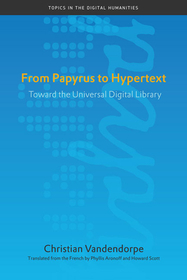
From Papyrus to Hypertext
Toward the Universal Digital Library
Sorozatcím: Topics in the Digital Humanities; 20;
-
20% KEDVEZMÉNY?
- A kedvezmény csak az 'Értesítés a kedvenc témákról' hírlevelünk címzettjeinek rendeléseire érvényes.
- Kiadói listaár GBP 20.99
-
9 476 Ft (9 025 Ft + 5% áfa)
Az ár azért becsült, mert a rendelés pillanatában nem lehet pontosan tudni, hogy a beérkezéskor milyen lesz a forint árfolyama az adott termék eredeti devizájához képest. Ha a forint romlana, kissé többet, ha javulna, kissé kevesebbet kell majd fizetnie.
- Kedvezmény(ek) 20% (cc. 1 895 Ft off)
- Kedvezményes ár 7 581 Ft (7 220 Ft + 5% áfa)
- A kedvezmény érvényes eddig: 2026. június 30.
Iratkozzon fel most és részesüljön kedvezőbb árainkból!
Feliratkozom
9 476 Ft

Beszerezhetőség
Becsült beszerzési idő: A Prosperónál jelenleg nincsen raktáron, de a kiadónál igen. Beszerzés kb. 3-5 hét..
A Prosperónál jelenleg nincsen raktáron.
Why don't you give exact delivery time?
A beszerzés időigényét az eddigi tapasztalatokra alapozva adjuk meg. Azért becsült, mert a terméket külföldről hozzuk be, így a kiadó kiszolgálásának pillanatnyi gyorsaságától is függ. A megadottnál gyorsabb és lassabb szállítás is elképzelhető, de mindent megteszünk, hogy Ön a lehető leghamarabb jusson hozzá a termékhez.
A termék adatai:
- Kiadás sorszáma 1st Edition
- Kiadó University of Illinois Press
- Megjelenés dátuma 2009. március 23.
- Kötetek száma Paperback
- ISBN 9780252076251
- Kötéstípus Puhakötés
- Terjedelem208 oldal
- Méret 229x152x15 mm
- Súly 286 g
- Nyelv angol
- Illusztrációk 10 black & white photographs; 1 line drawing; 1 table 0
Kategóriák
Hosszú leírás:
In this study, Christian Vandendorpe examines how digital media and the Internet have changed the process of reading and writing, significantly altering our approaches toward research and reading, our assumptions about audience and response, and our theories of memory, legibility, and context. Reflecting on the full history of the written word, Vandendorpe provides a clear overview of how materiality makes a difference in the creation and interpretation of texts.
Surveying the conventions of reading and writing that have appeared and disappeared in the Internet's wake, Vandendorpe considers various forms of organization, textual design, the use (and distrust) of illustrations, and styles of reference and annotation. He also examines the novel components of digital texts, including hyperlinks and emoticons, and looks at emergent, collaborative genres such as blogs and wikis, which blur the distinction between author and reader. Looking to the future, reading and writing will continue to evolve based on the current, contested trends of universal digitization and accessibility.
TöbbTartalomjegyzék:
Series Preface -- Ray Siemens and Susan Schreibman---- vii
1. Introduction---- 1
2. In the Beginning Was the Ear---- 5
3. Writing and the Fixation of Thought---- 8
4. The Power of the Written Sign---- 10
5. Writing and Orality---- 12
6. Standards of Readability---- 15
7. Linearity and Tabularity---- 22
8. Toward the Tabular Text---- 28
9. Meaning and Effect---- 40
10. Filters in Reading---- 49
11. Textuality: Form and Substance---- 52
12. Textual Connections---- 56
13. Instances of Utterance---- 59
14. From Interactivity to the Pseudo-Text---- 63
15. Varieties of Hypertext---- 70
16. Context and Hypertext---- 77
17. The Limitations of Lists---- 80
18. Aporias of Hyperfiction---- 82
19. Reading Images---- 87
20. The Writer and Images---- 94
21. The Rise of the Visual---- 97
22. The Period, the Pause, and the Emoticon---- 102
23. Op. cit.---- 105
24. The Reader: User or Consumer of Signs/---- 108
25. Intensive and Extensive Reading, or the Rights of the Reader---- 112
26. Metaphors for Reading---- 116
27. Representations of the Book---- 119
28. The Role of the Publisher---- 121
29. The CD-ROM and Nostalgia for teh Papyrus Scroll---- 123
30. Giving the Reader Control---- 125
31. Text and Interactivity---- 129
32. Managing Hyperlinks---- 131
33. I Click, Therefore I Read---- 133
34. The End of the Page?---- 136
35. On the Fragment---- 143
36. The Body of the Text---- 146
37. The Decline of the Novel---- 149
38. The Rise of the Blog---- 152
39. A Culture of Participation and Sharing---- 155
40. Toward the Universal Digital Library---- 159
Notes---- 167
References---- 177
Index---- 187

