

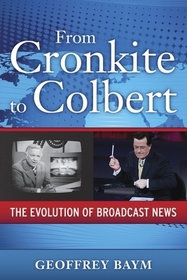
From Cronkite to Colbert
The Evolution of Broadcast News
-
10% KEDVEZMÉNY?
- A kedvezmény csak az 'Értesítés a kedvenc témákról' hírlevelünk címzettjeinek rendeléseire érvényes.
- Kiadói listaár GBP 57.99
-
26 182 Ft (24 935 Ft + 5% áfa)
Az ár azért becsült, mert a rendelés pillanatában nem lehet pontosan tudni, hogy a beérkezéskor milyen lesz a forint árfolyama az adott termék eredeti devizájához képest. Ha a forint romlana, kissé többet, ha javulna, kissé kevesebbet kell majd fizetnie.
- Kedvezmény(ek) 10% (cc. 2 618 Ft off)
- Kedvezményes ár 23 564 Ft (22 442 Ft + 5% áfa)
Iratkozzon fel most és részesüljön kedvezőbb árainkból!
Feliratkozom
26 182 Ft

Beszerezhetőség
Csak rendelésre kapható a kiadónál, kissé időigényes.
Why don't you give exact delivery time?
A beszerzés időigényét az eddigi tapasztalatokra alapozva adjuk meg. Azért becsült, mert a terméket külföldről hozzuk be, így a kiadó kiszolgálásának pillanatnyi gyorsaságától is függ. A megadottnál gyorsabb és lassabb szállítás is elképzelhető, de mindent megteszünk, hogy Ön a lehető leghamarabb jusson hozzá a termékhez.
A termék adatai:
- Kiadó OUP USA
- Megjelenés dátuma 2009. január 15.
- ISBN 9780199945849
- Kötéstípus Puhakötés
- Terjedelem oldal
- Méret 150x226x12 mm
- Súly 295 g
- Nyelv angol 0
Kategóriák
Hosszú leírás:
With increasing numbers of people tuning out the nightly news and media consumption falling, late-night comedians have become some of the most important newscasters in the country. From Cronkite to Colbert explains why. It examines a historical path that begins at the height of the network age with Walter Cronkite and Edward R. Murrow--when the evening news was considered the authoritative record of the day's events and forged our assumptions about what "the news" is, or should be. The book then winds its way through the breakdown of the paradigm of "real" news and into its reinvention in the unlikely form of such shows as The Daily Show and The Colbert Report. From Cronkite to Colbert makes the case that rather than "fake news," these shows should be understood as a new kind of journalism, one that has the potential to save the news and reinvigorate the conversation on democracy in today's society.
Winner of the 2010 NCA Award for Outstanding Book in Political Communication!
FEATURES
BL Uses a tripartite analytical framework for tracking the history of broadcast news from Cronkite to Colbert: high modern, postmodern, and neomodern
BL Puts recent media developments in context with intellectual and philosophical history including the writings of Wittgenstein, Bahktin, and Foucault
BL Explains the concept and action of "media convergence" clearly and critically
BL Looks at the "post network" age in news history and illustrates the problems and possibilities of the era of "digital instability" in which many media platforms--cable, satellite, internet, smart phones, and more--converge to create a new "life after TV"
BL Plays with now familiar media images--Ted Koppel's "big head;" Jon Stewart's repetitive clip technique; Stephen Colbert's "The Word" feature--in order to illustrate media postmodernity
Geoffrey Baym is the Jon Stewart of journalism studies (though not as funny): If you want to see the emerging shape of television journalism, watch The Daily Show. If you want to understand its roots, significance and potential for invigorating democracy, read From Cronkite to Colbert: The Evolution of Broadcast News.
Tartalomjegyzék:
Chapter One: Jon Stewart, Brian Williams, and Ted Koppel's Giant Head
Chapter Two: Representing Reality
Chapter Three: Publicizing Politics
Chapter Four: The Slow Death of CBS News
Chapter Five: News from Somewhere: Hybrid Blends in the Multichannel Era
Chapter Six: The Daily Show and The Reinvention of Political Journalism
Chapter Seven: "Nothing I'm Saying Means Anything": Stephen Colbert and the New Language of Public Affairs
Chapter Eight: Networked News: Stewart, Colbert, and the New Public Sphere
Chapter Nine: Real News, Fake News, and the Conversation of Democracy

