

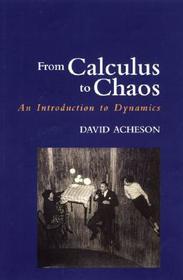
From Calculus to Chaos
An Introduction to Dynamics
-
10% KEDVEZMÉNY?
- A kedvezmény csak az 'Értesítés a kedvenc témákról' hírlevelünk címzettjeinek rendeléseire érvényes.
- Kiadói listaár GBP 51.00
-
24 365 Ft (23 205 Ft + 5% áfa)
Az ár azért becsült, mert a rendelés pillanatában nem lehet pontosan tudni, hogy a beérkezéskor milyen lesz a forint árfolyama az adott termék eredeti devizájához képest. Ha a forint romlana, kissé többet, ha javulna, kissé kevesebbet kell majd fizetnie.
- Kedvezmény(ek) 10% (cc. 2 437 Ft off)
- Kedvezményes ár 21 929 Ft (20 885 Ft + 5% áfa)
Iratkozzon fel most és részesüljön kedvezőbb árainkból!
Feliratkozom
24 365 Ft

Beszerezhetőség
Megrendelésre a kiadó utánnyomja a könyvet. Rendelhető, de a szokásosnál kicsit lassabban érkezik meg.
Why don't you give exact delivery time?
A beszerzés időigényét az eddigi tapasztalatokra alapozva adjuk meg. Azért becsült, mert a terméket külföldről hozzuk be, így a kiadó kiszolgálásának pillanatnyi gyorsaságától is függ. A megadottnál gyorsabb és lassabb szállítás is elképzelhető, de mindent megteszünk, hogy Ön a lehető leghamarabb jusson hozzá a termékhez.
A termék adatai:
- Kiadó OUP Oxford
- Megjelenés dátuma 1997. augusztus 28.
- ISBN 9780198500773
- Kötéstípus Puhakötés
- Terjedelem280 oldal
- Méret 233x156x17 mm
- Súly 432 g
- Nyelv angol
- Illusztrációk halftones, numerous line figures, tables 0
Kategóriák
Rövid leírás:
What is calculus really for? It helps tell us how - and why - things change with time. This is the purpose of dynamics, which lies at the heart of much of applied mathematics, science and engineering. From calculus to chaos takes a fresh approach to the subject as a whole. This is a highly readable and well-illustrated introduction to dynamics which aims to inspire the interest and enthusiasm of students embarking on a course of mathematical study. The writing is inviting, illuminating, and informative, not heavy or pedantic. Acheson explains why the mathematics which students learn is useful by exploring the most central and interesting ideas of calculus and dynamics from Newton to the present.
TöbbHosszú leírás:
What is calculus really for? This book is a highly readable introduction to applications of calculus, from Newton's time to the present day. These often involve questions of dynamics, i.e. of how - and why - things change with time. Problems of this kind lie at the heart of much of applied mathematics, physics, and engineering. From Calculus to Chaos takes a fresh approach to the subject as a whole, by moving from first steps to the frontiers, and by highlighting only the most important and interesting ideas, which can get lost amid a snowstorm of detail in conventional texts. The book is aimed at a wide readership, and assumes only some knowledge of elementary calculus. There are exercises (with full solutions) and simple but powerful computer programs which are suitable even for readers with no previous computing experience. David Acheson's book will inspire new students by providing a foretaste of more advanced mathematics and showing just how interesting the subject can be.
'The book is aimed at a wide readership, and assumes only some knowledge of elementary calculus. There are exercises (with full solutions) and a simple but powerful computer program.' L'Enseignement Mathematique
Tartalomjegyzék:
Introduction
A brief review of calculus
Ordinary differential equations
Computer solution methods
Elementary oscillations
Planetary motion
Waves and diffusion
The best of all possible worlds?
Fluid flow
Instability and catastrophe
Nonlinear oscillations and chaos
The not-so-simple pendulum
Further reading
Appendix A: Elementary programming in QBASIC
Appendix B: Ten programs for exploring dynamics
Solutions to the exercises
Index

