

-
20% KEDVEZMÉNY?
- A kedvezmény csak az 'Értesítés a kedvenc témákról' hírlevelünk címzettjeinek rendeléseire érvényes.
- Kiadói listaár GBP 74.00
-
33 411 Ft (31 820 Ft + 5% áfa)
Az ár azért becsült, mert a rendelés pillanatában nem lehet pontosan tudni, hogy a beérkezéskor milyen lesz a forint árfolyama az adott termék eredeti devizájához képest. Ha a forint romlana, kissé többet, ha javulna, kissé kevesebbet kell majd fizetnie.
- Kedvezmény(ek) 20% (cc. 6 682 Ft off)
- Kedvezményes ár 26 729 Ft (25 456 Ft + 5% áfa)
- A kedvezmény érvényes eddig: 2026. június 30.
Iratkozzon fel most és részesüljön kedvezőbb árainkból!
Feliratkozom
33 411 Ft

Beszerezhetőség
Becsült beszerzési idő: A Prosperónál jelenleg nincsen raktáron, de a kiadónál igen. Beszerzés kb. 3-5 hét..
A Prosperónál jelenleg nincsen raktáron.
Why don't you give exact delivery time?
A beszerzés időigényét az eddigi tapasztalatokra alapozva adjuk meg. Azért becsült, mert a terméket külföldről hozzuk be, így a kiadó kiszolgálásának pillanatnyi gyorsaságától is függ. A megadottnál gyorsabb és lassabb szállítás is elképzelhető, de mindent megteszünk, hogy Ön a lehető leghamarabb jusson hozzá a termékhez.
A termék adatai:
- Kiadó OUP USA
- Megjelenés dátuma 2022. február 2.
- ISBN 9780197600160
- Kötéstípus Keménykötés
- Terjedelem438 oldal
- Méret 244x170x38 mm
- Súly 726 g
- Nyelv angol
- Illusztrációk 31 figures 176
Kategóriák
Rövid leírás:
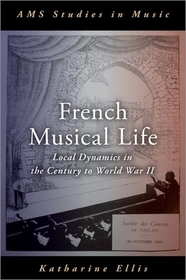
French Musical Life is a study of French musical centralization and its discontents during the period leading up to and beyond the "provincial awakening" of the Belle Époque.
TöbbHosszú leírás:
Explicitly or not, the historical musicology of post-Revolutionary France has focused on Paris as a proxy for the rest of the country. This distorting lens is the legacy of political and cultural struggle during the long nineteenth century, indicating a French Revolution unresolved both then and now. In light of the capital's power as the seat of a centralizing French state (which provincials found 'colonizing') and as a cosmopolitan musical crossroads of nineteenth-century Europe, the struggles inherent in creating sustainable musical cultures outside Paris, and in composing local and regionalist music, are ripe for analysis. Replacement of 'France' with Paris has encouraged normative history-writing articulated by the capital's opera and concert life. Regional practices have been ignored, disparaged or treated piecemeal.
This book is a study of French musical centralization and its discontents during the period leading up to and beyond the "provincial awakening" of the Belle Époque. The book explains how different kinds of artistic decentralization and regionalism were hard won (or not) across a politically turbulent century from the 1830s to World War II. In doing so it redraws the historical map of musical power relations in mainland France. Based on work in over 70 archives, chapters on conservatoires, concert life, stage music, folk music and composition reveal how tensions of State and locality played out differently depending on the structures and funding mechanisms in place, the musical priorities of different communities, and the presence or absence of galvanizing musicians. Progressively, the book shifts from musical contexts to musical content, exploring the pressure point of folk music and its translation into "local color" for officials who perpetually feared national division. Control over composition on the one hand, and the emotional intensity of folk-based musical experience on the other, emerges as a matter of consistent official praxis. In terms of "French music" and its compositional styles, what results is a surprising new historiography of French neoclassicism, bound into and growing out of a study of diversity and its limits in daily musical life.
All France is not Paris. Katharine Ellis trains her keen researcher's eye on concerts, opera, conservatories, and other aspects of music-making in Lyon and other French centers during the years from Berlioz to Les Six. Compendious, exquisitely precise, written with total clarity—and instantly indispensable.
Tartalomjegyzék:
Introduction
-Centralization and its discontents
-Decentralization, deconcentration, regionalism
-Politics, then and now
-A Study in four Parts
-Approaches
Part I Education
Introduction
Chapter 1: The National Conservatoire System
-Class and access: working-class men
-Class and status: young bourgeoises
-Power, hard and soft
-Directorial discretion: curricula
-The 1930s: towards reform
Chapter 2: Educational Independence
-Pedagogical Difference c.1900
-The Schola's ghostly presences I: Montpellier
-The Schola's ghostly presences II: Séverac's vision, Le Havre and Nancy
-Strasbourg
-Bordeaux
-Composition: the final frontier
Part II Concert Rites
Introduction
Chapter 3: Choral Voices
-Orphéons: uniformity and regional identity
-Cathedral maîtrises
-Mixed choirs: Poitou-Charentes and Strasbourg
-Belle Époque ambition: Bordes, Witkowski and Lyon
Chapter 4: Instrumental Music and Urban Gravitas
-Private, public, "populaire"
-The Symphony orchestra as musical hub
-Amateur to professional
-Provincial programming: orchestral, chamber and specialist ensembles
-Local vs. (inter)national
Part III Stage Musics
Introduction
Chapter 5: Opera Against the Odds
-The 1864 liberté des théâtres
-Municipal perspectives
-Industry perspectives
Chapter 6: Operatic Competition
-The Café-Concert
-Operetta
-Touring: individual and collective
-Technology
Chapter 7: Opera Inside and Out
-Wagner's "tour de France"
-Couleur locale in Paris and at home
-Open-air opera
Part IV Folk, Region, Nation
Introduction
Chapter 8: Folk Musics
-The French folk-music problem
-Politics of collection, transcription, and classification
-Soundscapes of popular Catholicism
-Folk music, the peasant, and the bourgeoisie
-Display, domestication, tourism
-Coda
Chapter 9: Composition
-A View from 1937
-Provincial career paths
-Rethinking the Schola's regionalism
-The Allure of the Russian Five
-Back to opera: regionalism and nation
-Mode, multi-regionalism, and patrimoine
Conclusions
-"Decentralization" through the lens of Lyon
-Musical localism
-Repositioning the rural
Bibliography
Index

