

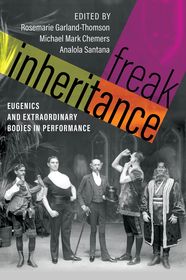
Freak Inheritance
Eugenics and Extraordinary Bodies in Performance
-
10% KEDVEZMÉNY?
- A kedvezmény csak az 'Értesítés a kedvenc témákról' hírlevelünk címzettjeinek rendeléseire érvényes.
- Kiadói listaár GBP 81.00
-
36 571 Ft (34 830 Ft + 5% áfa)
Az ár azért becsült, mert a rendelés pillanatában nem lehet pontosan tudni, hogy a beérkezéskor milyen lesz a forint árfolyama az adott termék eredeti devizájához képest. Ha a forint romlana, kissé többet, ha javulna, kissé kevesebbet kell majd fizetnie.
- Kedvezmény(ek) 10% (cc. 3 657 Ft off)
- Kedvezményes ár 32 914 Ft (31 347 Ft + 5% áfa)
Iratkozzon fel most és részesüljön kedvezőbb árainkból!
Feliratkozom
36 571 Ft

Beszerezhetőség
Megrendelésre a kiadó utánnyomja a könyvet. Rendelhető, de a szokásosnál kicsit lassabban érkezik meg.
Why don't you give exact delivery time?
A beszerzés időigényét az eddigi tapasztalatokra alapozva adjuk meg. Azért becsült, mert a terméket külföldről hozzuk be, így a kiadó kiszolgálásának pillanatnyi gyorsaságától is függ. A megadottnál gyorsabb és lassabb szállítás is elképzelhető, de mindent megteszünk, hogy Ön a lehető leghamarabb jusson hozzá a termékhez.
A termék adatai:
- Kiadó OUP USA
- Megjelenés dátuma 2024. június 23.
- ISBN 9780197691120
- Kötéstípus Keménykötés
- Terjedelem348 oldal
- Méret 235x156 mm
- Súly 621 g
- Nyelv angol
- Illusztrációk 47 b&w halftones 515
Kategóriák
Rövid leírás:
In Freak Inheritance, both leading authors and emerging voices use cutting-edge disability and cultural theories to expose the operations of eugenicist thought in historical and contemporary culture. It is the follow-up to the field-defining Freakery: Cultural Spectacles of the Extraordinary Body (1996).
TöbbHosszú leírás:
The long-awaited follow-up to Garland-Thomson's field-defining book Freakery, Freak Inheritance illuminates the convergence of the freak show era with the eugenics era, explicating the cultural work of the freak show as a compelling range of performances of cultural and social Others that emerge as eugenic targets from the late 19th century into the 20th century and beyond.
This book explores the wildly popular performances that told compelling stories about categories of people that scientific and social-scientific discourses increasingly described - and sometimes still describe - as biologically inferior. Although much work has emerged recently about the history of eugenics, this collection highlights the specific ways that modes of exaggerated commercial popular performances create a public conversation that mirrors pathological narratives of human difference that are now firmly established as the categories of normal and abnormal, healthy and diseased, beneficial and harmful. This connection between narratives of freakery and normalcy gesture towards a fuller understanding of how eugenic thinking has re-emerged strongly as a force in medical science and cultural thinking aimed at producing the supposed “best” and “most useful” kinds of people.
Tartalomjegyzék:
FOREWORD by Jeffrey Jerome Cohen
INTRODUCTION: “Step Right Up! A New Introduction to the Old Freak Show” by Rosemarie Garland Thomson, Michael Mark Chemers, and Analola Santana
I. STAGING
1. “Abject Bodies in Performance Art” by Josefina Alcazar. Translated by Analola Santana
2. “The Normativity of the Extraordinary: Musical Theatre on the Page and on the Stage” by Stacy Wolf & Ryan Donovan
3. “Performance, Pleasure, and Profit at the Victorian Freak Show” by Nadya Durbach
4. “Chick Webb's Extraordinary Body of Music” by Meisha Rosenberg
5. “The Enfreakment of the Premature Infant: incubator baby shows in the United States” by Susan Kattwinkel
II. HYBRIDITY
6. “The Tragic Journey of a Mexican Savage to the Civilized World” by Roger Bartra. Translated by Analola Santana
7. “Rest in Peace, Charles Byrne?: The Last Testament and Enduring Legacy of the 18th Century 'Irish Giant'” by David A. Gerber
8. “Chin Up: Befriending the Bearded Ladies” by Lilian Craton
9. “Spectacles of Prognosis: El Niño Fidencio in the 21st Century” by Susan Antebi
III. MONSTROSITY
10. “Monstrous Births and the Religious Imagination” by Devan Stahl
11. “Human or Alien: Tracing Enfreaked Subjects in the 20th and 21st Century Theatre of Disability” by Danielle Bainbridge
12. “The Mortification of Harvey Leach” by Michael Mark Chemers
IV. UNSETTLING
13. “Freakish Fecundity: Birth and Baby Reality Television as Eugenicist Discourse” by Katya Vrtis
14. “Alexandrine: A German Princess with Down Syndrome who Survived the Holocaust” by Robert Bogdan
15. “Dead Weight: Exhibiting Fatness Postmortem” by Joyce Huff
16. “Disornamentation: An Optic for Reading Depictions of Disabled, Asian Women” by Jenna Gerdsen
17. “Sex Mad: Gender and Disability in the Art of Eudora Welty and Reginald Marsh” Keri Watson
V. LEARNING
18. “The Pedagogical Utility of Early Freak Show Scholarship” by Cynthia Wu
19. “Teaching the Extraordinary Body: A Generation of Freaks and Monsters in the Classroom” by Leonard Cassuto

