

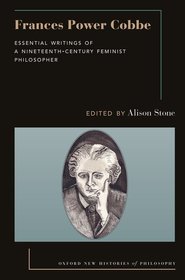
Frances Power Cobbe
Essential Writings of a Nineteenth-Century Feminist Philosopher
Sorozatcím: Oxford New Histories of Philosophy;
-
10% KEDVEZMÉNY?
- A kedvezmény csak az 'Értesítés a kedvenc témákról' hírlevelünk címzettjeinek rendeléseire érvényes.
- Kiadói listaár GBP 91.00
-
41 086 Ft (39 130 Ft + 5% áfa)
Az ár azért becsült, mert a rendelés pillanatában nem lehet pontosan tudni, hogy a beérkezéskor milyen lesz a forint árfolyama az adott termék eredeti devizájához képest. Ha a forint romlana, kissé többet, ha javulna, kissé kevesebbet kell majd fizetnie.
- Kedvezmény(ek) 10% (cc. 4 109 Ft off)
- Kedvezményes ár 36 978 Ft (35 217 Ft + 5% áfa)
Iratkozzon fel most és részesüljön kedvezőbb árainkból!
Feliratkozom
41 086 Ft

Beszerezhetőség
Megrendelésre a kiadó utánnyomja a könyvet. Rendelhető, de a szokásosnál kicsit lassabban érkezik meg.
Why don't you give exact delivery time?
A beszerzés időigényét az eddigi tapasztalatokra alapozva adjuk meg. Azért becsült, mert a terméket külföldről hozzuk be, így a kiadó kiszolgálásának pillanatnyi gyorsaságától is függ. A megadottnál gyorsabb és lassabb szállítás is elképzelhető, de mindent megteszünk, hogy Ön a lehető leghamarabb jusson hozzá a termékhez.
A termék adatai:
- Kiadó OUP USA
- Megjelenés dátuma 2022. július 4.
- ISBN 9780197628225
- Kötéstípus Keménykötés
- Terjedelem270 oldal
- Méret 241x159x20 mm
- Súly 513 g
- Nyelv angol 218
Kategóriák
Rövid leírás:
This book brings together essential writings by the unjustly neglected nineteenth-century philosopher Frances Power Cobbe (1822-1904). A prominent ethicist, feminist, champion of animal welfare, and critic of Darwinism and atheism, Cobbe was very well known and highly regarded in the Victorian era. Together, these writings demonstrate the range, systematicity and philosophical character of Cobbe's work and make her core ethical theory and its central applications and developments available for teaching and scholarship.
TöbbHosszú leírás:
This volume brings together essential writings by the unjustly neglected nineteenth-century philosopher Frances Power Cobbe (1822-1904). A prominent ethicist, feminist, champion of animal welfare, and critic of Darwinism and atheism, Cobbe was well known and highly regarded in the Victorian era. This collection of her work introduces contemporary readers to Cobbe and shows how her thought developed over time, beginning in 1855 with her Essay on Intuitive Morals, in which she set out her duty-based moral theory, arguing that morality and religion are indissolubly connected. This work provided the framework within which she addressed many theoretical and practical issues in her prolific publishing career. In the 1860s and early 1870s, she gave an account of human duties to animals; articulated a duty-based form of feminism; defended a unique type of dualism in the philosophy of mind; and argued against evolutionary ethics. Cobbe put her philosophical views into practice, campaigning for women's rights and for first the regulation and later the abolition of vivisection. In turn her political experiences led her to revise her ethical theory. From the 1870s onwards she increasingly emphasized the moral role of the emotions, especially sympathy, and she theorized a gradual historical progression in sympathy. Moving into the 1880s, Cobbe combatted secularism, agnosticism, and atheism, arguing that religion is necessary not only for morality but also for meaningful life and culture.
Shedding light on Cobbe's philosophical perspective and its applications, this volume demonstrates the range, systematicity and philosophical character of her work and makes her core ethical theory and its central applications and developments available for teaching and scholarship.
Tartalomjegyzék:
Series Foreword
Introduction (by the Editor)
Further Reading on Cobbe
Chapter 1: What Is The Moral Law (Chapter One of An Essay on Intuitive Morals, Volume One: Theory of Morals, 1855)
Chapter 2: The Rights of Man and the Claims of Brutes (1863)
Chapter 3: The Final Cause of Woman (1869)
Chapter 4: Unconscious Cerebration: A Psychological Study (1870)
Chapter 5: Darwinism in Morals (1871)
Chapter 6: Heteropathy, Aversion, Sympathy or The Evolution of the Social Sentiment (1874)
Chapter 7: A Faithless World (1884)
Bibliography

