

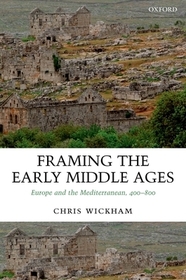
Framing the Early Middle Ages
Europe and the Mediterranean, 400-800
-
10% KEDVEZMÉNY?
- A kedvezmény csak az 'Értesítés a kedvenc témákról' hírlevelünk címzettjeinek rendeléseire érvényes.
- Kiadói listaár GBP 297.50
-
134 321 Ft (127 925 Ft + 5% áfa)
Az ár azért becsült, mert a rendelés pillanatában nem lehet pontosan tudni, hogy a beérkezéskor milyen lesz a forint árfolyama az adott termék eredeti devizájához képest. Ha a forint romlana, kissé többet, ha javulna, kissé kevesebbet kell majd fizetnie.
- Kedvezmény(ek) 10% (cc. 13 432 Ft off)
- Kedvezményes ár 120 889 Ft (115 133 Ft + 5% áfa)
Iratkozzon fel most és részesüljön kedvezőbb árainkból!
Feliratkozom
134 321 Ft

Beszerezhetőség
Megrendelésre a kiadó utánnyomja a könyvet. Rendelhető, de a szokásosnál kicsit lassabban érkezik meg.
Why don't you give exact delivery time?
A beszerzés időigényét az eddigi tapasztalatokra alapozva adjuk meg. Azért becsült, mert a terméket külföldről hozzuk be, így a kiadó kiszolgálásának pillanatnyi gyorsaságától is függ. A megadottnál gyorsabb és lassabb szállítás is elképzelhető, de mindent megteszünk, hogy Ön a lehető leghamarabb jusson hozzá a termékhez.
A termék adatai:
- Kiadó OUP Oxford
- Megjelenés dátuma 2005. szeptember 22.
- ISBN 9780199264490
- Kötéstípus Keménykötés
- Terjedelem1017 oldal
- Méret 242x163x59 mm
- Súly 1273 g
- Nyelv angol
- Illusztrációk 13 maps 0
Kategóriák
Rövid leírás:
In the most ambitious and ground-breaking survey of the early middle ages ever written, Chris Wickham moves away from the fragmentary tendency to view the history of the period as a collection of regional histories, roughly corresponding to the land-areas of modern nation states. Instead he provides a comparative history of the years 400-800 systematically analysing each of the regions of the early middle ages, from Denmark to Egypt. In doing so he creates a framework for early medieval social and economic history in Europe that is both innovative and authoritative.
TöbbHosszú leírás:
The Roman empire tends to be seen as a whole whereas the early middle ages tends to be seen as a collection of regional histories, roughly corresponding to the land-areas of modern nation states. As a result, early medieval history is much more fragmented, and there have been few convincing syntheses of socio-economic change in the post-Roman world since the 1930s. In recent decades, the rise of early medieval archaeology has also transformed our source-base, but this has not been adequately integrated into analyses of documentary history in almost any country.
In Framing the Early Middle Ages Chris Wickham aims at integrating documentary and archaeological evidence together, and also, above all, at creating a comparative history of the period 400-800, by means of systematic comparative analyses of each of the regions of the latest Roman and immediately post-Roman world, from Denmark to Egypt (only the Slav areas are left out). The book concentrates on classic socio-economic themes, state finance, the wealth and identity of the aristocracy, estate management, peasant society, rural settlement, cities, and exchange. These are only a partial picture of the period, but they are intended as a framing for other developments, without which those other developments cannot be properly understood.
Wickham argues that only a complex comparative analysis can act as the basis for a wider synthesis. Whilst earlier syntheses have taken the development of a single region as 'typical', with divergent developments presented as exceptions, this book takes all different developments as typical, and aims to construct a synthesis based on a better understanding of difference and the reasons for it. This is the most ambitious and original survey of the period ever written.
history doesn't get any better
Tartalomjegyzék:
Part I: States
Introduction
Geography and Politics
The Form of the State
Part II: Aristocratic Power-Structures
Aristocracies
Managing the Land
Political Breakdown and State-Building in the North
Part III: Peasantries
Peasants and Local Societies: Case Studies
Rural Settlement and Village Societies
Peasant Society and its Problems
Part IV: Networks
Cities
Systems of Exchange
Conclusion
Bibliography
Index

