

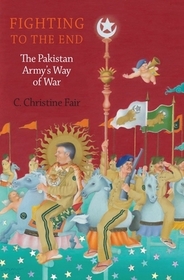
Fighting to the End
The Pakistan Army's Way of War
-
10% KEDVEZMÉNY?
- A kedvezmény csak az 'Értesítés a kedvenc témákról' hírlevelünk címzettjeinek rendeléseire érvényes.
- Kiadói listaár GBP 51.00
-
23 026 Ft (21 930 Ft + 5% áfa)
Az ár azért becsült, mert a rendelés pillanatában nem lehet pontosan tudni, hogy a beérkezéskor milyen lesz a forint árfolyama az adott termék eredeti devizájához képest. Ha a forint romlana, kissé többet, ha javulna, kissé kevesebbet kell majd fizetnie.
- Kedvezmény(ek) 10% (cc. 2 303 Ft off)
- Kedvezményes ár 20 724 Ft (19 737 Ft + 5% áfa)
Iratkozzon fel most és részesüljön kedvezőbb árainkból!
Feliratkozom
23 026 Ft

Beszerezhetőség
Megrendelésre a kiadó utánnyomja a könyvet. Rendelhető, de a szokásosnál kicsit lassabban érkezik meg.
Why don't you give exact delivery time?
A beszerzés időigényét az eddigi tapasztalatokra alapozva adjuk meg. Azért becsült, mert a terméket külföldről hozzuk be, így a kiadó kiszolgálásának pillanatnyi gyorsaságától is függ. A megadottnál gyorsabb és lassabb szállítás is elképzelhető, de mindent megteszünk, hogy Ön a lehető leghamarabb jusson hozzá a termékhez.
A termék adatai:
- Kiadó OUP USA
- Megjelenés dátuma 2014. június 19.
- ISBN 9780199892709
- Kötéstípus Keménykötés
- Terjedelem364 oldal
- Méret 236x155x22 mm
- Súly 544 g
- Nyelv angol 0
Kategóriák
Rövid leírás:
The Pakistan army is poised for perpetual conflict with India which it cannot win militarily or politically. What explains Pakistan's persistent revisionism despite increasing costs and decreasing likelihood of success? This book argues that an understanding of the army's strategic culture explains its willingness to fight to the end.
TöbbHosszú leírás:
Pakistan's army has dominated the state for most of its 66 years. It has locked the country in an enduring rivalry with India to revise the maps in Kashmir and to resist India's slow but inevitable rise. To prosecute these dangerous policies, the army employs non-state actors under the security of its ever-expanding nuclear umbrella. The Pakistan army started three wars with India over Kashmir in 1947, 1965, and 1999 and failed to win any of them. It has sustained a proxy war in Kashmir since 1989 using Islamist militants, some of whom have now turned their guns against the Pakistani state. The Pakistan army has supported non-Islamist insurgencies throughout India as well as a country-wide Islamist terror campaign that have brought the two countries to the brink of war on several occasions. Despite Pakistan's efforts to coerce India, it has only achieved modest successes. Even though India vivisected Pakistan in 1971, Pakistan continues to see itself as India's equal and demands the world do the same. The tools that the army prefers to use, non-state actors under a nuclear umbrella, has brought international opprobrium upon the country and the army. In recent years, erstwhile proxies have turned their gun on the Pakistani state itself and its peoples. Why does the army persist in pursuing these revisionist policies that have come to imperil the very viability of the state itself, from which the army feeds? This volume argues that the answer lies, at least partially, in the strategic culture of the army. From the army's distorted view of history, the army is victorious as long as can resist India's purported hegemony and the territorial status quo. To acquiesce is defeat. Because the army is unlikely to abandon these preferences, the world must prepare for an ever more dangerous future Pakistan.
she concentrates on the international dimensions of the policies pursued by the Pakistani army and the implications that this has forregional and international security.
Tartalomjegyzék:
Acknowledgments
Chapter 1. Introduction
The Argument: Explaining Pakistan's Persistent Revisionism In the Face of Repeated Defeats
Organization of this Volume
Chapter 2. Can Strategic Culture Explain the Pakistan Army's Persistent Revisionism?
Pakistan's Enduring and Expanding Revisionism
Explaining Persistent Revisionism
Strategic Culture Wars
Pakistan: An Army with a Country
Reproducing Culture: Recruitment in the Pakistan Army
Methods and Sources of this Study
Chapter 3. Born an Insecure State
Cracking the Raj
Imagining Pakistan
The Problem of the Princely States
Untangling the Punjab
Breaking Up the Indian Army
Historical Legacies: A Punjabi Army
Building a Modern Army
Table 2.1: Corps and Locations
Implications for the Pakistan Army's Strategic Culture
Chapter 4. The Army's Defense of Pakistan's 'Ideological Frontiers'
The Ideology of Pakistan
The Army's Embrace of the Ideology of Pakistan
The Army's Methods of Islamization
The Army's Instrumentalization of Islam
Implications
Chapter 5. Pakistan's Quest for Strategic Depth
British Management of the Frontier: The Great Game
Pakistan's Army Seeks Strategic Depth: Managing Pakistan's Frontier and Beyond
The Army Manages the Afghan Threat
The Rise and Fall of the Taliban
The Army's and the Internal Threat on the 'Frontier'
Implications: Is the Past Prologue for Afghanistan and the Frontier?
Chapter 6. India under the Pakistan Army's Gaze
Multiple Crises and Four Wars
India: Through the Eyes of the Pakistan Army
Conclusions and Implications
Chapter 7. Seeking Security through Alliances
Pursuing the Americans: An Alliance for Survival
The Pakistan Tilt
Chasing China: The All-Weather Friend
The Strains of War
Pakistan's Relations with the United States and China through the Eyes of the Army
Conclusions and Implications
Chapter 8. Seeking Security under a Nuclear Umbrella
Origins of Pakistan's Nuclear Program
Proliferation Under the Eye of the State
Nuclear Doctrine and Use
Risk Taking Under an Expanding Nuclear Umbrella
As Bad As it Gets?
Table 8.1 Cross Tabulations of Conflict Months by Nuclear Status
Table 8.2: Conflict Rate by Nuclear Period
Conclusions and Implications
Chapter 9. Jihad under the Nuclear Umbrella
Origins of Pakistan's Use of Non-state Actors
From Peoples' War to Low Intensity Conflict under a Nuclear Umbrella
Pakistan's Militant Assets
Pakistani Support for the Militants?
The Internal Jihad: A Case Study of Lashkar-e-Taiba
Conclusions and Implications
Chapter 10. Is the Past Prologue
Endogenous Game Changers
Democratic Transition?
Economic Shocks-For Better and for Worse
Civil and Un-Civil Society: Impetus for Change?
Change from Within the Army?
Table 10.5. Punjabis versus Baloch in Balochistan
Exogenous Sources of Change?
Conclusions: Prospects for Change from Within and Without?
Chapter 11. The Army's Strategic Culture and Implications for International Security
Managing Pakistan's Persistent Revisionism?
References
Appendices: Maps

