

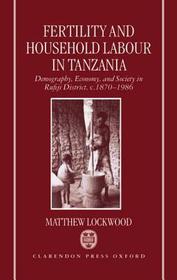
Fertility and Household Labour in Tanzania
Demography, Economy, and Society in Rufiji District, c.1870-1986
-
10% KEDVEZMÉNY?
- A kedvezmény csak az 'Értesítés a kedvenc témákról' hírlevelünk címzettjeinek rendeléseire érvényes.
- Kiadói listaár GBP 40.49
-
18 281 Ft (17 410 Ft + 5% áfa)
Az ár azért becsült, mert a rendelés pillanatában nem lehet pontosan tudni, hogy a beérkezéskor milyen lesz a forint árfolyama az adott termék eredeti devizájához képest. Ha a forint romlana, kissé többet, ha javulna, kissé kevesebbet kell majd fizetnie.
- Kedvezmény(ek) 10% (cc. 1 828 Ft off)
- Kedvezményes ár 16 452 Ft (15 669 Ft + 5% áfa)
Iratkozzon fel most és részesüljön kedvezőbb árainkból!
Feliratkozom
18 281 Ft

Beszerezhetőség
Megrendelésre a kiadó utánnyomja a könyvet. Rendelhető, de a szokásosnál kicsit lassabban érkezik meg.
Why don't you give exact delivery time?
A beszerzés időigényét az eddigi tapasztalatokra alapozva adjuk meg. Azért becsült, mert a terméket külföldről hozzuk be, így a kiadó kiszolgálásának pillanatnyi gyorsaságától is függ. A megadottnál gyorsabb és lassabb szállítás is elképzelhető, de mindent megteszünk, hogy Ön a lehető leghamarabb jusson hozzá a termékhez.
A termék adatai:
- Kiadó Clarendon Press
- Megjelenés dátuma 1998. március 12.
- ISBN 9780198287544
- Kötéstípus Keménykötés
- Terjedelem216 oldal
- Méret 243x163x18 mm
- Súly 511 g
- Nyelv angol
- Illusztrációk tables, maps 0
Kategóriák
Rövid leírás:
High fertility in Africa has not only fuelled rapid population growth, but has placed a huge burden of domestic work on African women. This book is a detailed study of the causes and consequences of fertility patterns on coastal Tanzania. Combining demography, history and sociology, it also offers a new methodological framework for the understanding of reproductive change.
TöbbHosszú leírás:
This book is an interdisciplinary study of the way in which human reproduction interweaves with the reproduction of society and economy in coastal Tanzania. Combining demography, history, and sociology, and with a breadth of theoretical discussion and empirical detail, it offers a new methodology for the study of African fertility and the role of household demography in agrarian economies.
Part I provides a political economy of changing fertility. Demographic patterns are situated within the wider social and economic context, in particular the transformation of marriage in relation to kinship and local political structures, and child-spacing dynamics rooted in the moral exonomy of gender.
In Part II, the author examines the implications of demographic patterns for people's work-loads and economic fortunes at the individual and household level. Based on extensive field-work in a Tanzanian village, the analysis shows the importance of women's involvement in rice cultivation, and the fluidity of life cycles.
This empirically grounded study provides valuable insight into village-level demographics in an East African community and a highly logical critique of conventional demographic theory ... a valuable addition to the contemporary literature on Tanzania and to theories of the peasant household.
Tartalomjegyzék:
List of Figures. List of Tables. Abbreviations. Introduction. PART I. Introduction to Part I. 1. The Historical Demography of Coastal Tanzania. 2. The Proximate Determinants of Fertility. Appendix 2.1: Calculation of the Bongaarts and Potter Indices. 3. The Historical Roots of a Fertility Regime. 4. Twentieth-Century Transformations. 5. Interpretations of Change. PART II. Introduction to Part II. 6. Labour and Land in Mng'aru. 7. Inequality and Accumulation in Mng'ary: Norms and Patterns. 9. Household Demography and Patterns of Work. Conclusion. References. Index.
Több
