

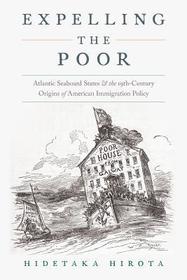
Expelling the Poor
Atlantic Seaboard States and the Nineteenth-Century Origins of American Immigration Policy
-
10% KEDVEZMÉNY?
- A kedvezmény csak az 'Értesítés a kedvenc témákról' hírlevelünk címzettjeinek rendeléseire érvényes.
- Kiadói listaár GBP 27.49
-
12 411 Ft (11 820 Ft + 5% áfa)
Az ár azért becsült, mert a rendelés pillanatában nem lehet pontosan tudni, hogy a beérkezéskor milyen lesz a forint árfolyama az adott termék eredeti devizájához képest. Ha a forint romlana, kissé többet, ha javulna, kissé kevesebbet kell majd fizetnie.
- Kedvezmény(ek) 10% (kb. 1 241 Ft)
- Kedvezményes ár 11 170 Ft (10 638 Ft + 5% áfa)
Iratkozzon fel most és részesüljön kedvezőbb árainkból!
Feliratkozom
12 411 Ft

Beszerezhetőség
Megrendelésre a kiadó utánnyomja a könyvet. Rendelhető, de a szokásosnál kicsit lassabban érkezik meg.
Why don't you give exact delivery time?
A beszerzés időigényét az eddigi tapasztalatokra alapozva adjuk meg. Azért becsült, mert a terméket külföldről hozzuk be, így a kiadó kiszolgálásának pillanatnyi gyorsaságától is függ. A megadottnál gyorsabb és lassabb szállítás is elképzelhető, de mindent megteszünk, hogy Ön a lehető leghamarabb jusson hozzá a termékhez.
A termék adatai:
- Kiadó OUP USA
- Megjelenés dátuma 2019. augusztus 13.
- ISBN 9780190055561
- Kötéstípus Puhakötés
- Terjedelem320 oldal
- Méret 231x155x22 mm
- Súly 454 g
- Nyelv angol
- Illusztrációk 13 illus. 0
Kategóriák
Rövid leírás:
Expelling the Poor argues that immigration policies in nineteenth-century New York and Massachusetts, driven by cultural prejudice against the Irish and more fundamentally by economic concerns about their poverty, laid the foundations for American immigration control.
TöbbHosszú leírás:
Historians have long assumed that immigration to the United States was free from regulation until anti-Asian racism on the West Coast triggered the introduction of federal laws to restrict Chinese immigration in the 1880s. Studies of European immigration and government control on the East Coast have, meanwhile, focused on Ellis Island, which opened in 1892.
In this groundbreaking work, Hidetaka Hirota reinterprets the origins of immigration restriction in the United States, especially deportation policy, offering the first sustained study of immigration control conducted by states prior to the introduction of federal immigration law. Faced with the influx of impoverished Irish immigrants over the first half of the nineteenth century, nativists in New York and Massachusetts built upon colonial poor laws to develop policies for prohibiting the landing of destitute foreigners and deporting those already resident to Europe, Canada, or other American states. These policies laid the foundations for federal immigration law. By investigating state officials' practices of illegal removal, including the overseas deportation of citizens, this book reveals how the state-level treatment of destitute immigrants set precedents for the use of unrestricted power against undesirable aliens. It also traces the transnational lives of the migrants from their initial departure from Ireland and passage to North America through their expulsion from the United States and postdeportation lives in Europe, showing how American deportation policy operated as part of the broader exclusion of nonproducing members from societies in the Atlantic world.
By locating the roots of American immigration control in cultural prejudice against the Irish and, more essentially, economic concerns about their poverty in nineteenth-century New York and Massachusetts, Expelling the Poor fundamentally revises the history of American immigration policy.
A superbly disruptive new book ... Expelling the Poor helps explain the powerful federal system of subsequent centuries, but as a history of the nineteenth century, it illustrates localism and inconsistency.
Tartalomjegyzék:
Acknowledgments
Introduction
Chapter 1 "Shovelling Out": Ireland and the Emigration of the Poor
Chapter 2 Problems of Irish Poverty: The Rise of State Control on the Atlantic Seaboard
Chapter 3 Different Paths: The Development of Immigration Policy in Antebellum Coastal States
Chapter 4 Radical Nativism: The Know Nothing Movement and the Citizenship of Paupers
Chapter 5 A New Birth of Poverty: Pauper Policy in the Age of the Civil War and Reconstruction
Chapter 6 The Journey Continued: Post-Deportation Lives in Britain and Ireland
Chapter 7 The Moment of Transition: State Officials, the Federal Government, and the Formation of American Immigration Policy
Conclusion
Appendices
Notes
Bibliography
Index

