

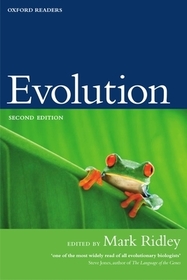
Evolution
Sorozatcím: Oxford Readers;
-
10% KEDVEZMÉNY?
- A kedvezmény csak az 'Értesítés a kedvenc témákról' hírlevelünk címzettjeinek rendeléseire érvényes.
- Kiadói listaár GBP 57.99
-
26 182 Ft (24 935 Ft + 5% áfa)
Az ár azért becsült, mert a rendelés pillanatában nem lehet pontosan tudni, hogy a beérkezéskor milyen lesz a forint árfolyama az adott termék eredeti devizájához képest. Ha a forint romlana, kissé többet, ha javulna, kissé kevesebbet kell majd fizetnie.
- Kedvezmény(ek) 10% (cc. 2 618 Ft off)
- Kedvezményes ár 23 564 Ft (22 442 Ft + 5% áfa)
Iratkozzon fel most és részesüljön kedvezőbb árainkból!
Feliratkozom
26 182 Ft

Beszerezhetőség
Megrendelésre a kiadó utánnyomja a könyvet. Rendelhető, de a szokásosnál kicsit lassabban érkezik meg.
Why don't you give exact delivery time?
A beszerzés időigényét az eddigi tapasztalatokra alapozva adjuk meg. Azért becsült, mert a terméket külföldről hozzuk be, így a kiadó kiszolgálásának pillanatnyi gyorsaságától is függ. A megadottnál gyorsabb és lassabb szállítás is elképzelhető, de mindent megteszünk, hogy Ön a lehető leghamarabb jusson hozzá a termékhez.
A termék adatai:
- Kiadás sorszáma 2
- Kiadó OUP Oxford
- Megjelenés dátuma 2003. december 18.
- ISBN 9780199267941
- Kötéstípus Puhakötés
- Terjedelem472 oldal
- Méret 233x155x24 mm
- Súly 700 g
- Nyelv angol
- Illusztrációk numerous figures 0
Kategóriák
Rövid leírás:
Evolution contains extracts from 60 published scientific papers, by an impressive list of eminent scientific authors. The extracts are organized to enable the reader to sample a range of viewpoints on each topic. They are readable, and can be understood as well as enjoyed by the general reader and introductory biology students.
TöbbHosszú leírás:
Evolution is unlike any other theory in science in the generality of its interest and the excellence of the authors who write about it. This anthology contains extracts from over 60 scientific papers, by authors such as Stephen Jay Gould, Richard Dawkins, Francis Crick and Jacques Monod. It starts with Charles Darwin, but concentrates on modern research, including genomics - evolution's latest gusher of scientic insights. The extracts are organized in sections, enabling the reader to sample a range of views on each topic, such as how new species arise, or the significance of adaptive design in living things. The extracts have been chosen for their readability as well as their scientific importance, making this book an enjoyable way to meet some of the greatest minds of our time, writing on the greatest idea of all time.
TöbbTartalomjegyzék:
Introduction
A. From Darwin to the Modern Synthesis
Section Introduction
Darwin, C. (1858) Extract from an unpublished work on species
Darwin, C. (1858) Abstract of a letter from C. Darwin, Esq., to Prof. Asa Gray, Boston, U.S.A.
Maynard Smith, J. (1987) Weismann and modern biology
Fisher, R. A. (1930) The nature of inheritance
Wright, S. (1932) The roles of mutation, inbreeding, crossbreeding, and selection in evolution
Haldane, J. B. S. (1949) Disease and evolution
B. Natural selection and random drift in populations
Section Introduction
Kettlewell, H. B. D. (1958) A résumé of investigations of the evolution of melanism in the Lepidoptera
Cook, L. M.; Dennis, R. L. H.; & G. S. Mani (1999). Melanic morph frequency in the peppered moth in the Manchester area
Karn, M. N. & Penrose, L. S. (1951) Birth weight and gestation time in relation to infant survival
Ulizzi, L. & Terrenato, L. (1992) Natural selection associated with birth weight. VI. Towards the end of the stabilizing component
Gibbs, H. L & Grant, P. R. (1987) Oscillating selection on Darwin's finches
Lewontin, R. C. The paradox of variation
Kimura, M. Recent developments of the neutral theory
C. Adaptation
Section introduction
Fisher, R. A. (1930). The nature of adaptation
Williams, G. C. (1966). Adaptation and natural selection
Grafen, A. (1986). Adaptation versus selection in progress
Reeve, H. K. & Sherman, P. W. (1991). An operational, nonhistorical definition of adaptation
Orr, H. A. & Coyne, J. The genetics of adaptation: a reassessment
Cain, A. J. (1964). The perfection of animals
Gould, S. J. & Lewontin, R. C. (1979). The spandrels of San Marco and the Panglossian paradigm: a critique of the adaptationist programme
D. Speciation and biodiversity
Section introduction
Mayr, E. Typological v population thinking
Mayr, E. Species concepts and their application
Darwin, C. (1859) The sterility of hybrids
Dobzhansky, T. (1970). Reproductive isolation as a product of genetic divergence and natural selection
Rice, W. R. & Hostert, E. E. Laboratory experiments on speciation: what have we learned in 40 years?
Coyne, J. H. & Orr, H. A. (2000). The evolutionary genetics of speciation
Schluter, D. (2000) Ecological basis of postmating isolation
Grant, V. Hybrid speciation
E. Macroevolution
Section introduction
Erwin, D. H. & Anstey, R. L. (1995) Speciation in the fossil record
De Beer, G. R. (1971). Homology: an unsolved problem
Dawkins, R. (1996). The ey gene
Dickinson, W. J. (1995) Molecules and morphology: where's the homology?
Haeckel, E. (1905) The fundamental law of organic evolution
Garstang, W. (1951) Three poems
F. Evolutionary genomics
Section introduction
Ochman, H.; Lawrence, J. G.; & Groisman, E. A. (2000). Lateral gene transfer and the nature of bacterial innovation
Vision, T. J.; Brown, D. G.; & Tanksley, S. D. (2000). The origins of genomic duplications in Arabidopsis
Humans, M. Ridley
Raff, R. A. (1996). Co-option of eye structures and genes
Benner, S. A.; Caraco, M. D.; Thomson, J. M.; & Gaucher, E. A. (2002). Planetary biology - paleontological, geological, and molecular histories of life
G. The history of life
Section introduction
Schopf, J. W. (1994). Disparate rates, differing fates: tempo and mode of evolution changed from the Precambrian to the Phanerozoic
Cooper, A. & Fortey, R. (1998). Evolutionary explosions and the phylogenetic fuse
Dilcher, D. (2000). Major evolutionary trends in the angiosperm fossil record
H. Case studies
Section introduction
Medawar, P. B. (1951) An unsolved problem in biology
Crick , F. H. C. (1968). The origin of the genetic code
Maynard Smith, J. (1971) The origin and maintenance of sex
Janzen, D. H. (1983) A caricature of seed dispersal by animal guts
Nilsson, D-E. & Pelger, S. (1994). A pessimistic estimate of the time required for an eye to evolve
Sniegowski, P. D.; Gerrish, P. J.; Johnson, T.. & Shaver, A. (2000). The evolution of mutation rates
J. Human evolution.
Section introduction
Sarich, V. & Wilson, A. C. (1967) Immunological time scale for hominid evolution
King, M-C. & Wilson, A. C. (1975). Evolution at two levels in humans and chimpanzees
Britton, R. J. (2002). Divergence between samples of chimpanzee and human DNA sequences is 5%, counting indels
Muller, H. J. (1950). Our load of mutations
Livingstone. F. B. (1962). On the non-existence of human races
Krogman, W. M. (1951). The scars of human evolution
Pinker, S. (1994). The big bang
K. Evolution and human affairs
Section introduction
Antolin, M. F. & Herbers, J. M. (2001). Evolution's struggle for existence in America's public schools
Dobzhansky, T. (1973). Nothing in biology makes sense except in the light of evolution
Hume, D. The argument from design
Monod, J. (1974). On the molecular theory of evolution
Huxley, T. H. (1893). Evolution and ethics
Palumbi, S. (2001) Humans as the world's greatest evolutionary force
Biographical notes
Select bibliography
Acknowledgements
Index

