

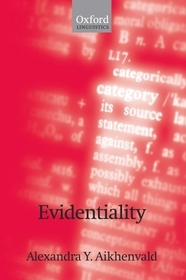
Evidentiality
-
10% KEDVEZMÉNY?
- A kedvezmény csak az 'Értesítés a kedvenc témákról' hírlevelünk címzettjeinek rendeléseire érvényes.
- Kiadói listaár GBP 207.50
-
93 686 Ft (89 225 Ft + 5% áfa)
Az ár azért becsült, mert a rendelés pillanatában nem lehet pontosan tudni, hogy a beérkezéskor milyen lesz a forint árfolyama az adott termék eredeti devizájához képest. Ha a forint romlana, kissé többet, ha javulna, kissé kevesebbet kell majd fizetnie.
- Kedvezmény(ek) 10% (kb. 9 368 Ft)
- Kedvezményes ár 84 318 Ft (80 303 Ft + 5% áfa)
Iratkozzon fel most és részesüljön kedvezőbb árainkból!
Feliratkozom
93 686 Ft

Beszerezhetőség
Megrendelésre a kiadó utánnyomja a könyvet. Rendelhető, de a szokásosnál kicsit lassabban érkezik meg.
Why don't you give exact delivery time?
A beszerzés időigényét az eddigi tapasztalatokra alapozva adjuk meg. Azért becsült, mert a terméket külföldről hozzuk be, így a kiadó kiszolgálásának pillanatnyi gyorsaságától is függ. A megadottnál gyorsabb és lassabb szállítás is elképzelhető, de mindent megteszünk, hogy Ön a lehető leghamarabb jusson hozzá a termékhez.
A termék adatai:
- Kiadó OUP Oxford
- Megjelenés dátuma 2004. november 4.
- ISBN 9780199263882
- Kötéstípus Keménykötés
- Terjedelem480 oldal
- Méret 242x165x32 mm
- Súly 856 g
- Nyelv angol
- Illusztrációk 1 map, numerous tables 0
Kategóriák
Rövid leírás:
Evidentiality is one of the most fascinating categories of human languages. In a number of languages, scattered across the world, every statement must contain a specification of the type of evidence on which it is based - whether the speaker saw it, or heard it, or inferred it from indirect evidence, or learnt it from somebody else. This is a very powerful device for human communication. Many people think that it would be a good thing if our politicians had to talk in this way.
The book investigates a variety of other grammatical categories related to evidentiality, such as aspect and person. It will be of interest to any grammarian. It also discusses the cognitive and sociolinguistic consequences of evidentiality in a language. This will make it of interest to a wider audience, including psychologists and philosophers.
Hosszú leírás:
In some languages every statement must contain a specification of the type of evidence on which it is based: for example, whether the speaker saw it, or heard it, or inferred it from indirect evidence, or learnt it from someone else. This grammatical reference to information source is called 'evidentiality', and is one of the least described grammatical categories. Evidentiality systems differ in how complex they are: some distinguish just two terms (eyewitness and noneyewitness, or reported and everything else), while others have six or even more terms. Evidentiality is a category in its own right, and not a subcategory of epistemic or some other modality, nor of tense-aspect.
Every language has some way of referring to the source of information, but not every language has grammatical evidentiality. In English expressions such as I guess, they say, I hear that, the alleged are not obligatory and do not constitute a grammatical system. Similar expressions in other languages may provide historical sources for evidentials. True evidentials, by contrast, form a grammatical system. In the North Arawak language Tariana an expression such as "the dog bit the man" must be augmented by a grammatical suffix indicating whether the event was seen, or heard, or assumed, or reported.
This book provides the first exhaustive cross-linguistic typological study of how languages deal with the marking of information source. Examples are drawn from over 500 languages from all over the world, several of them based on the author's original fieldwork. Professor Aikhenvald also considers the role evidentiality plays in human cognition, and the ways in which evidentiality influences human perception of the world.. This is an important book on an intriguing subject. It will interest anthropologists, cognitive psychologists and philosophers, as well as linguists.
...well written and well structured
Tartalomjegyzék:
Preliminaries and Key Concepts
Evidentials World-wide
How to Mark Information Source
Evidential Extensions of Non-evidential Categories
Evidentials and Their Meanings
Evidentiality and Mirativity
Whose Evidence is That? Evidentials and Person
Evidentials and Other Grammatical Categories
Evidentials: Where do They Come From?
How to Choose the Correct Evidential: Evidentiality in Discourse and in Lexicon
What are Evidentials Good for? Evidentiality, Cognition and Cultural Knowledge
What can we Conclude; Summary and Prospects
Fieldworker's Guide. How to Gather Materials on Evidentiality Systems
Glossary of Terms
References
Index of Languages
Index of Authors
Subject Index

