

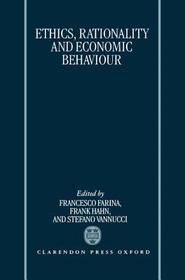
Ethics, Rationality, and Economic Behaviour
-
10% KEDVEZMÉNY?
- A kedvezmény csak az 'Értesítés a kedvenc témákról' hírlevelünk címzettjeinek rendeléseire érvényes.
- Kiadói listaár GBP 220.00
-
99 330 Ft (94 600 Ft + 5% áfa)
Az ár azért becsült, mert a rendelés pillanatában nem lehet pontosan tudni, hogy a beérkezéskor milyen lesz a forint árfolyama az adott termék eredeti devizájához képest. Ha a forint romlana, kissé többet, ha javulna, kissé kevesebbet kell majd fizetnie.
- Kedvezmény(ek) 10% (cc. 9 933 Ft off)
- Kedvezményes ár 89 397 Ft (85 140 Ft + 5% áfa)
Iratkozzon fel most és részesüljön kedvezőbb árainkból!
Feliratkozom
99 330 Ft

Beszerezhetőség
Megrendelésre a kiadó utánnyomja a könyvet. Rendelhető, de a szokásosnál kicsit lassabban érkezik meg.
Why don't you give exact delivery time?
A beszerzés időigényét az eddigi tapasztalatokra alapozva adjuk meg. Azért becsült, mert a terméket külföldről hozzuk be, így a kiadó kiszolgálásának pillanatnyi gyorsaságától is függ. A megadottnál gyorsabb és lassabb szállítás is elképzelhető, de mindent megteszünk, hogy Ön a lehető leghamarabb jusson hozzá a termékhez.
A termék adatai:
- Kiadó OUP Oxford
- Megjelenés dátuma 1996. április 18.
- ISBN 9780198289814
- Kötéstípus Keménykötés
- Terjedelem360 oldal
- Méret 242x163x25 mm
- Súly 665 g
- Nyelv angol
- Illusztrációk line figures, tables 0
Kategóriák
Rövid leírás:
The connection between economics and ethics is as old as economics itself, and central to both disciplines. It is an issue that has recently attracted much interest from economists and philosophers. A number of influential contemporary approaches to ethics advocate decision-theoretic or game-theoretic foundations of some sort for moral principles, while several economic theorists are now taking into account the ethical dimensions of rational decisions. The essays included in the present volume provude a detailed analysis of the connections between ethics and economics as viewed from several different - sometimes conflicting - perspectives. There are three main themes: the validity of utilitarianism much used by economists, the notion of fairness and equity, and the coherence of the rationality postulate of economics. The book does not reach any final conclusions, but it greatly illuminates the exact areas of possible disagreement and indeed the open-ended nature of ethical reasoning.
TöbbHosszú leírás:
The connection between economics and ethics is as old as economics itself, and central to both disciplines. It is an issue that has recently attracted much interest from economists and philosophers. The connection is, in part, a result of the desire of economists to make policy prescriptions, which clearly require some normative criteria. More deeply, much economic theory is founded on the assumption of utility maximization, thereby creating an immediate connection between the foundations of economics and the philosophical literature on utilitarianism and reasons for action. In fact, some influential contemporary approaches to ethics advocate decision-theoretic or game-theoretic foundations of some sort for moral principles, while several economic theorists are now prepared to take into account the ethical dimensions of rational decisions. As a result, it appears that economics and ethics are somehow inextricably linked through theories of rational decision-making.
Most of us would probably find it disturbing to concede that there are contradictions between the prescriptions of rationality and the requirements of moral `rightness'. The essays included in the present volume provide a detailed analysis of the connections between ethics and economics as viewed from several different - sometimes conflicting - perspectives. This book, the outcome of a joint meeting of philosophers and economists, has three main themes: the validity of utilitarianism much used by economists, the notion of fairness and equity, and the coherence of the rationality postulate of economics. The book does not reach any final conclusions, but it greatly illuminates the exact areas of possible disagreement and indeed the open-ended nature of ethical reasoning. There is much that economists, and especially welfare economists, can learn from these papers - not least circumspection.
In this well-assembled collection of papers, the editors, who are also among the authors of individual articles, provide a good sense of liveliness, complexity and variety of topics in the three areas of inquiry listed in the title of the book ... Philosophers and economists will enjoy mulling over the ideas and reasoning found in the book.

