

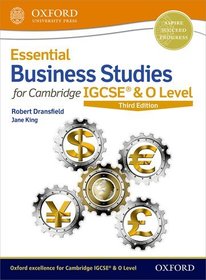
Essential Business Studies for Cambridge IGCSE? & O Level
-
10% KEDVEZMÉNY?
- A kedvezmény csak az 'Értesítés a kedvenc témákról' hírlevelünk címzettjeinek rendeléseire érvényes.
- Kiadói listaár GBP 34.49
-
16 477 Ft (15 692 Ft + 5% áfa)
Az ár azért becsült, mert a rendelés pillanatában nem lehet pontosan tudni, hogy a beérkezéskor milyen lesz a forint árfolyama az adott termék eredeti devizájához képest. Ha a forint romlana, kissé többet, ha javulna, kissé kevesebbet kell majd fizetnie.
- Kedvezmény(ek) 10% (cc. 1 648 Ft off)
- Kedvezményes ár 14 829 Ft (14 123 Ft + 5% áfa)
Iratkozzon fel most és részesüljön kedvezőbb árainkból!
Feliratkozom
16 477 Ft

Beszerezhetőség
Becsült beszerzési idő: A Prosperónál jelenleg nincsen raktáron, de a kiadónál igen. Beszerzés kb. 3-5 hét..
A Prosperónál jelenleg nincsen raktáron.
Why don't you give exact delivery time?
A beszerzés időigényét az eddigi tapasztalatokra alapozva adjuk meg. Azért becsült, mert a terméket külföldről hozzuk be, így a kiadó kiszolgálásának pillanatnyi gyorsaságától is függ. A megadottnál gyorsabb és lassabb szállítás is elképzelhető, de mindent megteszünk, hogy Ön a lehető leghamarabb jusson hozzá a termékhez.
A termék adatai:
- Kiadás sorszáma 3
- Kiadó OUP Oxford
- Megjelenés dátuma 2018. április 5.
- ISBN 9780198424864
- Kötéstípus Kötés ismeretlen
- Terjedelem216 oldal
- Méret 265x196x10 mm
- Súly 526 g
- Nyelv angol
- Illusztrációk Colour 0
Kategóriák
Rövid leírás:
Support your EAL learners with the step-by-step approach of Essential Business Studies for Cambridge IGCSE, IGCSE 9-1 & O Level (Third Edition), which builds understanding and confidence. Written by examiners, it is fully matched to the latest syllabus (0450/0986/7115), for examination from 2020.
TöbbHosszú leírás:
Ensure your EAL learners succeed in Business Studies with a structured approach for the latest IGCSE, IGCSE (9-1) & O Level (0450/0986/7115) syllabuses, for examination from 2020. Written by examiners, the step-by-step approach is fully aligned to the latest Cambridge syllabuses with a comprehensive mapping grid so you can be sure of complete support.
Build assessment achievement with updated exam-style questions and guidance. Consolidate understanding with summary questions on every double page. International case studies engage students and link learning to real life.
Embed comprehension for your second language learners with topic guidance drawn from the syllabus and specialist vocabulary that is clearly highlighted and explained.
Support learning with interactive tests, exam-style practice and Student Book answers on the accompanying support site.
Tartalomjegyzék:
Syllabus matching grid
Unit 1 Understanding business activity
The purpose and nature of business activity
The importance of specialisation
1.2 Classification of businesses
Business activity in terms of primary, secondary and tertiary sectors
The private sector and the public sector in a mixed economy
1.3 Enterprise, business growth and size
Enterprise and entrepreneurs
Contents and benefits of a business plan and how business plans assist entrepreneurs
Why and how governments support start-ups
Business growth and measurement of size
Why some (new or established) businesses fail
1.4 Types of business organisation
Sole traders and partnerships
Other types of business organisation
Objectives, growth and business organisation
Limited and unlimited liability
Business organisations in the public sector
1.5 Business objectives and stakeholder objectives
Business objectives
Stakeholders and their different objectives
Objectives of private and and public sector enterprises
Practice questions
Unit 2 People in business
2.1 Motivating employees
Motivation
Why people work - the concept of human needs
Key motivational theories - Taylor and Herzberg
Methods of motivation - financial rewards
Methods of motivation - non-financial rewards
2.2 Organisation and management
Organisational charts
Roles and responsibilities
The role of management
Styles of leadership
Trade unions
2.3 Recruitment, selection and training
The recruitment and selection process
Recruiting and selecting in practice
Recommending who to employ?
Training and methods of training
Reducing the size of the workforce
Legal controls over employment issues
2.4 Internal and external communication
Communication
Internal communication
External communication
Practice questions
Unit 3 Marketing
3.1 Marketing, competition and the customer
The role of marketing
Market changes
Market segmentation
Mass markets and niche markets
3.2 Market research
Primary and secondary market research
Quantitative and qualitative research
Presentation and use of results
3.3 The marketing mix
The four P's
The product
The price
Place - distribution channels
Promotion
Technology and the marketing mix
3.4 Marketing strategy
Elements of a marketing strategy
Legal controls related to marketing
Opportunities and threats of entering overseas markets
Practice questions
Unit 4 Operations management
4.1 Production of goods and services
The meaning of production
Lean production
The main methods of production
How technology has changed production methods
4.2 Costs, scale of production and breakeven analysis
Identify and classify costs
Economies and diseconomies of scale
Break-even analysis
Break-even and margin of safety
4.3 Achieving quality production
What quality means
4.4 Location decisions
Factors influencing location and relocation
Practice questions
Unit 5 Financial information and decisions
5.1 Business finance: needs and sources
The need for business finance
Major sources of finance
Sources of internal and external finance
How to choose finance
5.2 Cash flow forecasting and working capital
Cash-flow and cash-flow forecasting
Working capital
5.3 Income statements
What profit is and why it is important
How profit is made
Income statements
5.4 Statement of financial position
The main elements of a statement of financial position
Further analysis of the statement of financial position
5.5 Analysis of accounts (financial statements)
Profitability analysis
Liquidity
Why and how accounts are used
Practice questions
Unit 6 External influences on business activity
6.1 Economic issues
Business cycle
Government control of the economy and business
Reasons for government intervention in the economy
Taxes and interest rates
6.2 Environmental and ethical issues
Environmental concerns and issues that affect business
External costs and benefits
Legal controls and environmental issues
Ethical issues
6.3 Business and the international economy
The importance of globalisation
Importance and growth of multinational companies
The impact of exchange rate changes
Practice questions
Glossary of key terms
Index

