

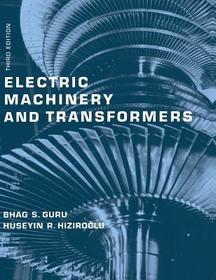
Electric Machinery and Transformers
Sorozatcím: The Oxford Series in Electrical and Computer Engineering;
-
10% KEDVEZMÉNY?
- A kedvezmény csak az 'Értesítés a kedvenc témákról' hírlevelünk címzettjeinek rendeléseire érvényes.
- Kiadói listaár GBP 265.99
-
120 094 Ft (114 375 Ft + 5% áfa)
Az ár azért becsült, mert a rendelés pillanatában nem lehet pontosan tudni, hogy a beérkezéskor milyen lesz a forint árfolyama az adott termék eredeti devizájához képest. Ha a forint romlana, kissé többet, ha javulna, kissé kevesebbet kell majd fizetnie.
- Kedvezmény(ek) 10% (cc. 12 009 Ft off)
- Kedvezményes ár 108 084 Ft (102 938 Ft + 5% áfa)
Iratkozzon fel most és részesüljön kedvezőbb árainkból!
Feliratkozom
120 094 Ft

Beszerezhetőség
Megrendelésre a kiadó utánnyomja a könyvet. Rendelhető, de a szokásosnál kicsit lassabban érkezik meg.
Why don't you give exact delivery time?
A beszerzés időigényét az eddigi tapasztalatokra alapozva adjuk meg. Azért becsült, mert a terméket külföldről hozzuk be, így a kiadó kiszolgálásának pillanatnyi gyorsaságától is függ. A megadottnál gyorsabb és lassabb szállítás is elképzelhető, de mindent megteszünk, hogy Ön a lehető leghamarabb jusson hozzá a termékhez.
A termék adatai:
- Kiadás sorszáma 3
- Kiadó OUP USA
- Megjelenés dátuma 2000. november 2.
- ISBN 9780195138900
- Kötéstípus Keménykötés
- Terjedelem720 oldal
- Méret 240x194x38 mm
- Súly 1397 g
- Nyelv angol
- Illusztrációk numerous halftones and line figures 0
Kategóriák
Rövid leírás:
This is a revision of Guru/Hiziroglu: Electric Machinery and Transformers 2/e. The text is designed for the standard third or fourth year (junior/senior) course in electrical engineering commonly called electric machinery or electromechanical energy conversion. This text discusses the principles behind building the primary infrastructure for the generation of electricity (such as hydroelectric dams, turbines, etc.) that supplies the energy needs of people throughout the world. In addition to power generation, the book covers the basics of various types of electric motors, from large electric train motors, to those in hair dryers and smaller devices. The largest markets for a book such as this will be found in countries with developing infrastructures.
TöbbHosszú leírás:
This is a revision of Guru/Hiziroglu: Electric Machinery and Transformers, 2/E. The text is designed for the standard third or fourth year (junior/senior) course in electrical engineering commonly called electric machinery or electromechanical energy conversion. This text discusses the principles behind building the primary infrastructure for the generation of electricity (such as hydroelectric dams, turbines, etc.) that supplies the energy needs of people throughout the world. In addition to power generation, the book covers the basics of various types of electric motors, from large electric train motors, to those in hair dryers and smaller devices. The largest markets for a book such as this will be found in countries with developing infrastructures.
The text is best known for its accuracy, pedagogy, and clear writing style. This revision should make Electric Machinery and Transformers the most up-to-date text on the market. Electric Machinery and Transformers continues its strong pedagogical tradition with a wealth of examples, new exercises, review questions, and effective chapter summaries.
Electric Machinery and Transformers begins with a review of the basics of circuit theory and electromagnetics. Chapter 3 begins the heart of the course with the principles of electromehcanical energy conversion; Chapter 4 covers transformers; Chapters 5 & 6 cover direct current generators and motors; Chapters 7 & 8 cover synchronous generators and motors. Chapters 9 and 10 round out the motors coverage with an introduction to polyphase induction motors and single-phase motors. Finally, Chapter 11 deals with dynamics of electrics machines and Chapter 12 covers special purpoe machines.
This revised second edition features updated examples for modern applications, new problems, and additional material on power electronics. An instructor's manual will accompany the main text and will be available free to adopters.
Tartalomjegyzék:
Preface
Acknowledgments
1 Review of Electric Circuit Theory
Introduction
Direct-Current Ciruit Analysis
Alternating-Current Circuit Analysis
Three-Phase Circuits
Power and Impendance Measurement
Summary
Review Questions
Problems
2. Review of Basic Laws of Electromagnetism
Introduction
Maxwell's Equations
Magnetic Materials and Their Properties
Magnetic Circuits
Self- and Mututal Inductances
Magnetically Coupled Coils
Magnetic Losses
Permanent Magnets
Summary
Review Questions
Problems
3. Principles of Electromechanical Energy Conversion
Introdcution
Electric Field as a Medium
Magnetic Field as a Medium
A Coil in a Uniform Magnetic Field
A Coil in a Time-Varying Magnetic Field
Synchronous Motor
Reluctance Motor
Electromagnetic Relays
Summary
Review Quesitons
Problems
4 Tranformers
Introduction
Construction of a Transformer
An Ideal Transformer
A Nonideal Transformer
Voltage Regulation
Maximum Efficiency Criterion
Determination of Tranformer Parameters
Per-Unit Computations
The Autotransformer
Three-Phase Transformers
The Constant-Current Transformer
Instrument Transformers
Summary
Review Questions
Problems
5 Direct-Current Generators
Introduction
Mechanical Construction
Armature Windings
Induced EMF Equations
Developed Torque
Magnetization Charateristic of a DC Machine
Theory of Communication
Armature Reaction
Types of DC Machines
Voltage Regulation
Losses in DC Machines
A Separately Excited DC Generator
A Shunt Generator
A Series Generator
Compound Geneators
Maxiumum Efficiency Criterion
Summary
Review Questions
Problems
6 Direct-Current Motors
Introduction
Operation of a DC Motor
Speed Regulation
Losses in a DC Motor
A Series Motor
A Shunt Motor
The Compound Motor
Methods of Speed Control
The Ward-Leonard System
Torque Measurements
Braking or Reversing DC Motors
Summary
Review Questions
Problems
7 Synchronous Generators
Introduction
Construction of a Synchronous Machine
Armature Windings
Pitch Factor
Distribution Factor
Winding Connections
Induced EMF Equation
The Equivalent Circuit
Power Relationships
Synchronous Generator Tests
The External Characteristics
Salient-Pole Synchronous Generator
Parallel Operation of Synchronous Generators
Summary
Review Questions
Problems
8 Synchronous Motors
Introduction
Construction and Operation of a Synchronous Motor
Equivalent Circuit of a Synchronous motor
Power Expressions
Exact Condition for Maximum Power
Effect of Excitation
Power Fact Correction
Summary
Review Questions
Problems
9 Polyphase Induction Motors
Introduction
Construction
Principle of Operation
Development of an Equivalent Circuit
An Approximate Equivalent Circuit
Maximym Power Criterion
Maximum Torque Criterion
Maximum Efficiency Criterion
Some Important Conclusions
Equivalent Circuit Parameters
Starting of Induction Motors
Rotor Impedence Tranformation
Speed Control of Induction Motors
Types of Induction Motors
Summary
Review Questions
Problems
10 Single-Phase Motors
Introduction
Singe-Phase Induction Motor
Analysis of a Single-Phase Induction Motor
Types of Single-Phase Induction Motors
Analysis of a Single-Phase Motor Using Both Windings
Testing Single-Phase Motors
Shaded-Pole Motor
Universal Motor
Summary
Review Questions
Problems
11 Dynamics of Electricla Machines
Introduction
DC Machines
Synchronous Generator Dynamics
Summary
Review Questions
Problems
12 Special-Purpose Electric Machiens
Introduction
Permanent-Magnet Motors
Step Motors
Switched-Reluctance Motors
Brushless DC Motors
Hystersis Motors
Linear Induction Motors
Summary
Review Questions
Problems
Appendices
A System of Units
B The Laplace Transform
Bibliography
Index

