

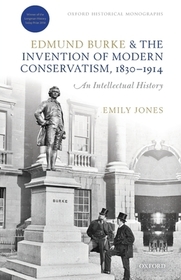
Edmund Burke and the Invention of Modern Conservatism, 1830-1914
An Intellectual History
Sorozatcím: Oxford Historical Monographs;
-
10% KEDVEZMÉNY?
- A kedvezmény csak az 'Értesítés a kedvenc témákról' hírlevelünk címzettjeinek rendeléseire érvényes.
- Kiadói listaár GBP 36.49
-
16 475 Ft (15 690 Ft + 5% áfa)
Az ár azért becsült, mert a rendelés pillanatában nem lehet pontosan tudni, hogy a beérkezéskor milyen lesz a forint árfolyama az adott termék eredeti devizájához képest. Ha a forint romlana, kissé többet, ha javulna, kissé kevesebbet kell majd fizetnie.
- Kedvezmény(ek) 10% (cc. 1 648 Ft off)
- Kedvezményes ár 14 827 Ft (14 121 Ft + 5% áfa)
Iratkozzon fel most és részesüljön kedvezőbb árainkból!
Feliratkozom
16 475 Ft

Beszerezhetőség
Megrendelésre a kiadó utánnyomja a könyvet. Rendelhető, de a szokásosnál kicsit lassabban érkezik meg.
Why don't you give exact delivery time?
A beszerzés időigényét az eddigi tapasztalatokra alapozva adjuk meg. Azért becsült, mert a terméket külföldről hozzuk be, így a kiadó kiszolgálásának pillanatnyi gyorsaságától is függ. A megadottnál gyorsabb és lassabb szállítás is elképzelhető, de mindent megteszünk, hogy Ön a lehető leghamarabb jusson hozzá a termékhez.
A termék adatai:
- Kiadó OUP Oxford
- Megjelenés dátuma 2019. február 7.
- ISBN 9780198831334
- Kötéstípus Puhakötés
- Terjedelem288 oldal
- Méret 216x151x15 mm
- Súly 360 g
- Nyelv angol 0
Kategóriák
Rövid leírás:
Edmund Burke, eighteenth-century Irishman and politician, was no 'C/conservative', yet 'Burkean conservatism' is seen as the core of modern C/conservatism. For the first time, Jones shows how Burke's legacy was transformed over the course of the nineteenth century to create one of our most significant theories of modern politics and thought.
TöbbHosszú leírás:
Between 1830 and 1914 in Britain a dramatic modification of the reputation of Edmund Burke (1730-1797) occurred. Burke, an Irishman and Whig politician, is now most commonly known as the 'founder of modern conservatism' - an intellectual tradition which is also deeply connected to the identity of the British Conservative Party. The idea of 'Burkean conservatism' - a political philosophy which upholds 'the authority of tradition', the organic, historic conception of society, and the necessity of order, religion, and property - has been incredibly influential both in international academic analysis and in the wider political world. This is a highly significant intellectual construct, but its origins have not yet been understood. Emily Jones demonstrates, for the first time, that the transformation of Burke into the 'founder of conservatism' was in fact part of wider developments in British political, intellectual, and cultural history in the nineteenth and early twentieth centuries.
Drawing from a wide range of sources, including political texts, parliamentary speeches, histories, biographies, and educational curricula, Edmund Burke and the Invention of Modern Conservatism shows how and why Burke's reputation was transformed over a formative period of British history. In doing so, it bridges the significant gap between the history of political thought as conventionally understood and the history of the making of political traditions. The result is to demonstrate that, by 1914, Burke had been firmly established as a 'conservative' political philosopher and was admired and utilized by political Conservatives in Britain who identified themselves as his intellectual heirs. This was one essential component of a conscious re-working of C/conservatism which is still at work today.
This is an impressive book, steeped in the intellectual history of Britain in the 19th century, but touching luminously on wider aspects of political and cultural history in explaining Burke's shifting fortunes. The resourcefulness and perceptiveness of the book strike the reader on every page, as does its feel for the different and often conflicting movements of thought that heightened interest in -- and controversy about -- Burke. It will inform new avenues of inquiry into C/conservatism, both in the period it has brought into focus and in others; also in related research areas. Most of all, this book underlines the nature of C/conservatism as a historical construct, rooted in claims and arguments that mobilise past thinkers in support of particular views rooted firmly in the present.
Tartalomjegyzék:
Introduction
Constitutional Politics, c. 1830-1880
Irishness, National Character, and the Interpretation of Political Thought, c. 1830-1914
Critical Recovery, c. 1860-1880
Irish Home Rule, c. 1886-1893
The New Conservatism, c. 1885-1914
Learning Conservatism: Burke in Education, c. 1880-1914
Epilogue
Bibliography
Index

