

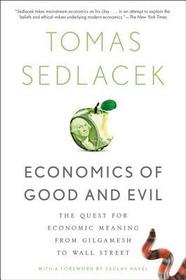
Economics of Good and Evil
The Quest for Economic Meaning from Gilgamesh to Wall Street
-
10% KEDVEZMÉNY?
- A kedvezmény csak az 'Értesítés a kedvenc témákról' hírlevelünk címzettjeinek rendeléseire érvényes.
- Kiadói listaár GBP 16.99
-
7 670 Ft (7 305 Ft + 5% áfa)
Az ár azért becsült, mert a rendelés pillanatában nem lehet pontosan tudni, hogy a beérkezéskor milyen lesz a forint árfolyama az adott termék eredeti devizájához képest. Ha a forint romlana, kissé többet, ha javulna, kissé kevesebbet kell majd fizetnie.
- Kedvezmény(ek) 10% (kb. 767 Ft)
- Kedvezményes ár 6 903 Ft (6 575 Ft + 5% áfa)
Iratkozzon fel most és részesüljön kedvezőbb árainkból!
Feliratkozom
7 670 Ft

Beszerezhetőség
Megrendelésre a kiadó utánnyomja a könyvet. Rendelhető, de a szokásosnál kicsit lassabban érkezik meg.
Why don't you give exact delivery time?
A beszerzés időigényét az eddigi tapasztalatokra alapozva adjuk meg. Azért becsült, mert a terméket külföldről hozzuk be, így a kiadó kiszolgálásának pillanatnyi gyorsaságától is függ. A megadottnál gyorsabb és lassabb szállítás is elképzelhető, de mindent megteszünk, hogy Ön a lehető leghamarabb jusson hozzá a termékhez.
A termék adatai:
- Kiadó OUP USA
- Megjelenés dátuma 2013. november 28.
- ISBN 9780199322183
- Kötéstípus Puhakötés
- Terjedelem384 oldal
- Méret 235x156x17 mm
- Súly 535 g
- Nyelv angol
- Illusztrációk w. ill. 0
Kategóriák
Rövid leírás:
In The Economics of Good and Evil, Sedlacek challenges widely-held beliefs about economics and culture by tracing the study and themes of economics throughout history.
TöbbHosszú leírás:
Tomas Sedlacek has shaken the study of economics as few ever have. Named one of the "Young Guns" and one of the "five hot minds in economics" by the Yale Economic Review, he serves on the National Economic Council in Prague, where his provocative writing has achieved bestseller status. How has he done it? By arguing a simple, almost heretical proposition: economics is ultimately about good and evil.
In The Economics of Good and Evil, Sedlacek radically rethinks his field, challenging our assumptions about the world. Economics is touted as a science, a value-free mathematical inquiry, he writes, but it's actually a cultural phenomenon, a product of our civilization. It began within philosophy--Adam Smith himself not only wrote The Wealth of Nations, but also The Theory of Moral Sentiments--and economics, as Sedlacek shows, is woven out of history, myth, religion, and ethics. "Even the most sophisticated mathematical model," Sedlacek writes, "is, de facto, a story, a parable, our effort to (rationally) grasp the world around us." Economics not only describes the world, but establishes normative standards, identifying ideal conditions. Science, he claims, is a system of beliefs to which we are committed. To grasp the beliefs underlying economics, he breaks out of the field's confines with a tour de force exploration of economic thinking, broadly defined, over the millennia. He ranges from the epic of Gilgamesh and the Old Testament to the emergence of Christianity, from Descartes and Adam Smith to the consumerism in Fight Club. Throughout, he asks searching meta-economic questions: What is the meaning and the point of economics? Can we do ethically all that we can do technically? Does it pay to be good?
Placing the wisdom of philosophers and poets over strict mathematical models of human behavior, Sedlacek's groundbreaking work promises to change the way we calculate economic value.
Tartalomjegyzék:
oreword by Vaclav Havel
Acknowledgments and Thanks
Introduction
PART I: Ancient Economics
Chapter 1: The Epic of Gilgamesh: On effectiveness, Immortality and the Economics of Friendship
Chapter 2: The Old Testament: Earthliness and Goodness
Chapter 3: Ancient Greece
Chapter 4: Christianity: Spirituality in the Material World
Chapter 5: Descartes the Mechanic
Chapter 6: Bernard Mandeville's Beehive of Vice
Chapter 7: Adam Smith, Blacksmith of Economics
PART II: Blasphemous Thoughts
Chapter 8: Need for Greed - The History of Want
Chapter 9: Progress and Sabbath Economics
Chapter 10: The Axis of Good and Evil and the Bibles of Economics
Chapter 11: The History of the Invisible Hand of the Market and Homo Oeconomicus
Chapter 12: The History of Animal Spirits - the Dream Never Sleeps
Chapter 13: MetaMathematics
Chapter 14: Masters of Truth: Science, Myths and Faith
Conclusion: Where the Wild Things Are
Bibliography
Index

