

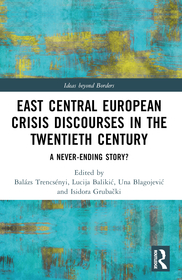
East Central European Crisis Discourses in the Twentieth Century
A Never-Ending Story?
Sorozatcím: Ideas beyond Borders;
-
20% KEDVEZMÉNY?
- A kedvezmény csak az 'Értesítés a kedvenc témákról' hírlevelünk címzettjeinek rendeléseire érvényes.
- Kiadói listaár GBP 45.99
-
20 764 Ft (19 775 Ft + 5% áfa)
Az ár azért becsült, mert a rendelés pillanatában nem lehet pontosan tudni, hogy a beérkezéskor milyen lesz a forint árfolyama az adott termék eredeti devizájához képest. Ha a forint romlana, kissé többet, ha javulna, kissé kevesebbet kell majd fizetnie.
- Kedvezmény(ek) 20% (cc. 4 153 Ft off)
- Kedvezményes ár 16 611 Ft (15 820 Ft + 5% áfa)
- A kedvezmény érvényes eddig: 2026. június 30.
Iratkozzon fel most és részesüljön kedvezőbb árainkból!
Feliratkozom
18 687 Ft

Beszerezhetőség
Becsült beszerzési idő: A Prosperónál jelenleg nincsen raktáron, de a kiadónál igen. Beszerzés kb. 3-5 hét..
A Prosperónál jelenleg nincsen raktáron.
Why don't you give exact delivery time?
A beszerzés időigényét az eddigi tapasztalatokra alapozva adjuk meg. Azért becsült, mert a terméket külföldről hozzuk be, így a kiadó kiszolgálásának pillanatnyi gyorsaságától is függ. A megadottnál gyorsabb és lassabb szállítás is elképzelhető, de mindent megteszünk, hogy Ön a lehető leghamarabb jusson hozzá a termékhez.
A termék adatai:
- Kiadás sorszáma 1
- Kiadó Routledge
- Megjelenés dátuma 2025. december 25.
- ISBN 9781032572048
- Kötéstípus Puhakötés
- Terjedelem440 oldal
- Méret 229x152 mm
- Súly 810 g
- Nyelv angol
- Illusztrációk 1 Illustrations, black & white; 1 Line drawings, black & white 775
Kategóriák
Rövid leírás:
This project is in dialogue with a number of recent transnational attempts to rethink political and intellectual history with regard to the recurrent epistemological frames that structure the political and cultural debate.
TöbbHosszú leírás:
The term “crisis,” with its complex history, has emerged as one of the pivotal notions of political modernity. As such, reconstructing the ways the discourse of crisis functioned in various contexts and historical moments gives us a unique insight not only into a series of conceptual transformations, but also into the underlying logic of key political and intellectual controversies of the last two centuries. Studying the ways crisis was experienced, conceptualized, and negotiated can contribute to the understanding of how various visions of time and history shape political thinking and, conversely, how political and social reconfigurations frame our assumptions about temporality and spatiality.
A historical region wedged in between various competing imperial centers, East Central Europe has been an area often associated with crisis phenomena by both internal and external observers. Seeking to employ the regional gaze as a vantage point to reflect on issues which are relevant well beyond those countries between the Baltic and the Adriatic, this project is also in dialogue with a number of recent transnational attempts to rethink political and intellectual history with regard to the recurrent epistemological frames that structure the political and cultural debate.
This book will thus be useful both for researchers, from the field of intellectual history and numerous adjacent fields, and graduate university students alike.
TöbbTartalomjegyzék:
Introduction
Part I. Interwar Crises of Body and Soul
- Balázs Trencsényi: “Crisis without Catharsis? Crisis Discourses and the Problem of Political Modernity in Interwar East Central Europe”
- Johannes Bent and Liisi Keedus: “Contesting German ‘Crisis Literature’: Oswald Spengler in Interwar Hungarian and Romanian Reviews
- Vilius Kubekas: “Confronting the Spiritual Crisis: The Philosophical and Political Reorientation of Lithuanian Catholicism in the mid-1930s”
- Suzana Vuljević: “Order Amid Chaos: The Crisis of Spirit and a Panoply of Pan-Balkan Solutions in Interwar Europe”
- Lucija Balikić: “Coming of Age with Crisis: Discourses on the ‘National Body’ in Youth Organizations of Interwar Yugoslavia and Hungary”
- Kristina Andělová and Isidora Grubački: “Crises of Feminism and Democracy in the Interwar Period. Yugoslav and Czechoslovak Entanglements”
- Katherine Lebow: “Bodies in Crisis: Women and Unemployment in Polish Sociological Research of the 1930s”
Part II. Crises of Transition To and From Socialism
- Olga Byrska: “Crisis, Revolution, Reconstruction? Early Postwar Debates on Social and Political Transformation in Poland”
- Julius Horvath: “Market Crisis and National Happiness: A Study of the Slovak and Czech Responses to Crisis in the Twentieth Century”
- Una Blagojević: “The Cunning of Crisis and Yugoslav Marxist Humanism”
- Stevo Đurašković: “Predrag Matvejević: The Crisis of Socialist Yugoslavia as a Crisis of Yugoslav Identity”
- Marko Zajc: “The Nova revija Magazine’s 1986 Survey on the Yugoslav crisis”
- Benedek Pál: “‘We all talk about crisis, but what do we mean by crisis?’ Polish and Hungarian Intellectuals Negotiating the Crisis of State Socialism in the First Half of the 1980s”
- Viola Lászlófi: “The Crisis of Biopolitics or Biopoliticizing the Crisis? Discourses on the Problems of Socialist Healthcare in Late Socialist Hungary”
- Martin Babička: “Discourses of Moral and Ecological Crisis in Czech Postsocialist Transformation”
- Tjaša Konovšek: “Crisis as Political Criticism: Slovenia, Post-communism, and the Conservative Turn”

