

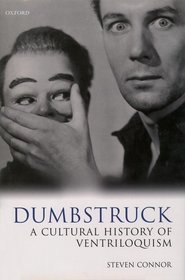
Dumbstruck - A Cultural History of Ventriloquism
-
10% KEDVEZMÉNY?
- A kedvezmény csak az 'Értesítés a kedvenc témákról' hírlevelünk címzettjeinek rendeléseire érvényes.
- Kiadói listaár GBP 122.50
-
55 308 Ft (52 675 Ft + 5% áfa)
Az ár azért becsült, mert a rendelés pillanatában nem lehet pontosan tudni, hogy a beérkezéskor milyen lesz a forint árfolyama az adott termék eredeti devizájához képest. Ha a forint romlana, kissé többet, ha javulna, kissé kevesebbet kell majd fizetnie.
- Kedvezmény(ek) 10% (cc. 5 531 Ft off)
- Kedvezményes ár 49 778 Ft (47 408 Ft + 5% áfa)
Iratkozzon fel most és részesüljön kedvezőbb árainkból!
Feliratkozom
55 308 Ft

Beszerezhetőség
Megrendelésre a kiadó utánnyomja a könyvet. Rendelhető, de a szokásosnál kicsit lassabban érkezik meg.
Why don't you give exact delivery time?
A beszerzés időigényét az eddigi tapasztalatokra alapozva adjuk meg. Azért becsült, mert a terméket külföldről hozzuk be, így a kiadó kiszolgálásának pillanatnyi gyorsaságától is függ. A megadottnál gyorsabb és lassabb szállítás is elképzelhető, de mindent megteszünk, hogy Ön a lehető leghamarabb jusson hozzá a termékhez.
A termék adatai:
- Kiadó OUP Oxford
- Megjelenés dátuma 2000. október 26.
- ISBN 9780198184331
- Kötéstípus Keménykötés
- Terjedelem458 oldal
- Méret 242x165x30 mm
- Súly 865 g
- Nyelv angol
- Illusztrációk 8 pp halftone plates 0
Kategóriák
Rövid leírás:
Dumbstruck - A Cultural History of Ventriloquism centres on the evolution of ventriloquism from demonic phenomenon to popular entertainment in order to analyse the shifting cultural values attached to the natural and disembodied voice. It moves from late classical accounts of oracles through theological disputes about the nature of magical voices, medieval mysticism, early modern possession cases, philosophical debates about ventriloquism in the Enlightenment, the rise of ventriloquism as popular entertainment and the appearance of the dummy in the nineteenth century to discussions of twentieth-century technology and occult belief. The book is at the intersection of cultural history, literary theory, and aesthetics.
TöbbHosszú leírás:
Why can none of us hear our own recorded voice without wincing? Why is the telephone still full of such spookiness and erotic possibility? Why does the metaphor of ventriloquism, the art of 'seeming to speak where one is not', speak so resonantly to our contemporary technological condition? These are the kind of questions which impel Steven Connor's wide-ranging, restlessly inquisitive history of ventriloquism and the disembodied voice. He tracks his subject from its first recorded beginnings in ancient Israel and Greece, through the fulminations of early Christian writers against the unholy (and, they believed, obscenely produced) practices of pagan divination, the aberrations of the voice in mysticism, witchcraft and possession, and the strange obsession with the vagrant figure of the ventriloquist, newly conceived as male rather than female, during the Enlightenment. He retrieves the stories of some of the most popular and versatile ventriloquists and polyphonists of the nineteenth century, and investigates the survival of ventriloquial delusions and desires in spiritualism and the 'vocalic uncanny' of technologies like telephone, radio, film, and internet. Learned but lucid, brimming with anecdote and insight, this is much more than an archaeology of one of the most regularly derided but tenaciously enduring of popular arts. It is also a series of virtuoso philosophical and psychological reflections on the problems and astonishments, the raptures and absurdities of the unhoused voice.
erudite and broad in scope. Its strength is the way it links cultural phenomena in new ways ... Connor gives us an intelligent study of a domain of skilful cultural creativity, against a background of several millennia of appalling irrational behaviour.
Tartalomjegyzék:
Part I: Powers
What I Say Goes
Part II: Prophecies
Earth, Breath, Frenzy: The Delphic Oracle
Origen, Eustathius, and The Witch of Endor
Part III: Possessions
Hoc Est Corpus
The Exorcism of John Darrell
O, that Oh is the Devill: Glover and Harsnett
Part IV: Prodigies
Miracles and the Encyclopédie
Speaking Parts: Diderot and Les Bijoux indiscrets
The Abbé and the Ventriloque
The Dictate of Phrenzy: Charles Brockden Brown's Wieland
Part V: Polyphonics
Ubiquitarical
At Home and Abroad: Monsieur Alexandre and Mr Matthews
Phenomena in the Philosophy of Sound: Mr Love
Writing the Voice
Part VI: Prosthetics
Vocal Reinforcement
Talking Heads, Automaton Ears
A Gramophone in Every Grave
Part VII: No Time Like the Present
No Time Like the Present
Works Cited
Index

