

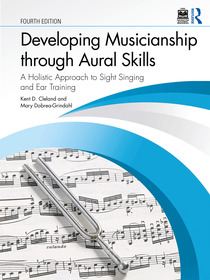
Developing Musicianship through Aural Skills
A Holistic Approach to Sight Singing and Ear Training
-
20% KEDVEZMÉNY?
- A kedvezmény csak az 'Értesítés a kedvenc témákról' hírlevelünk címzettjeinek rendeléseire érvényes.
- Kiadói listaár GBP 96.99
-
43 790 Ft (41 705 Ft + 5% áfa)
Az ár azért becsült, mert a rendelés pillanatában nem lehet pontosan tudni, hogy a beérkezéskor milyen lesz a forint árfolyama az adott termék eredeti devizájához képest. Ha a forint romlana, kissé többet, ha javulna, kissé kevesebbet kell majd fizetnie.
- Kedvezmény(ek) 20% (cc. 8 758 Ft off)
- Kedvezményes ár 35 032 Ft (33 364 Ft + 5% áfa)
- A kedvezmény érvényes eddig: 2026. június 30.
Iratkozzon fel most és részesüljön kedvezőbb árainkból!
Feliratkozom
39 411 Ft

Beszerezhetőség
Még nem jelent meg, de rendelhető. A megjelenéstől számított néhány héten belül megérkezik.
Why don't you give exact delivery time?
A beszerzés időigényét az eddigi tapasztalatokra alapozva adjuk meg. Azért becsült, mert a terméket külföldről hozzuk be, így a kiadó kiszolgálásának pillanatnyi gyorsaságától is függ. A megadottnál gyorsabb és lassabb szállítás is elképzelhető, de mindent megteszünk, hogy Ön a lehető leghamarabb jusson hozzá a termékhez.
A termék adatai:
- Kiadás sorszáma 4
- Kiadó Routledge
- Megjelenés dátuma 2026. június 17.
- ISBN 9781032996127
- Kötéstípus Puhakötés
- Terjedelem530 oldal
- Méret 280x210 mm
- Nyelv angol
- Illusztrációk 3104 Illustrations, black & white; 3104 Line drawings, black & white; 15 Tables, black & white 700
Kategóriák
Rövid leírás:
Developing Musicianship through Aural Skills, Fourth Edition, is a comprehensive method for learning to hear, sing, understand, and use the foundations of music as part of an integrated curriculum, incorporating both sight singing and ear training in one volume.
TöbbHosszú leírás:
Developing Musicianship through Aural Skills, Fourth Edition, is a comprehensive method for learning to hear, sing, understand, and use the foundations of music as part of an integrated curriculum, incorporating both sight singing and ear training in one volume. Under the umbrella of musicianship, this textbook guides students to "hear what they see, and see what they hear," with a trained, discerning ear on both a musical and an aesthetic level.
Key features of this new edition include:
- Revised selection of musical examples, with added new examples including more excerpts from the literature and additional easy and intermediate examples.
- Several modules have been reorganized to enhance pedagogy and reflect instructor practice, including sections on ties and dotted notes; pentatonic scales; intervals; seventh chords; chromaticism in tonal scalar structures; and post-tonal music.
- Revised and updated ‘Intermezzo’ chapters offering reflections on a variety of subjects related to building a career as a musician.
- Supporting Online Resources now include enhanced identification and dictation instruction.
The text reinforces both musicianship and theory in a systematic method, and its holistic approach provides students with the skills necessary to incorporate professionalism, creativity, confidence, and performance preparation in their music education. Over 1,600 musical examples represent a wide range of musical styles and genres, including classical, jazz, musical theatre, popular, and folk music. The fourth edition of Developing Musicianship through Aural Skills provides a strong foundation for undergraduate music students and answers the need for combining skills in a more holistic, integrated music theory core.
TöbbTartalomjegyzék:
Preface
Overture: Why Study Aural Skills
The Method
UNIT 1: SIMPLE METER, SCALES, AND INTERVALS
Chapter 1: Simple Meters
1a: Simple Beats and Their First Division and Multiple Note Values
1b: Simple Duple and Quadruple Meter
1c: Simple Triple Meters
1d: Second Division and Multiple of the Beat in Simple Meters
1e: Rests
1f: Ties and Dotted Rhythms in Simple Meter
1g: The Anacrusis
1h: Less Common Simple Meters
Intermezzo 1: Professionalism
Chapter 2: Tonal Scales and Scale Degrees
2a: Reading in Clefs
2b: Major Scales and Scale Degrees
2c: Minor Scales and Scale Degrees
2d: How to Sing a Melody at Sight
2e: Major and Minor Pentatonic Scales
Intermezzo 2: Musicality
Chapter 3: Intervals
3a: The Process for Singing and Hearing Intervals
3b: Group 1 Intervals
3c: Group 2 Intervals
3d: Group 3 Intervals
3e: Introduction to Melodic Improvisation
Intermezzo 3: Listening
UNIT 2: COMPOUND METER AND DIATONIC CHORDS
Chapter 4: Compound Meter
4a: Compound Meter
4b: Second Division of the Beat in Compound Meter
4c: Less Common Compound Meters
Intermezzo 4: Confidence
Chapter 5: Diatonic Triads
5a: Singing and Hearing Triads
5b: Root Position Major Triads
5c: Root Position Minor Triads
5d: Inverted Major and Minor Triads
5e: Diminished Triads
5f: Improvising through Arpeggiation
5g: Common Harmonic Progressions 1
Intermezzo 5: Creativity
Chapter 6: Diatonic Seventh Chords
6a: Singing and Hearing Seventh Chords
6b: Dominant Seventh Chords
6c: Seventh Chords in the Major Mode
6d: Diatonic Seventh Chords in the Minor Mode
6e: Arpeggiation and Improvisation Using Seventh Chords
6f: Common Harmonic Progressions 2
Intermezzo 6: Perseverance
UNIT 3: IRREGULAR DIVISIONS OF BEATS, CHROMATICISM, AND MODULATION
Chapter 7: Irregular Divisions of Beats
7a: Beat-Level Triplets
7b: Beat-Level Duplets
7c: Triplets in Augmentation and Diminution
7d: Other Divisions of the Beat
Intermezzo 7: Energy, Space, and Time
Chapter 8: Chromaticism in Tonal Scalar Structures
8a: The Chromatic Scale and Surface Chromaticism
8b: The Ecclesiastic Modes
8c: Blues Scales and the Blues Progression
8d: Synthetic Scales
Intermezzo 8: Performance Preparation
Chapter 9: Chromaticism in Tonal Harmonic Structures
9a: Modal Mixture
9b: Secondary Chords in the Major Mode
9c: Secondary Chords in the Minor Mode
9d: Neapolitan and Augmented Sixth Chords
9e: Lead Sheets that Use Chromatic Chords
Intermezzo 9: Working with Other Musicians
Chapter 10: Syncopation
10a: Syncopation within a Measure (Intra-Measure Syncopation)
10b: Syncopation Across a Barline in Simple Meter (Inter-Measure Syncopation)
10c: Syncopation in Compound Meter
Intermezzo 10: Appreciating Diverse Musical Styles
Chapter 11: Music that Modulates
11a: Techniques for Modulation
11b: Modulation between Relative Keys
11c: Modulation to the Dominant and Subdominant
11d: Modulation to Other Closely Related Keys
11e: Modulation to Distantly Related Keys
Intermezzo 11: Taking Care of Yourself
UNIT 4: ADVANCED RHYTHMIC CONCEPTS AND POST-TONAL MUSIC
Chapter 12: Advanced Rhythmic Concepts
12a: Changing Meter
12b: Metric Modulation
12c: Polyrhythms and Polymeters
12d: Meters with Unequal Beats
Intermezzo 12: Building a Career in Music
Chapter 13: Post-Tonal Music
13a: Polytonality and Polymodality
13b: Whole Tone and Octatonic Scales
13c: Post-Tonal Music
Intermezzo 13: A Life of Aural Skills
Appendices
Appendix A Steps for Taking Rhythm Dictation
Appendix B Steps for Taking Harmonic Dictation
Appendix C Steps for Taking Melodic Dictation
Glossary of Non-English Musical Terms
Index of Musical Examples
Permissions

