

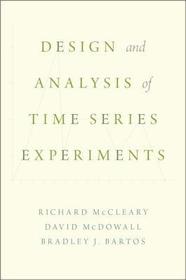
Design and Analysis of Time Series Experiments
-
10% KEDVEZMÉNY?
- A kedvezmény csak az 'Értesítés a kedvenc témákról' hírlevelünk címzettjeinek rendeléseire érvényes.
- Kiadói listaár GBP 122.50
-
58 524 Ft (55 737 Ft + 5% áfa)
Az ár azért becsült, mert a rendelés pillanatában nem lehet pontosan tudni, hogy a beérkezéskor milyen lesz a forint árfolyama az adott termék eredeti devizájához képest. Ha a forint romlana, kissé többet, ha javulna, kissé kevesebbet kell majd fizetnie.
- Kedvezmény(ek) 10% (cc. 5 852 Ft off)
- Kedvezményes ár 52 671 Ft (50 163 Ft + 5% áfa)
Iratkozzon fel most és részesüljön kedvezőbb árainkból!
Feliratkozom
58 524 Ft

Beszerezhetőség
Megrendelésre a kiadó utánnyomja a könyvet. Rendelhető, de a szokásosnál kicsit lassabban érkezik meg.
Why don't you give exact delivery time?
A beszerzés időigényét az eddigi tapasztalatokra alapozva adjuk meg. Azért becsült, mert a terméket külföldről hozzuk be, így a kiadó kiszolgálásának pillanatnyi gyorsaságától is függ. A megadottnál gyorsabb és lassabb szállítás is elképzelhető, de mindent megteszünk, hogy Ön a lehető leghamarabb jusson hozzá a termékhez.
A termék adatai:
- Kiadó OUP USA
- Megjelenés dátuma 2017. június 29.
- ISBN 9780190661557
- Kötéstípus Keménykötés
- Terjedelem392 oldal
- Méret 160x239x30 mm
- Súly 726 g
- Nyelv angol 0
Kategóriák
Rövid leírás:
Design and Analysis of Time Series Experiments develops methods and models for analysis and interpretation of time series experiments. Drawing on examples from criminology, economics, education, pharmacology, public policy, program evaluation, public health, and psychology, it addresses researchers and graduate students in a wide range of the behavioral, biomedical and social sciences.
TöbbHosszú leírás:
Design and Analysis of Time Series Experiments presents the elements of statistical time series analysis while also addressing recent developments in research design and causal modeling. A distinguishing feature of the book is its integration of design and analysis of time series experiments.
Drawing examples from criminology, economics, education, pharmacology, public policy, program evaluation, public health, and psychology, Design and Analysis of Time Series Experiments is addressed to researchers and graduate students in a wide range of behavioral, biomedical and social sciences. Readers learn not only how-to skills but, also the underlying rationales for the design features and the analytical methods. ARIMA algebra, Box-Jenkins-Tiao models and model-building strategies, forecasting, and Box-Tiao impact models are developed in separate chapters. The presentation of the models and model-building assumes only exposure to an introductory statistics course, with more difficult mathematical material relegated to appendices. Separate chapters cover threats to statistical conclusion validity, internal validity, construct validity, and external validity with an emphasis on how these threats arise in time series experiments. Design structures for controlling the threats are presented and illustrated through examples. The chapters on statistical conclusion validity and internal validity introduce Bayesian methods, counterfactual causality and synthetic control group designs.
Building on the earlier of the authors, Design and Analysis of Time Series Experiments includes more recent developments in modeling, and considers design issues in greater detail than any existing work. Additionally, the book appeals to those who want to conduct or interpret time series experiments, as well as to those interested in research designs for causal inference.
Richard McCleary is Professor of Criminology, Law & Society and Planning, Policy & Design at the University of California, Irvine.
David McDowall is Distinguished Teaching Professor in the School of Criminal Justice at the University at Albany.
Bradley J. Bartos is a graduate student in the department of Criminology, Law, and Society at the University of California, Irvine.
Tartalomjegyzék:
List of Figures and Tables
Preface
1: Introduction
2:ARIMA Algebra
Appendix 2A-Expected Values
Appendix 2B-Sequences, Series, and Limits
3: Noise Modeling
Appendix 3A-Maximum Likelihood Estimation
Appendix 3B-The Box-Cox Transformation Function
4: Forecasting
5: Intervention Modeling
6: Statistical Conclusion Validity
Appendix 6-Probability and Odds
7: Internal Validity
8: Construct Validity
9: External Validity
Notes
Bibliography
Index

