

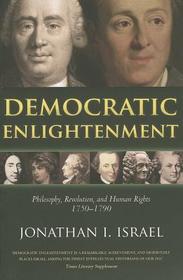
Democratic Enlightenment
Philosophy, Revolution, and Human Rights 1750-1790
-
10% KEDVEZMÉNY?
- A kedvezmény csak az 'Értesítés a kedvenc témákról' hírlevelünk címzettjeinek rendeléseire érvényes.
- Kiadói listaár GBP 26.99
-
12 185 Ft (11 605 Ft + 5% áfa)
Az ár azért becsült, mert a rendelés pillanatában nem lehet pontosan tudni, hogy a beérkezéskor milyen lesz a forint árfolyama az adott termék eredeti devizájához képest. Ha a forint romlana, kissé többet, ha javulna, kissé kevesebbet kell majd fizetnie.
- Kedvezmény(ek) 10% (cc. 1 219 Ft off)
- Kedvezményes ár 10 967 Ft (10 445 Ft + 5% áfa)
Iratkozzon fel most és részesüljön kedvezőbb árainkból!
Feliratkozom
12 185 Ft

Beszerezhetőség
Megrendelésre a kiadó utánnyomja a könyvet. Rendelhető, de a szokásosnál kicsit lassabban érkezik meg.
Why don't you give exact delivery time?
A beszerzés időigényét az eddigi tapasztalatokra alapozva adjuk meg. Azért becsült, mert a terméket külföldről hozzuk be, így a kiadó kiszolgálásának pillanatnyi gyorsaságától is függ. A megadottnál gyorsabb és lassabb szállítás is elképzelhető, de mindent megteszünk, hogy Ön a lehető leghamarabb jusson hozzá a termékhez.
A termék adatai:
- Kiadó OUP Oxford
- Megjelenés dátuma 2013. január 17.
- ISBN 9780199668090
- Kötéstípus Puhakötés
- Terjedelem1104 oldal
- Méret 233x166x57 mm
- Súly 1602 g
- Nyelv angol
- Illusztrációk 16 page plate section 0
Kategóriák
Rövid leírás:
Jonathan Israel's radical new account of the late Enlightenment highlights forgotten currents and figures. Running counter to mainstream thinking, he demonstrates how a group of philosophe-revolutionnaires provided the intellectual powerhouse of the French Revolution, and how their ideas connect with modern Western democracy.
TöbbHosszú leírás:
The Enlightenment shaped modernity. Western values of representative democracy and basic human rights, gender and racial equality, individual liberty, and freedom of expression and the press, form an interlocking system that derives directly from the Enlightenment's philosophical revolution. This fact is uncontested - yet remarkably few historians or philosophers have attempted to trace the process of ideas from the political and social turmoil of the late eighteenth century to the present day. This is precisely what Jonathan Israel now does.
He demonstrates that the Enlightenment was an essentially revolutionary process, driven by philosophical debate. From 1789, its impetus came from a small group of philosophe-revolutionnaires, men such as Mirabeau, Sieyes, Condorcet, Volney, Roederer, and Brissot. Not aligned to any of the social groups who took the lead in the French National assembly, the Paris commune, or the editing of the Parisian revolutionary journals, they nonetheless forged 'la philosophie moderne' -- in effect Radical Enlightenment ideas -- into a world-transforming ideology that had a lasting impact in Latin America and eastern Europe as well as France, Italy, Germany, and the Low Countries.
Whilst all French revolutionary journals clearly stated that la philosophie moderne was the main cause of the French Revolution, the main stream of historical thought has failed to grasp what this implies. Israel sets the record straight, demonstrating the true nature of the engine that drove the Revolution, and the intimate links between the radical wing of the Enlightenment and the anti-Robespierriste 'Revolution of reason'.
Review from previous edition Israel has turned up evidence of the Radical Enlightenment's influence in surprising places, and that labor alone should ensure that this book finds a place on every specialist's shelf.
Tartalomjegyzék:
Introduction
Part 1: The Radical Challenge
Nature and Providence: Earthquakes and the Human Condition
The Encyclopédie Suppressed (1752-60)
Rousseau against the Philosophes
Voltaire, Enlightenment, and the European Courts
Anti-Philosophes
Central Europe: Aufklärung divided
Part II: Rationalizing the Ancien Régime
Hume, Scepticism, and Moderation
Scottish Enlightenment and Man's Progress
Enlightened Despotism
Aufklärung and the Fracturing of German Protestant Culture
Catholic Enlightenment: the Papacy's Retreat
Society and the Rise of the Italian revolutionary Enlightenment
Spain and the Challenge of Reform
Part III: Europe and the Re-Making of the World
The Histoire Philosophique, or Colonialism Overturned
The American Revolution
Europe and the Amerindians
Philosophy and Revolt in Ibero-America (1765-92)
Commercial Despotism: Dutch Colonialism in Asia
China, Japan, and the West
India and the Two Enlightenments
Russia's Greeks, Poles, and Serfs
Part IV: Spinoza Controversies in the Later Enlightenment
Rousseau, Spinoza and the 'General Will'
Radical Break-Through
The Pantheismusstreit (1780-87)
Kant and the Radical Challenge
Goethe, Schiller and the new "Dutch Revolt against Spain"
Part V: Revolution
1788-9: the "General Revolution" begins
The Diffusion
'Philosophy' as the Maker of Revolutions
Aufklärung and the Secret Societies (1776-92)
Small State Revolution in the 1780s
The Dutch Democratic Revolution of the 1780s
The French Revolution: from 'Philosophy' to Basic Human Rights (1788-90)
Epilogue: 1789 as an Intellectual Revolution

