

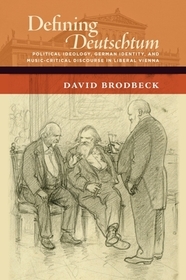
Defining Deutschtum
Political Ideology, German Identity, and Music-Critical Discourse in Liberal Vienna
Sorozatcím: The New Cultural History of Music Series;
-
10% KEDVEZMÉNY?
- A kedvezmény csak az 'Értesítés a kedvenc témákról' hírlevelünk címzettjeinek rendeléseire érvényes.
- Kiadói listaár GBP 54.00
-
24 381 Ft (23 220 Ft + 5% áfa)
Az ár azért becsült, mert a rendelés pillanatában nem lehet pontosan tudni, hogy a beérkezéskor milyen lesz a forint árfolyama az adott termék eredeti devizájához képest. Ha a forint romlana, kissé többet, ha javulna, kissé kevesebbet kell majd fizetnie.
- Kedvezmény(ek) 10% (cc. 2 438 Ft off)
- Kedvezményes ár 21 943 Ft (20 898 Ft + 5% áfa)
Iratkozzon fel most és részesüljön kedvezőbb árainkból!
Feliratkozom
24 381 Ft

Beszerezhetőség
Megrendelésre a kiadó utánnyomja a könyvet. Rendelhető, de a szokásosnál kicsit lassabban érkezik meg.
Why don't you give exact delivery time?
A beszerzés időigényét az eddigi tapasztalatokra alapozva adjuk meg. Azért becsült, mert a terméket külföldről hozzuk be, így a kiadó kiszolgálásának pillanatnyi gyorsaságától is függ. A megadottnál gyorsabb és lassabb szállítás is elképzelhető, de mindent megteszünk, hogy Ön a lehető leghamarabb jusson hozzá a termékhez.
A termék adatai:
- Kiadó OUP USA
- Megjelenés dátuma 2014. november 6.
- ISBN 9780199362707
- Kötéstípus Keménykötés
- Terjedelem392 oldal
- Méret 163x236x30 mm
- Súly 635 g
- Nyelv angol
- Illusztrációk 13 images, 57 music examples 0
Kategóriák
Rövid leírás:
Defining Deutschtum engages the political-cultural milieu of Liberal Vienna through the discourse of three generations of music critics. Author David Brodbeck argues that Vienna's music critics were important agents in the public sphere whose writings gave voice to distinct, sometimes competing ideological positions.
TöbbHosszú leírás:
Defining Deutschtum: Political Ideology, German Identity, and Music-Critical Discourse in Liberal Vienna offers a nuanced look at the intersection of music, cultural identity, and political ideology in late-nineteenth-century Vienna. Drawing on an extensive selection of writings in the city's political press, correspondence, archival documents, and a large body of recent scholarship in late Habsburg cultural and political history, author David Brodbeck argues that Vienna's music critics were important agents in the public sphere whose writings gave voice to distinct, sometimes competing ideological positions. These conflicting positions are exemplified especially well in their critical writings about the music of three notable composers of the day who were Austrian citizens but not ethnic Germans: Carl Goldmark, a Jew from German West Hungary, and the Czechs Bed?ich Smetana and Antonín Dvo?ák.
Often at stake in the critical discourse was the question of who and what could be deemed "German " in the multinational Austrian state. For critics such as Eduard Hanslick and Ludwig Speidel, traditional German liberals who came of age in the years around 1848, "Germanness " was an attribute that could be earned by any ambitious bourgeois-including Jews and those of non-German nationality-by embracing German cultural values. The more nationally inflected liberalism evident in the writings of Theodor Helm, with its particularist rhetoric of German national property in a time of Czech gains at German expense, was typical of those in the next generation, educated during the 1860s. The radical student politics of the 1880s, with its embrace of racialist antisemitism and irredentist German nationalism, just as surely shaped the discourse of certain young Wagnerian critics who emerged at the end of the century. This body of music-critical writing reveals a continuum of exclusivity, from a conception of Germanness rooted in social class and cultural elitism to one based in blood.
Brodbeck neatly counters decades of musicological scholarship and offers a unique insight into the diverse ways in which educated German Austrians conceived of Germanness in music and understood their relationship to their non-German fellow citizens. Defining Deutschtum is sure to be an essential text for scholars of music history, cultural studies, and late 19th century Central European culture and society.
Throughout the convoluted twists and turns of this story, Brodbeck is always a clear and patient guide. The sheer density of detail might easily have become bewildering, but what emerges is a remarkably clear and finely drawn account. This is an impressive work of scholarship that reconstructs not only a musical but also a cultural and political history ... Brodbeck's analysis of how political tensions find an ideal areana in seemingly trivial disputes is both powerful and timely.
Tartalomjegyzék:
CONTENTS
List of Plates
Preface and Acknowledgments
Note on Place Names and Orthography
Introduction Viennese Critics and the "Habsburg Dilemma"
From the Vormärz to the Liberal Heyday
Chapter 1 Hanslick's Deutschtum
Chapter 2 Becoming a German: Goldmark and the Assimilationist Project
Chapter 3 Liberal Essentialism and Goldmark's Early Reception
Chapter 4 Rethinking the "Billroth Affair"
Plates
From the "Iron Ring" to the Fin de siècle
Chapter 5 Language Ordinances, National Property, and Dvo?ák's Reception in the Taaffe Era
Chapter 6 Goldmark's Reception Revisited: Liberal Accreditation and Antisemitic Attack
Chapter 7 "Politics Makes Strange Bedfellows"; or, Smetana's Reception in the 1890s
Chapter 8 Goldmark's Deutschtum Revisited
Epilogue Germans, Jews, and Czechs in Mahler's Vienna
Bibliography
Index

