

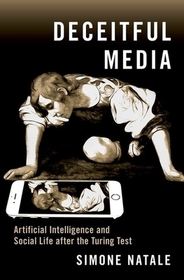
Deceitful Media
Artificial Intelligence and Social Life after the Turing Test
-
10% KEDVEZMÉNY?
- A kedvezmény csak az 'Értesítés a kedvenc témákról' hírlevelünk címzettjeinek rendeléseire érvényes.
- Kiadói listaár GBP 93.00
-
41 989 Ft (39 990 Ft + 5% áfa)
Az ár azért becsült, mert a rendelés pillanatában nem lehet pontosan tudni, hogy a beérkezéskor milyen lesz a forint árfolyama az adott termék eredeti devizájához képest. Ha a forint romlana, kissé többet, ha javulna, kissé kevesebbet kell majd fizetnie.
- Kedvezmény(ek) 10% (cc. 4 199 Ft off)
- Kedvezményes ár 37 791 Ft (35 991 Ft + 5% áfa)
Iratkozzon fel most és részesüljön kedvezőbb árainkból!
Feliratkozom
41 989 Ft

Beszerezhetőség
Megrendelésre a kiadó utánnyomja a könyvet. Rendelhető, de a szokásosnál kicsit lassabban érkezik meg.
Why don't you give exact delivery time?
A beszerzés időigényét az eddigi tapasztalatokra alapozva adjuk meg. Azért becsült, mert a terméket külföldről hozzuk be, így a kiadó kiszolgálásának pillanatnyi gyorsaságától is függ. A megadottnál gyorsabb és lassabb szállítás is elképzelhető, de mindent megteszünk, hogy Ön a lehető leghamarabb jusson hozzá a termékhez.
A termék adatai:
- Kiadó OUP USA
- Megjelenés dátuma 2021. augusztus 20.
- ISBN 9780190080365
- Kötéstípus Keménykötés
- Terjedelem204 oldal
- Méret 241x159x16 mm
- Súly 426 g
- Nyelv angol 130
Kategóriák
Rövid leírás:
Integrating media studies, science and technology studies, and social psychology, Deceitful Media examines the rise of artificial intelligence throughout history and exposes the very human fallacies behind this technology.
TöbbHosszú leírás:
Artificial intelligence (AI) is often discussed as something extraordinary, a dream--or a nightmare--that awakens metaphysical questions on human life. Yet far from a distant technology of the future, the true power of AI lies in its subtle revolution of ordinary life. From voice assistants like Siri to natural language processors, AI technologies use cultural biases and modern psychology to fit specific characteristics of how users perceive and navigate the external world, thereby projecting the illusion of intelligence.
Integrating media studies, science and technology studies, and social psychology, Deceitful Media examines the rise of artificial intelligence throughout history and exposes the very human fallacies behind this technology. Focusing specifically on communicative AIs, Natale argues that what we call "AI" is not a form of intelligence but rather a reflection of the human user. Using the term "banal deception," he reveals that deception forms the basis of all human-computer interactions rooted in AI technologies, as technologies like voice assistants utilize the dynamics of projection and stereotyping as a means for aligning with our existing habits and social conventions. By exploiting the human instinct to connect, AI reveals our collective vulnerabilities to deception, showing that what machines are primarily changing is not other technology but ourselves as humans.
Deceitful Media illustrates how AI has continued a tradition of technologies that mobilize our liability to deception and shows that only by better understanding our vulnerabilities to deception can we become more sophisticated consumers of interactive media.
a real breath of fresh air ... fundamental reading for an understanding of AI as a socio-material phenomenon
Tartalomjegyzék:
Table of Contents
Acknowledgments
Introduction
Chapter 1. The Turing Test: Cultural life of an idea
Chapter 2. How to dispel magic: Computers, interfaces, and the problem of the observer
Chapter 3. The Eliza effect: Joseph Weizenbaum and the emergence of chatbots
Chapter 4. Of daemons, dogs and trees: Situating AI in software
Chapter 5. How to create a bot: Programming deception at the Loebner Prize
Chapter 6. To believe in Siri: A critical analysis of voice assistants
Conclusion: Our sophisticated selves
Bibliography

