

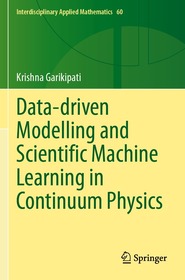
Data-driven Modelling and Scientific Machine Learning in Continuum Physics
Sorozatcím: Interdisciplinary Applied Mathematics;
-
20% KEDVEZMÉNY?
- A kedvezmény csak az 'Értesítés a kedvenc témákról' hírlevelünk címzettjeinek rendeléseire érvényes.
- Kiadói listaár EUR 139.09
- Prospero ár EUR 97.49
-
38 079 Ft (36 266 Ft + 5% áfa)
Az ár azért becsült, mert a rendelés pillanatában nem lehet pontosan tudni, hogy a beérkezéskor milyen lesz a forint árfolyama az adott termék eredeti devizájához képest. Ha a forint romlana, kissé többet, ha javulna, kissé kevesebbet kell majd fizetnie.
- Kedvezmény(ek) 20% (cc. 7 616 Ft off)
- Kedvezményes ár 30 463 Ft (29 013 Ft + 5% áfa)
- A kedvezmény érvényes eddig: 2026. június 30.
Iratkozzon fel most és részesüljön kedvezőbb árainkból!
Feliratkozom
33 510 Ft

Beszerezhetőség
Megrendelésre a kiadó utánnyomja a könyvet. Rendelhető, de a szokásosnál kicsit lassabban érkezik meg.
Why don't you give exact delivery time?
A beszerzés időigényét az eddigi tapasztalatokra alapozva adjuk meg. Azért becsült, mert a terméket külföldről hozzuk be, így a kiadó kiszolgálásának pillanatnyi gyorsaságától is függ. A megadottnál gyorsabb és lassabb szállítás is elképzelhető, de mindent megteszünk, hogy Ön a lehető leghamarabb jusson hozzá a termékhez.
A termék adatai:
- Kiadás sorszáma 2024
- Kiadó Springer International Publishing
- Megjelenés dátuma 2025. július 31.
- Kötetek száma 1 pieces, Book
- ISBN 9783031633645
- Kötéstípus Puhakötés
- Lásd még 9783031620287
- Terjedelem230 oldal
- Méret 235x155 mm
- Nyelv angol
- Illusztrációk XIV, 230 p. 75 illus., 70 illus. in color. Illustrations, black & white 625
Kategóriák
Hosszú leírás:
This monograph takes the reader through recent advances in data-driven methods and machine learning for problems in science—specifically in continuum physics. It develops the foundations and details a number of scientific machine learning approaches to enrich current computational models of continuum physics, or to use the data generated by these models to infer more information on these problems. The perspective presented here is drawn from recent research by the author and collaborators. Applications drawn from the physics of materials or from biophysics illustrate each topic. Some elements of the theoretical background in continuum physics that are essential to address these applications are developed first. These chapters focus on nonlinear elasticity and mass transport, with particular attention directed at descriptions of phase separation. This is followed by a brief treatment of the finite element method, since it is the most widely used approach to solve coupled partial differential equations in continuum physics.
With these foundations established, the treatment proceeds to a number of recent developments in data-driven methods and scientific machine learning in the context of the continuum physics of materials and biosystems. This part of the monograph begins by addressing numerical homogenization of microstructural response using feed-forward as well as convolutional neural networks. Next is surrogate optimization using multifidelity learning for problems of phase evolution. Graph theory bears many equivalences to partial differential equations in its properties of representation and avenues for analysis as well as reduced-order descriptions--all ideas that offer fruitful opportunities for exploration. Neural networks, by their capacity for representation of high-dimensional functions, are powerful for scale bridging in physics--an idea on which we present a particular perspective in the context of alloys.
One of the most compelling ideas in scientific machine learning is the identification of governing equations from dynamical data--another topic that we explore from the viewpoint of partial differential equations encoding mechanisms. This is followed by an examination of approaches to replace traditional, discretization-based solvers of partial differential equations with deterministic and probabilistic neural networks that generalize across boundary value problems. The monograph closes with a brief outlook on current emerging ideas in scientific machine learning.
TöbbTartalomjegyzék:
Part I. Introduction and Background in Continuum Materials Physics.- Introduction.- Nonlinear Elasticity.- Phase Field Methods.- Part II. Solving Partial Differential Equations.- Finite Element Methods.- Part III. Data-driven Modelling and Scientific Machine Learning.- Reduced Order Models: Numerical Homogenization for the Elastic Response of Material Microstructures.- Surrogate Optimization.- Graph Theoretic Methods.- Scale Bridging.- Inverse Modeling and System Inference from Data.- Machine Learning Solvers of Partial Differential Equations.- An Outlook on Scientific Machine Learning in Continuum Physics.- References.
Több
