

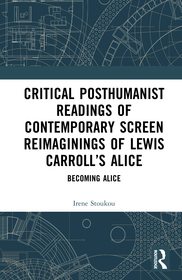
Critical Posthumanist Readings of Contemporary Screen Reimaginings of Lewis Carroll’s Alice
Becoming Alice
-
20% KEDVEZMÉNY?
- A kedvezmény csak az 'Értesítés a kedvenc témákról' hírlevelünk címzettjeinek rendeléseire érvényes.
- Kiadói listaár GBP 155.00
-
69 982 Ft (66 650 Ft + 5% áfa)
Az ár azért becsült, mert a rendelés pillanatában nem lehet pontosan tudni, hogy a beérkezéskor milyen lesz a forint árfolyama az adott termék eredeti devizájához képest. Ha a forint romlana, kissé többet, ha javulna, kissé kevesebbet kell majd fizetnie.
- Kedvezmény(ek) 20% (cc. 13 996 Ft off)
- Kedvezményes ár 55 986 Ft (53 320 Ft + 5% áfa)
- A kedvezmény érvényes eddig: 2026. június 30.
Iratkozzon fel most és részesüljön kedvezőbb árainkból!
Feliratkozom
62 984 Ft

Beszerezhetőség
Becsült beszerzési idő: A Prosperónál jelenleg nincsen raktáron, de a kiadónál igen. Beszerzés kb. 3-5 hét..
A Prosperónál jelenleg nincsen raktáron.
Why don't you give exact delivery time?
A beszerzés időigényét az eddigi tapasztalatokra alapozva adjuk meg. Azért becsült, mert a terméket külföldről hozzuk be, így a kiadó kiszolgálásának pillanatnyi gyorsaságától is függ. A megadottnál gyorsabb és lassabb szállítás is elképzelhető, de mindent megteszünk, hogy Ön a lehető leghamarabb jusson hozzá a termékhez.
A termék adatai:
- Kiadás sorszáma 1
- Kiadó Routledge
- Megjelenés dátuma 2026. április 13.
- ISBN 9781041163305
- Kötéstípus Keménykötés
- Terjedelem248 oldal
- Méret 229x152 mm
- Súly 620 g
- Nyelv angol 695
Kategóriák
Rövid leírás:
This groundbreaking study examines how Carroll's Victorian masterpieces and six major screen adaptations (1966-2016) anticipate today's critical posthuman thought.
TöbbHosszú leírás:
Journey through the rabbit hole into unexplored theoretical territory as Lewis Carroll's beloved Alice navigates the boundaries between human and nonhuman across literature and film. This ground-breaking study examines how Carroll's Victorian masterpieces and six major screen adaptations (1966–2016) anticipate today's critical posthuman thought. From Victorian scientific debates to contemporary concerns about ecological collapse and algorithmic governance, Alice emerges as a revolutionary figure constantly in flux—relational, affective, and materially embedded. Each chapter pairs a different Alice adaptation with illuminating theoretical frameworks—from Braidotti's affirmative ethics to vital materialism—revealing how these reimaginings address shifting configurations of humanity across time. This volume will be of interest to scholars and readers of literary and film studies, Victorian literature, feminist theory, and environmental humanities, offering a fresh perspective on childhood, trauma, embodiment, and Anthropocene politics through the looking glass of Carroll's enduring creation. Alice's adventures were never just about Wonderland—they were always about reimagining what it means to be human.
TöbbTartalomjegyzék:
Acknowledgements
List of Abbreviations
Chapter 1 Introduction
Chapter 2 Alice through the Posthuman Glass
Chapter 3 Childhood through the Looking Glass and Becoming-Minoritarian in Jonathan Miller’s Alice in Wonderland (1966)
Chapter 4 Posthumanous Alice: Death as Becoming-Imperceptible in Claude Chabrol’s Alice ou la Dernière Fugue (1977)
Chapter 5 Entangled Materialities, Vibrant Becomings and the Agency of Assemblages in Jan Švankmajer’s Alice (1988)
Chapter 6 Becoming-Heroine and the Technological Posthuman in Nick Willing’s Alice (2009)
Chapter 7 Becoming-Alice in Underland and Greta’s Muchness in the Anthropocene: Disney Reimaginings of Alice (2010, 2016)
Chapter 8 Conclusion
Bibliography
Filmography

