

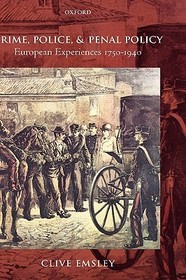
Crime, Police, and Penal Policy
European Experiences 1750-1940
-
10% KEDVEZMÉNY?
- A kedvezmény csak az 'Értesítés a kedvenc témákról' hírlevelünk címzettjeinek rendeléseire érvényes.
- Kiadói listaár GBP 120.00
-
54 180 Ft (51 600 Ft + 5% áfa)
Az ár azért becsült, mert a rendelés pillanatában nem lehet pontosan tudni, hogy a beérkezéskor milyen lesz a forint árfolyama az adott termék eredeti devizájához képest. Ha a forint romlana, kissé többet, ha javulna, kissé kevesebbet kell majd fizetnie.
- Kedvezmény(ek) 10% (cc. 5 418 Ft off)
- Kedvezményes ár 48 762 Ft (46 440 Ft + 5% áfa)
Iratkozzon fel most és részesüljön kedvezőbb árainkból!
Feliratkozom
54 180 Ft

Beszerezhetőség
Megrendelésre a kiadó utánnyomja a könyvet. Rendelhető, de a szokásosnál kicsit lassabban érkezik meg.
Why don't you give exact delivery time?
A beszerzés időigényét az eddigi tapasztalatokra alapozva adjuk meg. Azért becsült, mert a terméket külföldről hozzuk be, így a kiadó kiszolgálásának pillanatnyi gyorsaságától is függ. A megadottnál gyorsabb és lassabb szállítás is elképzelhető, de mindent megteszünk, hogy Ön a lehető leghamarabb jusson hozzá a termékhez.
A termék adatai:
- Kiadó OUP Oxford
- Megjelenés dátuma 2007. július 5.
- ISBN 9780199202850
- Kötéstípus Keménykötés
- Terjedelem304 oldal
- Méret 240x160x22 mm
- Súly 575 g
- Nyelv angol 0
Kategóriák
Rövid leírás:
How did ideas about crime and criminals change in Europe from around 1750 to 1940? How did European states respond to these changes with the development of police and penal institutions? Clive Emsley addresses these questions using recent research on the history of crime and criminal justice in Europe. He reveals that many of the ideas hailed as new in current debate on crime and its 'solutions', have a very long and illustrious history.
TöbbHosszú leírás:
How did ideas about crime and criminals change in Europe from around 1750 to 1940? How did European states respond to these changes with the development of police and penal institutions? Clive Emsley attempts to address these questions using recent research on the history of crime and criminal justice in Europe. Exploring the subject chronologically, he addresses the forms of offending, the changing interpretations and understandings of that offending at both elite and popular levels, and how the emerging nation states of the period responded to criminal activity by the development of police forces and the refinement of forms of punishment.
The book focuses on the comparative nature in which different states studied each other and their institutions, and the ways in which different reformers exchanged ideas and investigated policing and penal experiments in other countries. It also explores the theoretical issues underpinning recent research, emphasising that the changes in ideas on crime and criminals were neither linear nor circular, and demonstrating clearly that many ideas hailed as new by contemporary politicians and in current debate on crime and its 'solutions', have a very long and illustrious history.
The book is conceptually sophisticated...It is also consistently interesting. In sum, the book is a welcome addition to the literature
Tartalomjegyzék:
Introduction
The Old Regime and the Enlightenment
Laws and Punishments
The Understanding and Nature of Crime
Coping with Crime
The Revolutionary Era
The New French System
Crime and Police in Revolution and War
The Discovery of the Criminal Classes
Measuring a Problem
Danger in the City: Danger in the Countryside
Protection, Punishment and Reformation
The Appliance of Science
'Scientific Criminology
New Professionals: Old Problems
The Faces of Penal Welfare
Penal Policies and the Impact of War
Controlling and Punishing after the Great War
National Paths: Common Patterns

