

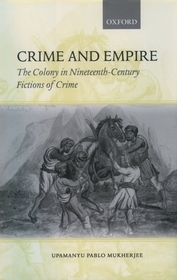
Crime and Empire
The Colony in Nineteenth-Century Fictions of Crime
-
10% KEDVEZMÉNY?
- A kedvezmény csak az 'Értesítés a kedvenc témákról' hírlevelünk címzettjeinek rendeléseire érvényes.
- Kiadói listaár GBP 132.50
-
59 823 Ft (56 975 Ft + 5% áfa)
Az ár azért becsült, mert a rendelés pillanatában nem lehet pontosan tudni, hogy a beérkezéskor milyen lesz a forint árfolyama az adott termék eredeti devizájához képest. Ha a forint romlana, kissé többet, ha javulna, kissé kevesebbet kell majd fizetnie.
- Kedvezmény(ek) 10% (cc. 5 982 Ft off)
- Kedvezményes ár 53 841 Ft (51 278 Ft + 5% áfa)
Iratkozzon fel most és részesüljön kedvezőbb árainkból!
Feliratkozom
59 823 Ft

Beszerezhetőség
Megrendelésre a kiadó utánnyomja a könyvet. Rendelhető, de a szokásosnál kicsit lassabban érkezik meg.
Why don't you give exact delivery time?
A beszerzés időigényét az eddigi tapasztalatokra alapozva adjuk meg. Azért becsült, mert a terméket külföldről hozzuk be, így a kiadó kiszolgálásának pillanatnyi gyorsaságától is függ. A megadottnál gyorsabb és lassabb szállítás is elképzelhető, de mindent megteszünk, hogy Ön a lehető leghamarabb jusson hozzá a termékhez.
A termék adatai:
- Kiadó OUP Oxford
- Megjelenés dátuma 2003. október 9.
- ISBN 9780199261055
- Kötéstípus Keménykötés
- Terjedelem218 oldal
- Méret 223x145x18 mm
- Súly 420 g
- Nyelv angol 0
Kategóriák
Rövid leírás:
In Crime and Empire, Upamanyu Pablo Mukherjee examines a wide range of nineteenth-century British fictions about crime in India - from writers such as Wilkie Collins, Walter Scott, and Conan Doyle to historical, parliamentary, and medical narratives. The discussion centres on the complex and productive relationship between crime and England's status as the world's leading imperial power.
TöbbHosszú leírás:
The language of crime and punishment is everywhere, especially in the context of building new global orders where old imperial relationships between the west and the rest of the world are being redefined and redesigned. This book is about one of the formative moments of this rhetorical strategy of representing empires. By looking at a variety of British narratives about India being produced from the later half of the eighteenth century onwards, it suggests that the discourse of crime was one of the major representative tools which the British employed to understand, imagine, and rule the vast country. However, to understand the full implication of this strategy for British understanding of both the colonised 'others' and a particular image of 'self', we must study the formation of this discourse not only in the context of the colony, but of its peculiar importance within 'domestic' Britain itself. Nineteenth-Century British society placed a huge amount of importance on issues of crime, punishment, order, and policing. These issues became fundamental to British claims of being a civilised nation. Naturally, they became an important part of British colonial/imperial strategy. But, since in Britain these issues were sites of contest and not consent, of debate and opposition and not unquestioned hegemonic power, they were inherently risky tools to use in building an ideology of empire. As the various readings of the narratives employing 'fictions' of crime offered here shows, an opposition or critique of empire was formed through these fictions even as they were used to build a consensus for empire-building. The slippages and ambiguities associated with imperial narratives then, are not products of some inherent semiotic disorder. Rather, they grew out of a particular history within which the rhetoric employed by these narratives took shape. This book is an attempt to recover the traces of that history within the various imperial fictions of crime.
As Upamanyu Pablo Mukherjee argues in his insightful, well-researched Crime and Empire, the British campaigns against both sati and Thuggee were part of a more general reformist approach to India that at once mirrored the rise of the "new police" in Britain and had the effect of criminalizing Indian culture as a whole. And if secular, utilitarian reformism worked to criminalize India, that was just as true of evangelicalism, as Jeffrey Cox points out: "For evangelicals ... something was very wrong with India, and the source of the evil was crystal clear: it was religion. Hinduism was obscene and cruel and bloody and lascivious, and so forth, and because of Hinduism, Indians were liars, thieves, widow-burners, murderers of infants, and so forth"(24)...
Tartalomjegyzék:
Introduction: Crime, Paradox, Fiction, Theory
The 'Criminal' Colony Before New Police
Demanding Reform: From Fielding to Peel
Resisting the New Police
New Policing, India, and Thuggee
Representing the Mutiny
Shifting Images of the Criminal
Conclusion
Bibliography
Index

