

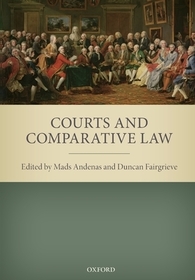
Courts and Comparative Law
-
10% KEDVEZMÉNY?
- A kedvezmény csak az 'Értesítés a kedvenc témákról' hírlevelünk címzettjeinek rendeléseire érvényes.
- Kiadói listaár GBP 78.00
-
35 217 Ft (33 540 Ft + 5% áfa)
Az ár azért becsült, mert a rendelés pillanatában nem lehet pontosan tudni, hogy a beérkezéskor milyen lesz a forint árfolyama az adott termék eredeti devizájához képest. Ha a forint romlana, kissé többet, ha javulna, kissé kevesebbet kell majd fizetnie.
- Kedvezmény(ek) 10% (kb. 3 522 Ft)
- Kedvezményes ár 31 695 Ft (30 186 Ft + 5% áfa)
Iratkozzon fel most és részesüljön kedvezőbb árainkból!
Feliratkozom
35 217 Ft

Beszerezhetőség
Becsült beszerzési idő: A Prosperónál jelenleg nincsen raktáron, de a kiadónál igen. Beszerzés kb. 3-5 hét..
A Prosperónál jelenleg nincsen raktáron.
Why don't you give exact delivery time?
A beszerzés időigényét az eddigi tapasztalatokra alapozva adjuk meg. Azért becsült, mert a terméket külföldről hozzuk be, így a kiadó kiszolgálásának pillanatnyi gyorsaságától is függ. A megadottnál gyorsabb és lassabb szállítás is elképzelhető, de mindent megteszünk, hogy Ön a lehető leghamarabb jusson hozzá a termékhez.
A termék adatai:
- Kiadó OUP Oxford
- Megjelenés dátuma 2019. július 11.
- ISBN 9780198846918
- Kötéstípus Puhakötés
- Terjedelem768 oldal
- Méret 243x169x40 mm
- Súly 1270 g
- Nyelv angol 0
Kategóriák
Rövid leírás:
A critical analysis of the use of comparative and foreign law by courts across the globe, this book provides an inclusive, coherent, and practical analysis of comparative reasoning in the forensic process.
TöbbHosszú leírás:
While the role of comparative law in the courts was previously only an exception, foreign sources are now increasingly becoming a source of law in regular use in supreme and constitutional courts. There is considerable variation between the practices of courts and the role of comparative law, and methods remain controversial. In the US, the issue has been one of intense public debate and it is still one of the major dividing issues in the discussion about the role of the courts.
Contributing to the existing discussion of the use of comparative law in the courts, this book provides an inclusive, coherent, and practical analysis of the relevant law and jurisprudence in comparative law in the courts. It examines the consequences for court procedures and the form of judgments, as well as how foreign sources are drawn upon in private international law, European law, administrative law, and constitutional law as well as before general courts. The book also includes case studies of comparative law used in particular spheres of the law, such as tort law and consumer law. Written by practising judges and lawyers as well as leading academics, this book serves as a central reference point concerning the role of comparative law before the courts.
This book provides a great starting point for much needed further research.
Tartalomjegyzék:
Introduction - Courts and Comparative Law: In Search of Common Language for Open Legal Systems
Part I: Conflicts and Comparisons
Is it Legitimate and Beneficial for Judges to Use Comparative Law?
Comparative Law and the Courts: What is Comparative and What is Law?
Foreign Law before the French Courts: The Conflicts of Law Perspective
Foreign Law in National Courts: A Common Law Perspective
Foreign Law in International Legal Practice
Part II: Comparative Law Within a European and International Law Context
Common Ground: A Starting Point or Destination for Comparative Law Analysis by the European Court of Human Rights?
Comparative Law and the Court of Justice of the European Union: Interlocking Legal Orders Revisted
National Judges and Strasbourg Case Law: Comparative Reflections About the Italian Experience
Comparative Law and the European Union Civil Service Tribunal
Networks, Dialogue, or One-Way Traffic? An Empirical Analysis of Cross-Citations Between Ten of Europe's Highest Courts
Comparative Law and the Method of Law: Ascertainment of the International Court of Justice
Part III: Comparative Law Before Administrative Courts
Comparative Law as an Essential Feature of French Public Law
Comparative Legal Methodology of the Conseil d'Etat: Towards an Innovative Judicial Process?
The Use of Comparative Law Before the French Administrative Law Courts: Or the Triumph of Castles Over Pyramids
The Use of Comparative Law Before the Italian Public Law Courts
Cooperation of Constitutional Courts in Europe - The Openness of the German Constitution to International, European, and Comparative Constitutional Law
Judicial Dialogue in a Multilevel Constitutional Network: The Role of the Portuguese Constitutional Court
Judges and Professors: the Influence of Foreign Scholarship on Constitutional Courts' Decisions
South Africa: Teaching an 'Old Dog' New Tricks? An Empirical Study of the Use of Foreign Precedents by the South African Constitutional Court (1995-2010)
Enhancing Constitutional Self-Understanding through Comparative Law: An Empirical Study of the Use of Foreign Case Law by the Supreme Court of Canada (1982-2013)
Comparative Law Before the Supreme Courts of the UK and the Netherlands: An Empirical and Comparative Analysis
Constructing the 'Foreign': American Law's Relationship to Non-Domestic Sources
The Use of Comparative Law Before the French Private Law Courts
The Use of Comparative Law Before the French Cour de Cassation : The View From Academia
Italian Courts and Comparative Law
The Controversial Status of International and Comparative Law in the United States
Foreign Law and the Modern Ius Gentium
Comparative Law Before the Spanish Private Law Courts in the XXI Century
Comparative Legal Reasoning and the Courts: A View from the Americas
Comparative Law in the German Courts
Comparative Law in the Syariah Courts: A Case Study of Singapore, Malaysia, and Brunei
Part VI: Using Comparative Law: Case Studies
Liaison Magistrates: Their Role in International Judicial Cooperation and Comparative Law
Comparative Law in Consumer Litigation
The Use of Comparative Law by Courts in Birth-Related Tort Cases
The Use of Comparative Law in A & Others v National Blood Authority
What Europeans Can Learn from an Untold Story of Transjudicial Communication: The Swiss-Turkish Experience
DCFR in the Courts: The Remaking of Comparative Law

