

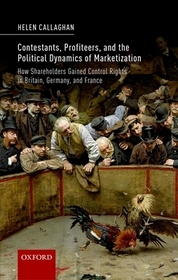
Contestants, Profiteers, and the Political Dynamics of Marketization
How Shareholders gained Control Rights in Britain, Germany, and France
-
10% KEDVEZMÉNY?
- A kedvezmény csak az 'Értesítés a kedvenc témákról' hírlevelünk címzettjeinek rendeléseire érvényes.
- Kiadói listaár GBP 63.00
-
28 444 Ft (27 090 Ft + 5% áfa)
Az ár azért becsült, mert a rendelés pillanatában nem lehet pontosan tudni, hogy a beérkezéskor milyen lesz a forint árfolyama az adott termék eredeti devizájához képest. Ha a forint romlana, kissé többet, ha javulna, kissé kevesebbet kell majd fizetnie.
- Kedvezmény(ek) 10% (cc. 2 844 Ft off)
- Kedvezményes ár 25 600 Ft (24 381 Ft + 5% áfa)
Iratkozzon fel most és részesüljön kedvezőbb árainkból!
Feliratkozom
28 444 Ft

Beszerezhetőség
Megrendelésre a kiadó utánnyomja a könyvet. Rendelhető, de a szokásosnál kicsit lassabban érkezik meg.
Why don't you give exact delivery time?
A beszerzés időigényét az eddigi tapasztalatokra alapozva adjuk meg. Azért becsült, mert a terméket külföldről hozzuk be, így a kiadó kiszolgálásának pillanatnyi gyorsaságától is függ. A megadottnál gyorsabb és lassabb szállítás is elképzelhető, de mindent megteszünk, hogy Ön a lehető leghamarabb jusson hozzá a termékhez.
A termék adatai:
- Kiadó OUP Oxford
- Megjelenés dátuma 2018. január 25.
- ISBN 9780198815020
- Kötéstípus Keménykötés
- Terjedelem182 oldal
- Méret 223x147x18 mm
- Súly 364 g
- Nyelv angol 0
Kategóriák
Rövid leírás:
This book highlights the role of "profiteers" in political efforts to expand market-based competition. Political struggles surrounding the gradual marketization of corporate control in Britain, Germany and France from the 1860s provide empirical illustration.
TöbbHosszú leírás:
Since the early 1980s, governments worldwide have taken many measures to expand the role of markets. Recent political events reflect widespread disenchantment with neoliberal policies, but it remains doubtful whether populist leaders will deliver the market restraints that many of their voters expect. This book explains the resilience of marketization processes by highlighting the role of profiteers- namely those who, like the organizer of a cock fight, benefit from contests regardless of who wins. By setting up shop on the sidelines, profiteers accumulate resources that boost political efforts to maintain and expand the arena of competition. Evidence comes from the evolution of support for shareholder rights relating to takeover bids among key interest groups and political parties in three countries since the late nineteenth century.
Regulating the markets in which struggles over corporate control take place is deeply political, but in ways that defy political tramlines. Helen Callaghan here carefully and revealingly unpicks the complex alliances and conflicts of interest that have determined changes on this issue. In so doing she also throws important new light on general debates about the nature of markets, varieties of capitalism, and processes of policy change.
Tartalomjegyzék:
Contents
Abbreviations
Acknowledgements
Introduction
The Puzzle: Market Liberalization Across Advanced Capitalist Democracies
Analytic Focus: Policy Feedback Processes
The Argument
Research Operationalization
Case Selection
Epistemology, Ontology, and Method
Outline
The Political Dynamics of Marketizing Corporate Control
The Marketization of Corporate Control as a Regulatory Challenge
The Marketization of Corporate Control as a Political Process
Economic Dynamics of the Market for Corporate Control
Economic Dynamism and Political Salience
Summary
Britain
The Prewar and Interwar Periods: Barriers to Hostile Bids
Puzzle 1: What prevented market-enabling reforms?
Turning Point after the Second World War: The Removal of Barriers to Hostile Bids
Puzzle 2: Why did incumbents' defenses crumble?
Subsequent Evolution of Political Support for Market-Enabling Rules
Puzzle 3: Why did pro-market groups prevail?
Summary
Germany
The Prewar, Interwar, and Postwar Periods: Barriers to Hostile Bids
Turning Point in the 1990s: The Removal of Barriers to Hostile Bids
Puzzle 1: What prevented market-enabling reforms?
Puzzle 2: Why did incumbents' defenses crumble?
Summary
France
Prewar, Interwar and Postwar Periods: Barriers to Hostile Bids
Puzzle 1: What prevented market-enabling reforms?
First Turning Point After the Second World War: State Supervision of Incumbents
Second Turning Point in the late 1960s: Steps Toward Marketization
Puzzle 2: Why did incumbents' defenses crumble?
Subsequent Evolution of Political Support for Market-Enabling Rules
Summary
Conclusion
Findings
Generalizability
Alternative Explanations
Value Added to Previous Research in the Same Empirical Domain
Broader Theoretical Significance
Bibliography

