

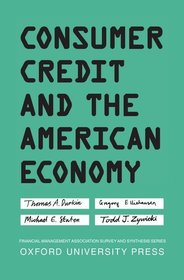
Consumer Credit and the American Economy
Sorozatcím: Financial Management Association Survey and Synthesis Series;
-
10% KEDVEZMÉNY?
- A kedvezmény csak az 'Értesítés a kedvenc témákról' hírlevelünk címzettjeinek rendeléseire érvényes.
- Kiadói listaár GBP 70.00
-
31 605 Ft (30 100 Ft + 5% áfa)
Az ár azért becsült, mert a rendelés pillanatában nem lehet pontosan tudni, hogy a beérkezéskor milyen lesz a forint árfolyama az adott termék eredeti devizájához képest. Ha a forint romlana, kissé többet, ha javulna, kissé kevesebbet kell majd fizetnie.
- Kedvezmény(ek) 10% (kb. 3 161 Ft)
- Kedvezményes ár 28 445 Ft (27 090 Ft + 5% áfa)
Iratkozzon fel most és részesüljön kedvezőbb árainkból!
Feliratkozom
31 605 Ft

Beszerezhetőség
Megrendelésre a kiadó utánnyomja a könyvet. Rendelhető, de a szokásosnál kicsit lassabban érkezik meg.
Why don't you give exact delivery time?
A beszerzés időigényét az eddigi tapasztalatokra alapozva adjuk meg. Azért becsült, mert a terméket külföldről hozzuk be, így a kiadó kiszolgálásának pillanatnyi gyorsaságától is függ. A megadottnál gyorsabb és lassabb szállítás is elképzelhető, de mindent megteszünk, hogy Ön a lehető leghamarabb jusson hozzá a termékhez.
A termék adatai:
- Kiadó OUP USA
- Megjelenés dátuma 2014. augusztus 28.
- ISBN 9780195169928
- Kötéstípus Keménykötés
- Terjedelem734 oldal
- Méret 162x247x42 mm
- Súly 1193 g
- Nyelv angol 0
Kategóriák
Rövid leírás:
This book examines the economic, psychological, sociological, historical, and legal traditions behind the demand, supply, institutions, and regulation of consumer credit in today's marketplace and how and why they have evolved.
TöbbHosszú leírás:
Consumer Credit and the American Economy examines the economics, behavioral science, sociology, history, institutions, law, and regulation of consumer credit in the United States.
After discussing the origins and various kinds of consumer credit available in today's marketplace, this book reviews at some length the long run growth of consumer credit to explore the widely held belief that somehow consumer credit has risen "too fast for too long. " It then turns to demand and supply with chapters discussing neoclassical theories of demand, new behavioral economics, and evidence on production costs and why consumer credit might seem expensive compared to some other kinds of credit like government finance. This discussion includes review of the economics of risk management and funding sources, as well discussion of the economic theory of why some people might be limited in their credit search, the phenomenon of credit rationing. This examination includes review of issues of risk management through mathematical methods of borrower screening known as credit scoring and financial market sources of funding for offerings of consumer credit.
The book then discusses technological change in credit granting. It examines how modern automated information systems called credit reporting agencies, or more popularly "credit bureaus, " reduce the costs of information acquisition and permit greater credit availability at less cost. This discussion is followed by examination of the logical offspring of technology, the ubiquitous credit card that permits consumers access to both payments and credit services worldwide virtually instantly.
After a chapter on institutions that have arisen to supply credit to individuals for whom mainstream credit is often unavailable, including "payday loans " and other small dollar sources of loans, discussion turns to legal structure and the regulation of consumer credit. There are separate chapters on the theories behind the two main thrusts of federal regulation to this point, fairness for all and financial disclosure. Following these chapters, there is another on state regulation that has long focused on marketplace access and pricing.
Before a final concluding chapter, another chapter focuses on two noncredit marketplace products that are closely related to credit. The first of them, debt protection including credit insurance and other forms of credit protection, is economically a complement. The second product, consumer leasing, is a substitute for credit use in many situations, especially involving acquisition of automobiles. This chapter is followed by a full review of consumer bankruptcy, what happens in the worst of cases when consumers find themselves unable to repay their loans.
Because of the importance of consumer credit in consumers' financial affairs, the intended audience includes anyone interested in these issues, not only specialists who spend much of their time focused on them. For this reason, the authors have carefully avoided academic jargon and the mathematics that is the modern language of economics. It also examines the psychological, sociological, historical, and especially legal traditions that go into fully understanding what has led to the demand for consumer credit and to what the markets and institutions that provide these products have become today.
This is a book for both professional economists who do and do not specialize in this field and for informed laypersons who want to understand better this important facet of the economy. For the first time a single work brings together the history, economics, sociology, law, and regulation of consumer credit markets and institutions. It will become the standard source and reference for questions of public policy in this important area.
Tartalomjegyzék:
1. Introduction and Overview of Consumer Credit: Development, Uses, Kinds, and Policy Issues
2. Consumer Credit in the Postwar Era
3. The Demand for Consumer Credit
4. Behavioral Analysis and the Demand for Consumer Credit
5. The Supply of Consumer Credit
6. Information and Credit Reporting
7. Consumer Credit and the Payments System: Evolution of the Credit Card
8. Credit for All? Issues and Concerns About Credit Availability
9. Federal Regulation of Consumer Credit: Credit Granting Discrimination
10. Federal Regulation of Consumer Credit: Disclosures
11. State Regulation of Consumer Credit
12. A Complement and a Supplement to Consumer Credit: Debt Protection and Automobile Leasing
13. Troubled Consumers
14. Conclusions

